Gutscheinbedingungen

**Gültig bis 06.07.2026 auf fremdsprachige Bücher online auf thalia.at, in der Thalia App ab einem Mindestbestellwert von 30€ und in allen Thalia Buchhandlungen in Österreich. In den Buchhandlungen nur gültig auf lagernde Ware. Einzelne Artikel können ausgeschlossen sein. Ausgenommen sind preisgebundene Artikel & eBooks. Pro Einkauf einmal einlösbar. Nur gültig gegen Vorlage oder im Onlineshop hinterlegter Bonuscard. Infos zur Einlösung in der Buchhandlung sind auf der Bonuscard-Vorteilspreisseite zu finden. Click & Collect nur bei Onlinevorabzahlung möglich. Keine Einlösung bei Scan & Go-Bezahlung. Keine Barauszahlung. Nicht kombinierbar mit anderen Aktionen und Gutscheinen. Gutschein wird auf max. 500€ Bestellwert angerechnet. Nicht gültig für Versandkosten und Services.

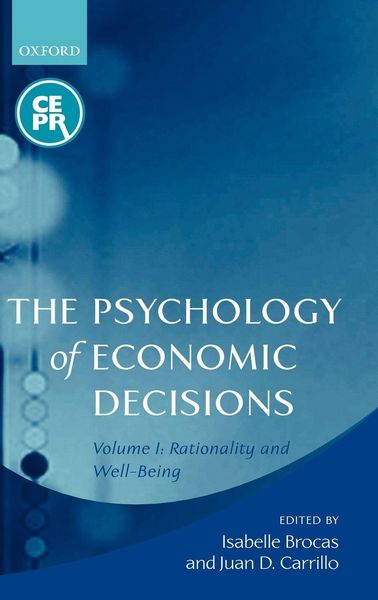
  • Produktbild: The Psychology of Economic Decisions
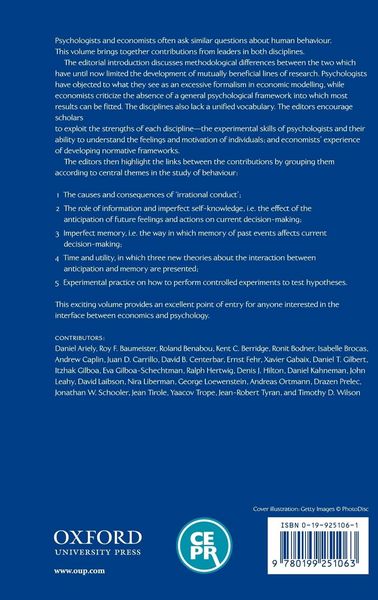
  • Produktbild: The Psychology of Economic Decisions

The Psychology of Economic Decisions Volume 1: Rationality and Well-Being

229,99 €

inkl. gesetzl. MwSt., Versandkostenfrei


Beschreibung

Produktdetails

Einband

Gebundene Ausgabe

Erscheinungsdatum

13.02.2003

Herausgeber

Brocas Isabelle + weitere

Verlag

Oxford Academic

Seitenzahl

356

Maße (L/B/H)

24/16,1/2,4 cm

Gewicht

648 g

Sprache

Englisch

ISBN

978-0-19-925106-3

Beschreibung

Produktdetails

Einband

Gebundene Ausgabe

Erscheinungsdatum

13.02.2003

Herausgeber

Verlag

Oxford Academic

Seitenzahl

356

Maße (L/B/H)

24/16,1/2,4 cm

Gewicht

648 g

Sprache

Englisch

ISBN

978-0-19-925106-3

Herstelleradresse

Libri GmbH
Europaallee 1
36244 Bad Hersfeld
DE

Email: gpsr@libri.de

Noch keine Bewertungen vorhanden

Verfassen Sie die erste Bewertung zu diesem Artikel

Helfen Sie anderen Kundinnen und Kunden durch Ihre Meinung.

Kundinnen und Kunden meinen

Bewertungen (0)

  • Produktbild: The Psychology of Economic Decisions
  • Produktbild: The Psychology of Economic Decisions
    • Introduction

    • Part I: The Causes and Consequences of 'Irrational' Conducts

    • 1: Roy F. Baumeister: The Psychology of Irrationality: Why people make foolish, self-defeating choices

    • 2: Kent Berridge: Irrational Pursuit: Hyper-incentives from a visceral brain

    • 3: Jonathan W. Schooler, Daniel Ariely, and George Loewenstein: The Pursuit and Assessment of Happiness May Be Self-Defeating

    • Part II: Imperfect Self-Knowledge and the Role of Information

    • 4: Andrew Caplin and John Leahy: Behavioral Policy

    • 5: Isabelle Brocas and Juan D. Carrillo: Information and Self-Control

    • 6: Ronit Bodner and Drazen Prelec: Self-Signaling and Diagnostic Utility in Everyday Decision-Making

    • Part III: Imperfect Memory and Limited Capacity to Process Information

    • 7: Itzhak Gilboa and Eva Gilboa-Schechtman: Mental Accounting and the Absentminded Driver

    • 8: Roland Benabou and Jean Tirole: Self-Knowledge and Self-Regulation: An economic approach

    • 9: Xavier Gabaix and David Laibson: A New Challenge for Economics: 'The frame problem'

    • Part IV: Time and Utility

    • 10: Daniel Kahneman: Experienced Utility and Objective Happiness: A moment-based approach

    • 11: Timothy D. Wilson, Daniel Gilbert, and David B. Centerbar: Making Sense: The causes of emotional evanescence

    • 12: Yaacov Trope and Nira Liberman: Temporal Construal Theory of Time-Dependent Preferences

    • Part V: Experimental Practices in Psychology, Economics, and Finance

    • 13: Ralph Hertwig and Andreas Ortmann: Economists' and Psychologists' Experimental Practices: How they differ, why they differ, and how they could converge

    • 14: Denis Hilton: Psychology and the Financial Markets: Applications to understanding and remedying irrational decision-making

    • 15: Ernst Fehr and Jean-Robert Tyran: What Causes Nominal Inertia? Insights from experimental economics