Beschreibung
Produktdetails
Einband
Taschenbuch
Erscheinungsdatum
28.02.1996
Verlag
Mit PressSeitenzahl
338
Maße (L/B/H)
21,6/15,6/2,2 cm
Gewicht
703 g
Sprache
Englisch
ISBN
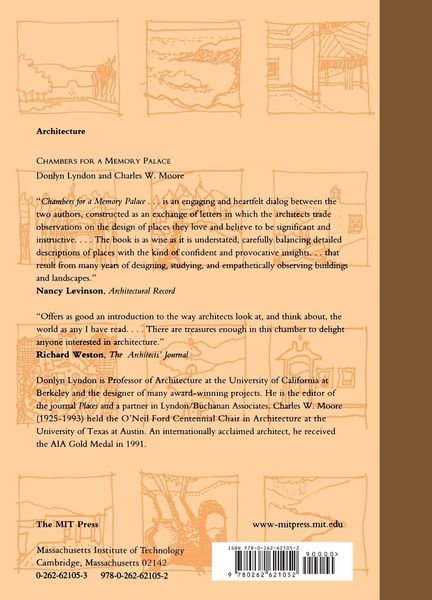
978-0-262-62105-2
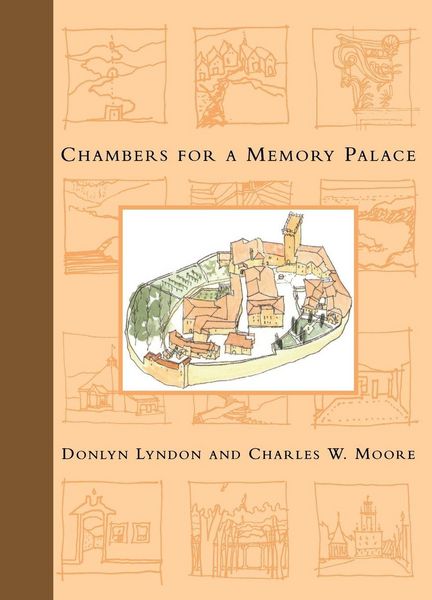
This ode to the spirit of place consists of an exchange of letters in which one author recalls and the other responds to the elements considered essential to the art of successful place-making. Each of the book's chapters forms a chamber, and each chamber is inscribed with the authors' personal observations.
This collaboration between two distinguished architects and former colleagues is a joyous celebration of admired places and a thoughtful consideration of the role that design has played in giving these places their memorable qualities. It is also an invitation to readers to inhabit the chambers of the book with their own imaginations to join in the making of the Memory Palace proposed. The authors' informal, witty, and anecdotal style extends to the illustrations—the freehand travel sketches, line drawings, and watercolors of places they have remembered and enjoyed. Chambers for a Memory Palace consists of an exchange of letters in which one author recalls and the other responds to the elements considered essential to the art of successful place-making. Each of the book's chapters forms a chamber, and each chamber is inscribed with personal observations on the composition of places and the architectural elements central to each building, garden, court, monument, or open space described. The examples considered in these dialogues range from classic Western tradition to Asian temples and Islamic tombs, from ancient ruins to modern cities. In "Axes that Reach/Paths that Wander," Lyndon and Moore discuss the Cranbrook Academy of Art in Bloomfield Hills, the Taj Mahal in Agra, Vaux le Vicomte in France, the Beverly Hills Civic Center, and the Kimbell Museum in Forth Worth. In "Orchards that Measure/Pilasters that Temper," they consider the rhythmic spacing of elements in the Mosque at Cordoba, the Cathedral at Bourges, the thousand-pillared mandapas of South Indian temples, the facades of Schauspielhaus in Berlin, and the Seagram building in New York City. They use these and many other examples to illustrate the ways in which architecture, experience, and memory intertwine to help us experience events and places.
Noch keine Bewertungen vorhanden
Verfassen Sie die erste Bewertung zu diesem Artikel
Helfen Sie anderen Kundinnen und Kunden durch Ihre Meinung.
Kurze Frage zu unserer Seite
Vielen Dank für Ihr Feedback
Wir nutzen Ihr Feedback, um unsere Produktseiten zu verbessern. Bitte haben Sie Verständnis, dass wir Ihnen keine Rückmeldung geben können. Falls Sie Kontakt mit uns aufnehmen möchten, können Sie sich aber gerne an unseren Kund*innenservice wenden.
zum Kundenservice