Gutscheinbedingungen

**Gültig bis 17.08.2026 auf Schreibwaren & Office-Artikel online auf thalia.at, in der Thalia App und in teilnehmenden Thalia Buchhandlungen in Österreich mit Schulsortiment. In den Buchhandlungen nur gültig auf lagernde Ware. Einzelne Artikel können ausgeschlossen sein. Ausgenommen sind preisgebundene Artikel. Pro Einkauf einmal einlösbar. Nur gültig gegen Vorlage oder im Onlineshop hinterlegter Bonuscard. Infos zur Einlösung in der Buchhandlung sind auf der Bonuscard-Vorteilspreisseite zu finden. Click & Collect nur bei Onlinevorabzahlung möglich. Keine Einlösung bei Scan & Go-Bezahlung. Keine Barauszahlung. Nicht kombinierbar mit anderen Aktionen und Gutscheinen. Gutschein wird auf max. 500€ Bestellwert angerechnet. Nicht gültig für Geschenkkarten, Versandkosten und Services.

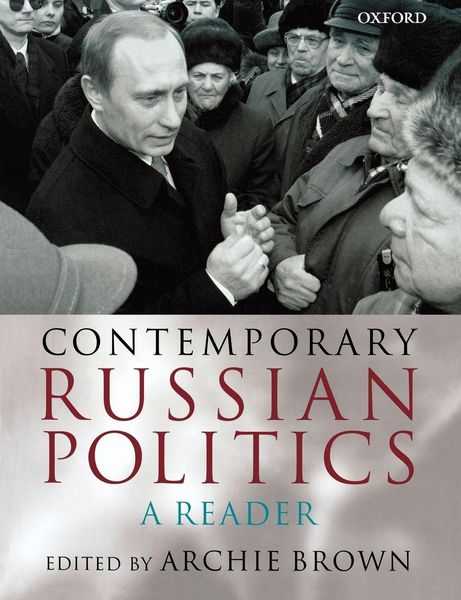
Produktbild: Contemporary Russian Politics

Contemporary Russian Politics A Reader

163,99 €

inkl. gesetzl. MwSt., Versandkostenfrei


Beschreibung

Produktdetails

Einband

Taschenbuch

Erscheinungsdatum

29.03.2001

Abbildungen

tables and graphs

Herausgeber

Archie Brown

Verlag

Oxford University Press

Seitenzahl

592

Maße (L/B/H)

24,6/18,9/3,2 cm

Gewicht

1129 g

Sprache

Englisch

ISBN

978-0-19-829999-8

Beschreibung

Produktdetails

Einband

Taschenbuch

Erscheinungsdatum

29.03.2001

Abbildungen

tables and graphs

Herausgeber

Archie Brown

Verlag

Oxford University Press

Seitenzahl

592

Maße (L/B/H)

24,6/18,9/3,2 cm

Gewicht

1129 g

Sprache

Englisch

ISBN

978-0-19-829999-8

Herstelleradresse

Libri GmbH
Europaallee 1
36244 Bad Hersfeld
DE

Email: gpsr@libri.de

Noch keine Bewertungen vorhanden

Verfassen Sie die erste Bewertung zu diesem Artikel

Helfen Sie anderen Kundinnen und Kunden durch Ihre Meinung.

Kundinnen und Kunden meinen

Bewertungen (0)

  • Produktbild: Contemporary Russian Politics
    • Introduction to Contemporary Russian Politics

    • Institutional Design

    • Introduction

    • 1: Igor Klyamkin and Lilia Shevtsova: The Tactical Origins of Russia's New Political Institutions

    • 2: Peter Ordeshook: Re-examining Russia: Institutions and Incentives

    • 3: Eugene Huskey: Democracy and Institutional Design in Russia

    • The Presidency and Political Leadership

    • Introduction

    • 4: John B. Dunlop: Sifting Through the Rubble of the Yeltsin Years

    • 5: George Breslauer: Boris Yeltsin as Patriarch

    • 6: Eugene Huskey: Overcoming the Yeltsin Legacy: Vladimir Putin and Russian Political Reform

    • The Legislature and the Law

    • Introduction

    • 7: Paul Chaisty: Legislative Politics in Russia

    • 8: Eugene Huskey: Legislative-Executive Relations in the Yeltsin Era

    • 9: Kathryn Hendley: Rewriting the Rules of the Game in Russia: The Neglected Issue of the Demand for Law

    • 10: Peter Rutland and Natasha Kogan: The Russian Mafia: Between Hype and Reality

    • Elections and the Electoral System

    • Introduction

    • 11: Yitzhak Brudny: Continuity and Change in Russian Electoral Patterns? The December 1999 - March 2000 Electoral Cycle

    • 12: Vladimir Gelman: The Iceberg of Russian Political Finance

    • 13: Robert G. Moser: The Impact of Parliamentary Electoral Systems in Russia

    • Problems of Party Formation and Consolidation

    • Introduction

    • 14: Richard Rose: How Floating Parties Frustrate Democratic Accountability: A Supply-Side View of Russia's Elections

    • 15: Darrell Slider: Russia's Governors and Party Formation

    • 16: Stephen Whitefield: Partisan and Party Divisions in Post-Communist Russia

    • Economic Reform: Politics, Interests, and Social Consequences

    • Introduction

    • 17: Richard Ericson: Is Russia in Transition to a Market Economy?

    • 18: Sergei Peregudov: The Oligarchical Model

    • 19: Nodari Simonia: Economic Interests and Political Power in Post-Soviet Russia

    • Public Opinion, Political Beliefs, and the Mass Media

    • Introduction

    • 20: Richard Rose: Living in an Antimodern Society

    • 21: Oksana Gaman-Golutvina: Modernization and the Value System of the Russian Elite

    • 22: Yury Levada: Homo Praevaricatus: Russian Doublethink

    • 23: Laura Belin: Political Bias and Self-Censorship in the Russian Media

    • Russian Statehood and the National Question

    • Introduction

    • 24: Gail Lapidus: State Building and State Breakdown in Russia

    • 25: Vera Tolz: Politicians' Conceptions of the Russian Nation

    • 26: Ronald Grigor Suny: Russia's Identity Crisis

    • Federalism, Regionalism, and Local Government

    • Introduction

    • 27: Jeff Kahn: What is the New Russian Federalism?

    • 28: Alla Chirikova and Natalya Lapina: Political Power and Political Stability in the Russian Regions

    • 29: Tomila Lankina: Local Government and Ethnic and Social Activism in Russia

    • Russia and the World

    • Introduction

    • 30: Margot Light: Post-Soviet Russian Foreign Policy: The First Decade

    • 31: Vladimir Baranovsky: Russia: A Part of Europe or Apart from Europe?

    • 32: Roy Allison: Russia and the New States of Eurasia

    • The Russian Transition in Comparative Perspective

    • Introduction

    • 33: Philippe C. Schmitter with Terry Lynn Karl: The Conceptual Travels of Transitologists ans Consolidologists: How Far to the East Should They Attempt to Go?

    • 34: Valerie Bunce: Should Transitologists be Grounded?

    • 35: Terry Lynn Karl and Philippe C. Schmitter: From an Iron Curtain to a Paper Curtain: Grounding Transitologists or Students of Postcommunism?

    • 36: Valerie Bunce: Paper Curtains and Paper Tigers

    • 37: Vladimir Gelman: Regime Transition, Uncertainty and Prospects for Democratisation: The Politics of Russia's Regions in Comparative Perspective

    • Is Russia becoming a Democracy?

    • Introduction

    • 38: William Smirnov: Russian Democratization: Achievements and Problems

    • 39: Alexander Lukin: Electoral Democracy or Electoral Clanism? Russian Democratization and Theories of Transition

    • 40: Archie Brown: Evaluating Russia's Democratization

    • Index