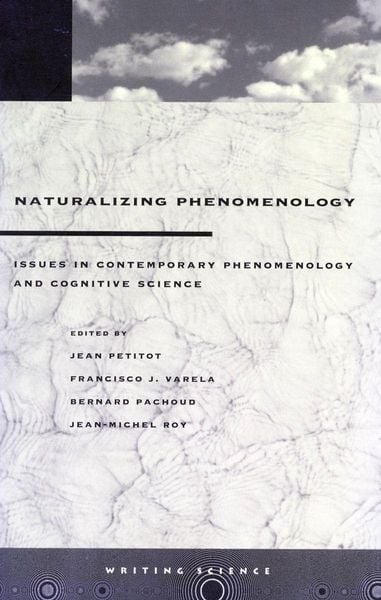
Naturalizing Phenomenology Issues in Contemporary Phenomenology and Cognitive Science
-
- Englisch ausgewählt
48,99 €
inkl. gesetzl. MwSt.,
Beschreibung
Produktdetails
Einband
Taschenbuch
Erscheinungsdatum
01.01.2000
Abbildungen
42 figures
Herausgeber
Jean Petitot + weitereVerlag
Stanford University PressSeitenzahl
672
Maße (L/B/H)
23,4/15,6/3,4 cm
Gewicht
921 g
Sprache
Englisch
ISBN
978-0-8047-3610-7
This ambitious work aims to shed new light on the relations between Husserlian phenomenology and the present-day efforts toward a scientific theory of cognition-with its complex structure of disciplines, levels of explanation, and conflicting hypotheses.
The book's primary goal is not to present a new exegesis of Husserl's writings, although it does not dismiss the importance of such interpretive and critical work. Rather, the contributors assess the extent to which the kind of phenomenological investigation Husserl initiated favors the construction of a scientific theory of cognition, particularly in contributing to specific contemporary theories either by complementing or by questioning them. What clearly emerges is that Husserlian phenomenology cannot become instrumental in developing cognitive science without undergoing a substantial transformation. Therefore, the central concern of this book is not only the progress of contemporary theories of cognition but also the reorientation of Husserlian phenomenology.
Because a single volume could never encompass the numerous facets of this dual aim, the contributors focus on the issue of naturalization. This perspective is far-reaching enough to allow for the coverage of a great variety of topics, ranging from general structures of intentionality, to the nature of the founding epistemological and ontological principles of cognitive science, to analyses of temporality and perception and the mathematical modeling of their phenomenological description.
This book, then, is a collective reflection on the possibility of utilizing a naturalized Husserlian phenomenology to contribute to a scientific theory of cognition that fills the explanatory gap between the phenomenological mind and brain.
Noch keine Bewertungen vorhanden
Verfassen Sie die erste Bewertung zu diesem Artikel
Helfen Sie anderen Kundinnen und Kunden durch Ihre Meinung.
Kurze Frage zu unserer Seite
Vielen Dank für Ihr Feedback
Wir nutzen Ihr Feedback, um unsere Produktseiten zu verbessern. Bitte haben Sie Verständnis, dass wir Ihnen keine Rückmeldung geben können. Falls Sie Kontakt mit uns aufnehmen möchten, können Sie sich aber gerne an unseren Kund*innenservice wenden.
zum Kundenservice