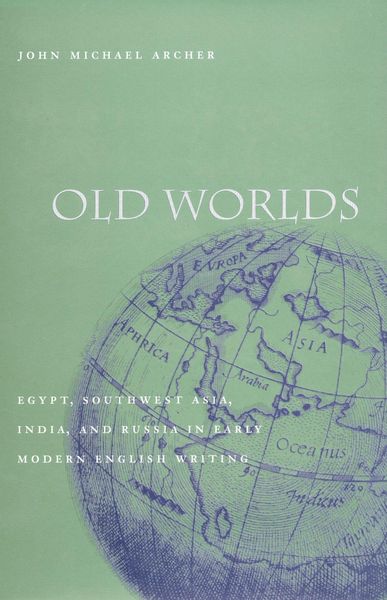
Old Worlds Egypt, Southwest Asia, India, and Russia in Early Modern English Writing
-
- Englisch ausgewählt
89,99 €
inkl. gesetzl. MwSt.,
Beschreibung
Produktdetails
Einband
Gebundene Ausgabe
Erscheinungsdatum
02.01.2002
Verlag
Stanford University PressSeitenzahl
256
Maße (L/B/H)
22,9/16,8/2 cm
Gewicht
522 g
Sprache
Englisch
ISBN
978-0-8047-4337-2
Although much attention has been paid to early modern European travel to the New World, attention is just beginning to be paid to the travels in the Old World, even though they speak to contemporary concerns with categories like civilization, race, and nation as much as, sometimes more than, the New World explorations.
This book aligns travel narratives and historical surveys of parts of the Old World--Egypt, Mesopotamia, India, and Russia--with texts by Shakespeare, Milton, and Dryden that contributed to English ideas about those regions. Addressing the current interest in Europe's relationship with its neighbors and near-neighbors in the Old World, the author introduces the term "paracolonial" to describe Europe's attitude toward those areas where its colonial reach was intermittent or nonexistent.
The book begins by matching ancient and early modern accounts of Egypt and Ethiopia with Shakespeare's Antony and Cleopatra, showing how antiquity's veneration of Egyptian values was tainted in Shakespeare's time by anxieties of racial and sexual degeneration. The next chapter, centered on Milton's Paradise Lost, relates degeneration to the epic cycle of imperial rise and fall attributed to Southwest Asia and its monumental ruins by European historians and travelers. The Elizabethan and Jacobean fascination with Russia is the topic of the third chapter, which argues that Herodotus' Scythia and early modern slavery were the dual origins of the barbarous Russia glimpsed in Shakespeare's Love's Labour's Lost and Milton's Muscovia. In the process, the author offers a novel explanation for the puzzling link between Russia and racial "blackness" in the English Renaissance. The book concludes with India, where degeneration, cyclic empire, and bodily images of racial and sexual difference were combined in geographical writings and sensationally staged in Dryden's Aureng-Zebe.
Tracing the overlap between Graeco-Roman geography and the itineraries of Renaissance travelers and traders, Old Worlds brings together a rich array of texts that rewrite European traditions about a plural antiquity from an early modern English perspective.
Noch keine Bewertungen vorhanden
Verfassen Sie die erste Bewertung zu diesem Artikel
Helfen Sie anderen Kundinnen und Kunden durch Ihre Meinung.
Kurze Frage zu unserer Seite
Vielen Dank für Ihr Feedback
Wir nutzen Ihr Feedback, um unsere Produktseiten zu verbessern. Bitte haben Sie Verständnis, dass wir Ihnen keine Rückmeldung geben können. Falls Sie Kontakt mit uns aufnehmen möchten, können Sie sich aber gerne an unseren Kund*innenservice wenden.
zum Kundenservice