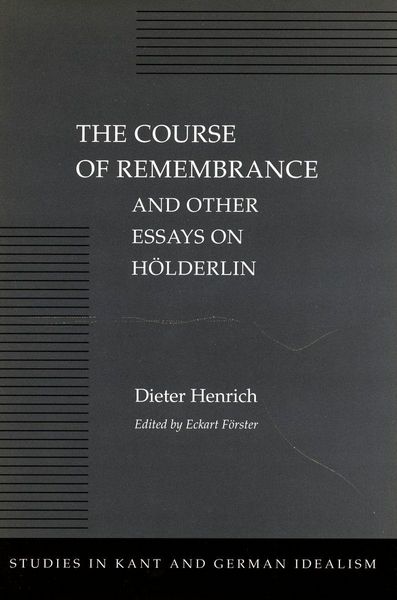
The Course of Remembrance and Other Essays on Hölderlin
-
- Englisch ausgewählt
77,99 €
inkl. gesetzl. MwSt.,
Beschreibung
Produktdetails
Einband
Gebundene Ausgabe
Erscheinungsdatum
01.05.1997
Herausgeber
Eckart FörsterVerlag
Stanford University PressSeitenzahl
316
Maße (L/B/H)
23,8/15,9/2,3 cm
Gewicht
621 g
Sprache
Englisch
ISBN
978-0-8047-2739-6
Friedrich Hölderlin (1770-1843) has long been recognized as one of the greatest poets of the German language, but his importance to philosophy has surfaced only comparatively recently. Although Schelling and Hegel acknowledged Hölderlin early on as their equal, for a long time his philosophical thought remained unknown outside the small circle of his friends.
Among the most prominent figures in the rediscovery of Hölderlin's thought is Dieter Henrich, who, in a series of highly influential studies over the last thirty years, has shown that Hölderlin played a decisive role in the development of philosophy from Kant to Hegel, and hence in the formation of German Idealism. Among other things, Henrich demonstrated that Hölderlin, while still a student, launched a powerful critique of Fichte's Wissenschaftslehre and outlined an alternative to the dominant view of the foundation of philosophy. This alternative proved pathbreaking for his philosophical friends, forcing Hegel, for example, to abandon his own Kantianism and, eventually, to give systematic articulation to a position that went even beyond Hölderlin's.
This volume includes six of Henrich's most important essays on Hölderlin's philosophical significance. Among the topics discussed are Hölderlin's motivation and methodological orientation in his work on German Idealism, the intellectual atmosphere of Hölderlin's student years and the philosophical problems that occupied him, Hölderlin's attitude toward any first-principle philosophy, and the complex personal and philosophical relationships between Hegel and Hölderlin. The last essay is a long, detailed interpretation of one of Hölderlin's greatest poems, "Remembrance." In elucidating its lyric composition and structure, Henrich also seeks to show how it incorporates and develops Hölderlin's philosophical thought.
Noch keine Bewertungen vorhanden
Verfassen Sie die erste Bewertung zu diesem Artikel
Helfen Sie anderen Kundinnen und Kunden durch Ihre Meinung.
Kurze Frage zu unserer Seite
Vielen Dank für Ihr Feedback
Wir nutzen Ihr Feedback, um unsere Produktseiten zu verbessern. Bitte haben Sie Verständnis, dass wir Ihnen keine Rückmeldung geben können. Falls Sie Kontakt mit uns aufnehmen möchten, können Sie sich aber gerne an unseren Kund*innenservice wenden.
zum Kundenservice