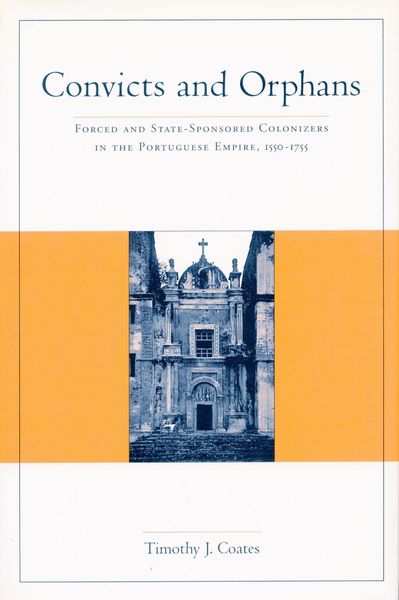
Convicts and Orphans Forced and State-Sponsored Colonization in Portuguese Empire, 1550-1755
-
- Englisch ausgewählt
92,99 €
inkl. gesetzl. MwSt.,
Beschreibung
Produktdetails
Einband
Gebundene Ausgabe
Erscheinungsdatum
11.02.2002
Abbildungen
15 illustrations, 4 maps
Verlag
Stanford University PressSeitenzahl
288
Maße (L/B/H)
23,4/15,7/2,4 cm
Gewicht
513 g
Sprache
Englisch
ISBN
978-0-8047-3359-5
This book examines how the early modern Portuguese state used convicts and orphans to populate its global empire over a period of two hundred years. In a country with as small a population base and the global labor requirements of Portugal, no one was expendable, not even such marginal figures as criminals, gypsies, orphans, and prostitutes. The author examines how the Portuguese judicial system, Overseas Council, Courts of the Inquisition, and charities coordinated their efforts to populate border cities in Portugal during the Middle Ages, and then turned to various sites in the empire as places of exile for these elements of society. In addition, he addresses the issue of gender in the state's use of two distinct groups of single women as colonizers, orphan girls and reformed prostitutes, each given state-awarded dowries if they agreed to relocate overseas.
We are well acquainted with this system as it was used by the British in Australia in the nineteenth century, and much work has been done on similar efforts by other imperial powers, such as France, Spain, Russia, and China, to populate remote regions of their empires. However, this is the first study of the much earlier Portuguese case, and it provides a significant link between the medieval and modern applications of penal exile.
The Portuguese state, with a population in 1600 one-sixth that of Great Britain and one-tenth that of France, exiled around 50,000 people, the same number as each of these larger powers. The punishment of exile was thus far more pervasive in Portuguese society. This work represents a new chapter in the study of exile as a punishment and the use of criminals as colonizers. It helps to explain the longevity of the Portuguese global empire as well as the growth of informal Portuguese-related communities around the world.
Noch keine Bewertungen vorhanden
Verfassen Sie die erste Bewertung zu diesem Artikel
Helfen Sie anderen Kundinnen und Kunden durch Ihre Meinung.
Kurze Frage zu unserer Seite
Vielen Dank für Ihr Feedback
Wir nutzen Ihr Feedback, um unsere Produktseiten zu verbessern. Bitte haben Sie Verständnis, dass wir Ihnen keine Rückmeldung geben können. Falls Sie Kontakt mit uns aufnehmen möchten, können Sie sich aber gerne an unseren Kund*innenservice wenden.
zum Kundenservice