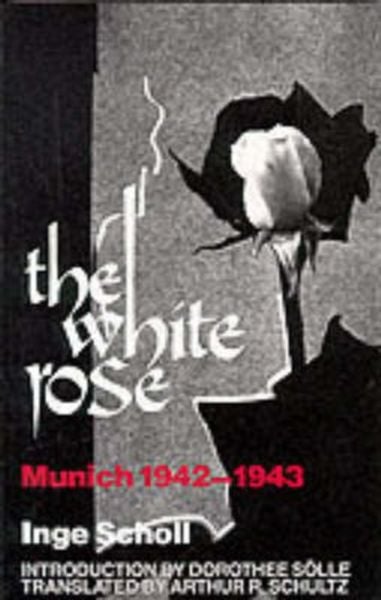
The White Rose tells the story of Hans Scholl and Sophie Scholl, who in 1942 led a small underground organization of German students and professors to oppose the atrocities committed by Hitler and the Nazi Party. They named their group the White Rose, and they distributed leaflets denouncing the Nazi regime. Sophie, Hans, and a third student were caught and executed.
Written by Inge Scholl (Han's and Sophie's sister), The White Rose features letters, diary excerpts, photographs of Hans and Sophie, transcriptions of the leaflets, and accounts of the trial and execution. This is a gripping account of courage and morality.
Kundinnen und Kunden meinen
5.0/5.0
Bewertung
5/5
13.12.2025
Buch (Taschenbuch)
Die Weiße Rose
Die Weiße Rose (The White Rose)
Inge Aicher-Scholl was the sister of Hans and Sophie Scholl, the founders of the German student resistance group Die Weiße Rose in Nazi Germany. She was born on August 11th , 1917 and died on the 4th September 1998 . She did not participate in her siblings’ activities concerning the Weiße Rose resistance, but in her book, she honors them and tells their stories.
What would you have done in Nazi Germany? A question that all of us must at some point ask ourselves. How far would we go for our beliefs, what would we risk for the freedom of a nation and to combat the hate and crimes that were the Third Reich? Hans and Sophie Scholl knew. They walked that path, and they were willing to give it all, even if it was just to encourage a few people to participate in passive resistance.
One of the things that surprised me about this book was the way in which it managed not only to create sympathy for the victims of the war, but to also show how easy it is to get swept into this kind of ideology. In the story, we are able to watch the Scholl siblings go from excitedly joining the Hitler Youth and Bund der Deutschen Mädchen, believing that Hitler was going to be the best thing that happened to Germany, to sacrificing their lives to raise awareness about the horrors that were Hitler’s doing.
The book starts in hindsight, with Inge reflecting on the world and telling us of the death penalties that were executed among the members of the Weiße Rose. Then she reflects about what these people did that made them heroes. “Sie haben nichts Übermenschliches unternommen. Sie haben etwas Einfaches verteidigt, sind für etwas Einfaches eingestanden, für das Recht und die Freiheit des einzelnen Menschen, für seine freie Entfaltung und ein freies Leben. Sie haben sich keiner außergewöhnlichen Idee geopfert, haben keine großen Ziele verfolgt; was sie wollten, war, daß Menschen wie du und ich in einer menschlichen Welt leben können. Und vielleicht liegt darin das Große, daß sie für etwas so Einfaches eintraten und ihr Leben dafür aufs Spiel setzten, daß sie die Kraft hatten, das einfachste Recht mit einer letzten Hingabe zu verteidigen.“ (They have not done anything superhuman. They have defended something simple, they stand for something simple, for the right and the freedom of the individual, for his free development and a free life. They did not sacrifice themselves to an extraordinary idea, did not pursue any great goals; What they wanted was for people like you and me to live in a human world. And maybe that's the big thing, that they stood up for something so simple and put their lives at risk, that they had the power to defend the simplest right with a final surrender.) We then go on to meet the Scholl siblings, see them first thrilled by the Nazis and not understanding their parents disapproving, and then slowly maturing, going to college and making friends there, learning about the horrors of Hitler and trying to stop them.
In the process, we also see many of the horrors of the Third Reich. The example that I am still in tears from every time that I think of it, is the example of the mentally disabled children. At some point we find out that these children would be picked up and driven to a gas chamber where they would die. The children that were left behind started to talk, and ask questions, so the nurses that took care of them told them that the trucks were driving them to God. From that day on, the children went to their death singing. This is not the first time that I learnt about Nazi Germany, I know that the Third Reich was horrible, but I was still, even after discovering that there was no humanity in there, shocked and angry when reading this. Any society that disregards children, (mentally) disabled people or otherwise helpless people is beyond any cruelty imaginable. Who on earth could do this to children, mentally disabled children in particular? We are left reeling at the cruelty that we are confronted with described in this book. Even after learning about the cruelty so often, and knowing of it, it is written here in a way that enrages even the most cool-headed person.
We also get to know the Scholl siblings, and feel like we know them. Especially in eye witness accounts of their last days, we can see the selflessness displayed in both of them. It is described that both of them would rather have died twice if possible than let their sibling die as well, and that they were competing to take the most blame for the actions. I would be truly honored to know such people. They are described from different perspectives and very well, from a loving sister. It broke my heart how full of life and enjoyment of life they were, and how tragically short it was cut.
I really liked the fact that we could also read the pamphlets that the Scholl siblings gave their lives to distribute. They were powerful, and well written. It also helped to honor the Weiße Rose, by sharing what they fought for even after their death and the fall of the regime they hated so much.
This is a historical non-fiction. The action was spread out, this is not a very action-packed book as we know from the start that it will end in death. Most of the action takes place in the first thirty percent of the book, which is the story. The later parts of the book are the pamphlets, and the eyewitness accounts, both of which are very worth reading.
I think that Inge Scholl’s writing style was very powerful and simple, I usually enjoy reading fiction books and that writing style, but her writing style was very appropriate for a non-fiction.
I give this book 4.5 stars out of 5, 9 out of 10. Would definitely recommend if you can stomach it.
Kurze Frage zu unserer Seite
Vielen Dank für Ihr Feedback
Wir nutzen Ihr Feedback, um unsere Produktseiten zu verbessern. Bitte haben Sie Verständnis, dass wir Ihnen keine Rückmeldung geben können. Falls Sie Kontakt mit uns aufnehmen möchten, können Sie sich aber gerne an unseren Kund*innenservice wenden.