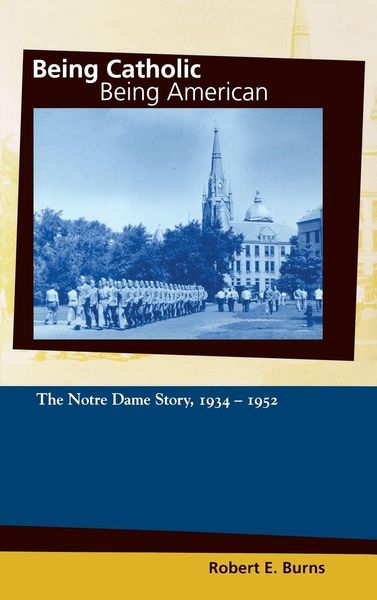
Being Catholic, Being American, Volume 2 The Notre Dame Story, 1934-1952
-
- Englisch ausgewählt
58,99 €
inkl. gesetzl. MwSt.,
Beschreibung
Produktdetails
Einband
Gebundene Ausgabe
Erscheinungsdatum
01.10.2000
Verlag
University Of Notre Dame PressSeitenzahl
538
Maße (L/B/H)
23,5/15,7/3,6 cm
Gewicht
1015 g
Sprache
Englisch
ISBN
978-0-268-02163-4
The University of Notre Dame, perhaps the best-known of American Catholic universities, often serves as a mirror of the travails and triumphs of Catholics in mid-twentieth-century America. Its story is as spirited and compelling as the traditions for which Notre Dame is famous. Being Catholic, Being American, Volume 2: The Notre Dame Story, 1934-1952, continues the work of Burns' first volume. By 1934, Notre Dame was widely perceived as a university where young men with Irish, German, Italian, and Polish surnames who excelled in sports were educated for success in middle-class America. It was a place where religion was taken seriously and patriotism was highly valued. In the years before, during, and immediately after World War II, this perception was seriously challenged. After a successful period of academic expansion and improvement under Father John O'Hara (1934-1940), his successor, Father J. Hugh O'Donnell (1940-1946), was drawn into the bitter conflict between isolationists and interventionists then raging in the country. In numerous, widely reported off-campus speeches, Father John A. O'Brien, a well-known, colorful diocesan priest and professor in the religion department, took up the isolationist cause. The more liberal Professor Francis E. McMahon of the philosophy department was an equally outspoken interventionist. The two generated storms of negative publicity. When McMahon's stance triggered pressure on O'Donnell from the apostolic delegate, the professor's dismissal was seen as a shameless assault on academic freedom. The incident, occurring as it did in the midst of a terrible war against authoritarian fascist regimes, created the greatest public relations disaster in the history of the university. Burns describes how the presence of the military and, after the war, the influx of veterans transformed the campus. O'Donnell's successor, Father John J. Cavanaugh (1946-1952), succeeded in restoring the university's reputation following the McMahon crisis, aided by the spectacular performance of Frank Leahy's championship football teams. Cavanaugh believed that a new style of leadership sensitive to public relations and committed to permanent fund raising was required if Notre Dame was to grow and prosper as an authentic modern research-based American Catholic university. This second volume is invaluable for historians, teachers, students, alumni, sports enthusiasts, and everyone else touched by the story of the University of Notre Dame.
Noch keine Bewertungen vorhanden
Verfassen Sie die erste Bewertung zu diesem Artikel
Helfen Sie anderen Kundinnen und Kunden durch Ihre Meinung.
Kurze Frage zu unserer Seite
Vielen Dank für Ihr Feedback
Wir nutzen Ihr Feedback, um unsere Produktseiten zu verbessern. Bitte haben Sie Verständnis, dass wir Ihnen keine Rückmeldung geben können. Falls Sie Kontakt mit uns aufnehmen möchten, können Sie sich aber gerne an unseren Kund*innenservice wenden.
zum Kundenservice