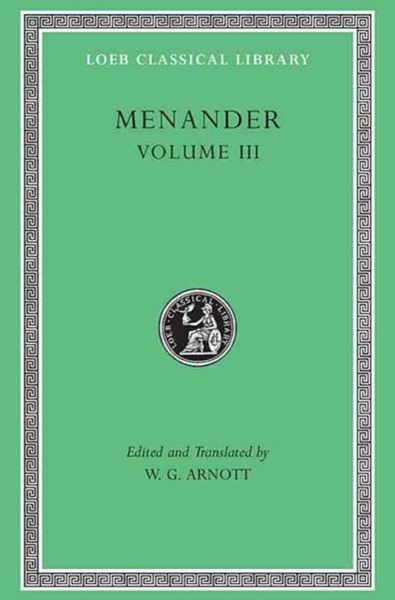
Menander, Volume III Samia. Sikyonioi. Synaristosai. Phasma. Unidentified Fragments
-
- Hardcover ausgewählt
- Taschenbuch
- eBook
-
Sprache:Englisch
-
Verlag:University Presses
35,99 €
inkl. gesetzl. MwSt.,
Beschreibung
Produktdetails
Einband
Gebundene Ausgabe
Erscheinungsdatum
15.09.2000
Herausgeber
William Geoffrey ArnottVerlag
University PressesSeitenzahl
656
Maße (L/B/H)
17/11,6/2,9 cm
Gewicht
399 g
Übersetzt von
William Geoffrey Arnott
Sprache
Englisch
ISBN
978-0-674-99584-0
The master of New Comedy.
Menander (?344/3-292/1 BC) of Athens, the leading playwright of the New Comedy, wrote more than 100 plays. Many of his comedies were adapted by Roman dramatists. By the middle ages, however, his works were lost. Then, at the end of the nineteenth century, papyrus texts, preserved from antiquity by the dry heat of Egypt, began to be discovered. These have yielded so far one play virtually complete (Dyskolos), large continuous portions of four more (Aspis, Epitrepontes, Perikeiromene, Samia), and sizable chunks of many others. Menander remains a paradox: artificial plots based on unlikely but conventional coincidences, enlivened by individualized characters, realistic situations, and at times deeply moving dialogue.
Volume I of Geoffrey Arnott's three-volume edition of Menander contains six plays, including Dyskolos (The Peevish Fellow), which won first prize in Athens in 317 BC, and Dis Exapaton (Twice a Swindler), the original of Plautus' Two Bacchises. Ten plays are in Volume II, among them the recently published fragments of Misoumenos (The Man She Hated), which sympathetically presents the flawed relationship of a soldier and a captive girl; and the surviving half of Perikeiromene (The Girl with Her Hair Cut Short), a comedy of mistaken identity and lovers' quarrel. Volume III begins with Samia (The Woman from Samos), which has come down to us nearly complete. Here too are the very substantial extant portions of Sikyonioi (The Sicyonians) and Phasma (The Apparition), as well as Synaristosai (Women Lunching Together), on which Plautus' Cistellaria was based.
Kundinnen und Kunden meinen
Verfassen Sie die erste Bewertung zu diesem Artikel
Helfen Sie anderen Kund*innen durch Ihre Meinung
Kurze Frage zu unserer Seite
Vielen Dank für Ihr Feedback
Wir nutzen Ihr Feedback, um unsere Produktseiten zu verbessern. Bitte haben Sie Verständnis, dass wir Ihnen keine Rückmeldung geben können. Falls Sie Kontakt mit uns aufnehmen möchten, können Sie sich aber gerne an unseren Kund*innenservice wenden.
zum Kundenservice