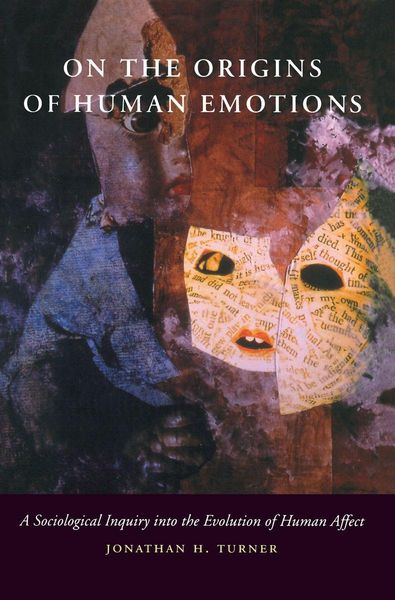
On the Origins of Human Emotions A Sociological Inquiry Into the Evolution of Human Affect
-
- Englisch ausgewählt
23,99 €
inkl. gesetzl. MwSt.,
- Kostenlose Lieferung ab 30 € Einkaufswert
- Versandkostenfrei für Bonuscard-Kund*innen
Beschreibung
Produktdetails
Einband
Taschenbuch
Erscheinungsdatum
01.06.2000
Verlag
Stanford University PressSeitenzahl
208
Maße (L/B/H)
22,8/15,2/1,7 cm
Gewicht
322 g
Sprache
Englisch
ISBN
978-0-8047-3720-3
Language and culture are often seen as unique characteristics of human beings. In this book the author argues that our ability to use a wide array of emotions evolved long before spoken language and, in fact, constituted a preadaptation for the speech and culture that developed among later hominids. Long before humans could speak with words, they communicated through body language their emotional dispositions; and it is the neurological wiring of the brain for these emotional languages that represented the key evolutionary breakthrough for our species.
How did natural selection work on the basic ape anatomy and neuroanatomy to create the hominid line? The author suggests that what distinguished our ancestors from other apes was the development of an increased capacity for sociality and organization, crucial for survival on the African savanna. All apes display a propensity for weak ties, individualism, mobility, and autonomy that was, and is today, useful in arboreal and woodland habitats but served them poorly when our ancestors began to move onto the African plain during the late Miocene.
The challenge for natural selection was to enhance traits in the species that would foster the social ties necessary for survival in the new environment. The author suggests that the result was a development of certain areas of the primate brain that encouraged strong emotional ties, allowing our ancestors to build higher levels of social solidarity. Our basic neurological wiring continues to reflect this adaptive development. From a sociological perspective that is informed by evolutionary biology, primatology, and neurology, the book examines the current neurological bases of our emotional repertoire and their implications for our social actions.
Noch keine Bewertungen vorhanden
Verfassen Sie die erste Bewertung zu diesem Artikel
Helfen Sie anderen Kundinnen und Kunden durch Ihre Meinung.
Kurze Frage zu unserer Seite
Vielen Dank für Ihr Feedback
Wir nutzen Ihr Feedback, um unsere Produktseiten zu verbessern. Bitte haben Sie Verständnis, dass wir Ihnen keine Rückmeldung geben können. Falls Sie Kontakt mit uns aufnehmen möchten, können Sie sich aber gerne an unseren Kund*innenservice wenden.
zum Kundenservice