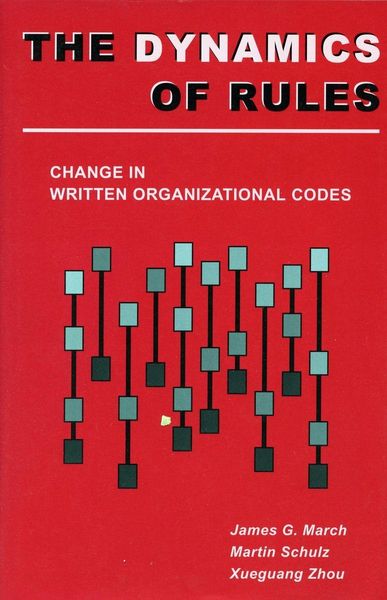
Dynamics of Rules Change in Written Organizational Codes
-
- Hardcover ausgewählt
- Taschenbuch
-
Sprache:Englisch
145,99 €
UVP
162,80 €
inkl. gesetzl. MwSt.,
Beschreibung
Produktdetails
Einband
Gebundene Ausgabe
Erscheinungsdatum
01.08.2000
Abbildungen
21 tables, 14 figures
Verlag
Stanford University PressSeitenzahl
248
Maße (L/B/H)
23,7/15,9/2,3 cm
Gewicht
540 g
Sprache
Englisch
ISBN
978-0-8047-3744-9
Written rules in formal organizations are distinctive elements of organizational history; they shape organizational change and are in turn shaped by it. These rules are created, revised, and eliminated in ways that leave historical traces, and they have a visibility and durability that elude non-written rules. They thus provide rich data for an empirical probe into the dynamics of organizational history.
This study uses qualitative and quantitative data from the history of a specific organization, Stanford University, to develop speculations about the ways in which written rules change. It contributes both to a theory of rules and to theories of organizational decision-making, change, and learning. Organizations respond to problems and react to internal or external pressures by focusing attention on existing and potential rules. The creation, modification, or elimination of a rule, then, is a response to events in the outside environment (such as new government regulations) or to events within the organization (such as alterations in internal government structures).
The authors elaborate a simple set of ideas about written rules and their dynamics, emphasizing the interplay among periodic major shocks to the system from outside, experiences with individual rules as they age and are revised, and the spread of effects through an interconnected set of rules. It is a story in which changes introduced in one part of a rule system create adjustments in other parts, including the same rule later in time, as the consequences of the changes are experienced and as rule-making attention is mobilized, satiated, and redirected. These processes involve the full panoply of political negotiation, symbolic competition, discussion, and problem solving that are typical of organizational decision making.
Noch keine Bewertungen vorhanden
Verfassen Sie die erste Bewertung zu diesem Artikel
Helfen Sie anderen Kundinnen und Kunden durch Ihre Meinung.
Kurze Frage zu unserer Seite
Vielen Dank für Ihr Feedback
Wir nutzen Ihr Feedback, um unsere Produktseiten zu verbessern. Bitte haben Sie Verständnis, dass wir Ihnen keine Rückmeldung geben können. Falls Sie Kontakt mit uns aufnehmen möchten, können Sie sich aber gerne an unseren Kund*innenservice wenden.
zum Kundenservice