
Designing Europe Comparative Lessons from the Federal Experience
-
- Hardcover
- Taschenbuch ausgewählt
-
Sprache:Englisch
85,99 €
inkl. gesetzl. MwSt.,
Beschreibung
Produktdetails
Einband
Taschenbuch
Erscheinungsdatum
01.02.2001
Abbildungen
numerous tables
Verlag
Oxford University PressSeitenzahl
180
Maße (L/B/H)
23,4/15,6/1 cm
Gewicht
284 g
Sprache
Englisch
ISBN
978-0-19-924435-5
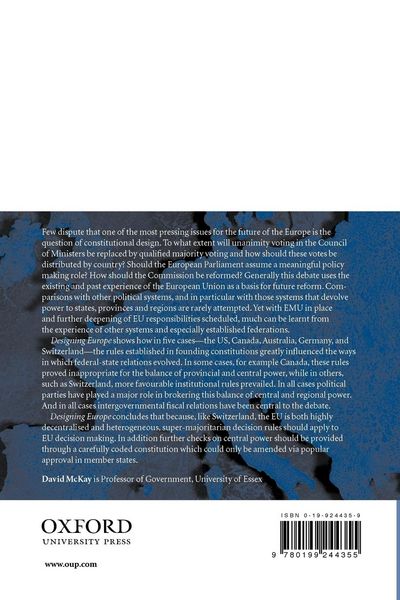
Few dispute that one of the most pressing issues for the future of the Europe is the question of constitutional design. To what extent will unanimity voting in the Council of Ministers replaced by qualified majority voting and how should these votes be distributed by country? Should the European Parliament assume a meaningful policy making role? How should the Commission be reformed? Generally this debate uses the existing and past experience of the European Union as a basis for future reform. Comparisons with other political systems and in particular with those systems that devolve power to states, provinces and regions are rarely attempted. Yet with EMU in place and further deepening of EU responsibilities scheduled, much can be learnt from the experience of other systems and especially established federations. Designing Europe shows how in five cases - the US, Canada, Australia, Germany and Switzerland - the rules established in founding constitutions greatly influenced the ways in which federal-state relations evolved. In some cases, for example Canada, these rules proved inappropriate for the balance of provincial and central power, while in others, such as Switzerland, more favourable institutional rules prevailed. In all cases political parties have played a major role in brokering this balance of central and regional power. And in all cases intergovernmental fiscal relations have been central to the debate.
Designing Europe concludes that because, like Switzerland, the EU is both highly decentralised and heterogeneous, super-majoritarian decision rules should apply to EU decision making. In addition further checks on central power should be provided through a carefully coded constitution amendments to which could only be amended via popular approval in member states.
Noch keine Bewertungen vorhanden
Verfassen Sie die erste Bewertung zu diesem Artikel
Helfen Sie anderen Kundinnen und Kunden durch Ihre Meinung.
Kurze Frage zu unserer Seite
Vielen Dank für Ihr Feedback
Wir nutzen Ihr Feedback, um unsere Produktseiten zu verbessern. Bitte haben Sie Verständnis, dass wir Ihnen keine Rückmeldung geben können. Falls Sie Kontakt mit uns aufnehmen möchten, können Sie sich aber gerne an unseren Kund*innenservice wenden.
zum Kundenservice