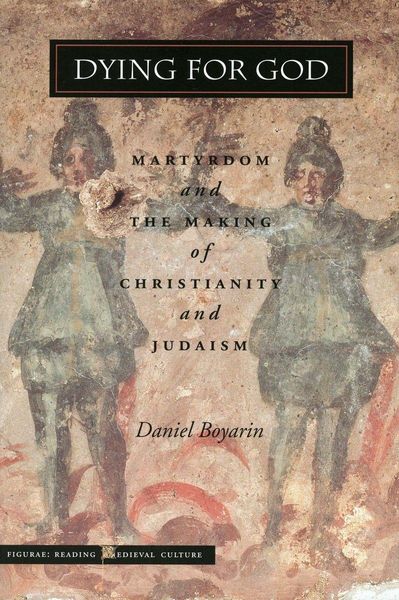
Dying for God Martyrdom and the Making of Christianity and Judaism
-
- Hardcover
- Taschenbuch ausgewählt
-
Sprache:Englisch
29,99 €
inkl. gesetzl. MwSt.,
- Kostenlose Lieferung ab 30 € Einkaufswert
- Versandkostenfrei für Bonuscard-Kund*innen
Beschreibung
Produktdetails
Einband
Taschenbuch
Erscheinungsdatum
01.11.1999
Verlag
Stanford University PressSeitenzahl
268
Maße (L/B/H)
22,7/15,4/2,2 cm
Gewicht
409 g
Sprache
Englisch
ISBN
978-0-8047-3704-3
Not long ago, everyone knew that Judaism came before Christianity. More recently, scholars have begun to recognize that the historical picture is quite a bit more complicated than that. In the Jewish world of the first century, many sects competed for the name of the true Israel and the true interpreter of the Torah-the Talmud itself speaks of seventy-and the form of Judaism that was to be the seedbed of what eventually became the Christian Church was but one of these many sects. Scholars have come to realize that we can and need to speak of a twin birth of Christianity and Judaism, not a genealogy in which one is parent to the other.
In this book, the author develops a revised understanding of the interactions between nascent Christianity and nascent Judaism in late antiquity, interpreting the two "new" religions as intensely and complexly intertwined throughout this period. Although the "officials" of the eventual winners in both communities-the Rabbis in Judaism and the orthodox leaders in Christianity-sought to deny it, until the end of late antiquity many people remained both Christians and Jews. This resulted, among other things, in much shared religious innovation that affected the respective orthodoxies as well.
Dying for God aims to establish this model as a realistic one through close and comparative readings of contemporary Christian texts and Talmudic narratives that thematize the connections and differences between Christians and Jews as these emerged around the issue of martyrdom. The author argues that, in the end, the developing discourse of martyrology involved the circulation and exchange of cultural and religious innovations between the two communities as they moved toward sharper self-definition.
Noch keine Bewertungen vorhanden
Verfassen Sie die erste Bewertung zu diesem Artikel
Helfen Sie anderen Kundinnen und Kunden durch Ihre Meinung.
Kurze Frage zu unserer Seite
Vielen Dank für Ihr Feedback
Wir nutzen Ihr Feedback, um unsere Produktseiten zu verbessern. Bitte haben Sie Verständnis, dass wir Ihnen keine Rückmeldung geben können. Falls Sie Kontakt mit uns aufnehmen möchten, können Sie sich aber gerne an unseren Kund*innenservice wenden.
zum Kundenservice