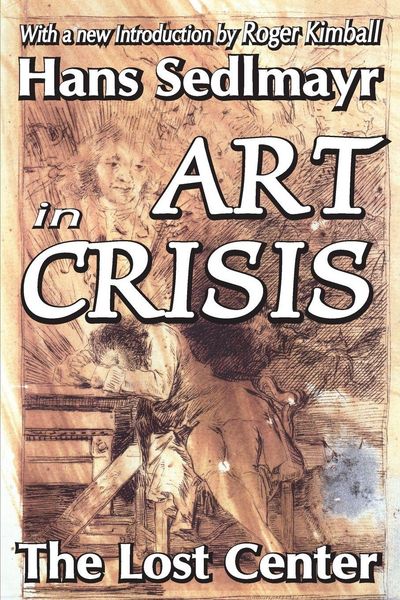
Art in Crisis The Lost Center
-
- Hardcover
- Taschenbuch ausgewählt
- eBook
-
Sprache:Englisch
65,99 €
inkl. gesetzl. MwSt.,
Beschreibung
Produktdetails
Einband
Taschenbuch
Erscheinungsdatum
15.11.2006
Verlag
Taylor & FrancisSeitenzahl
328
Maße (L/B/H)
22,9/15,2/1,8 cm
Gewicht
477 g
Sprache
Englisch
ISBN
978-1-4128-0607-7
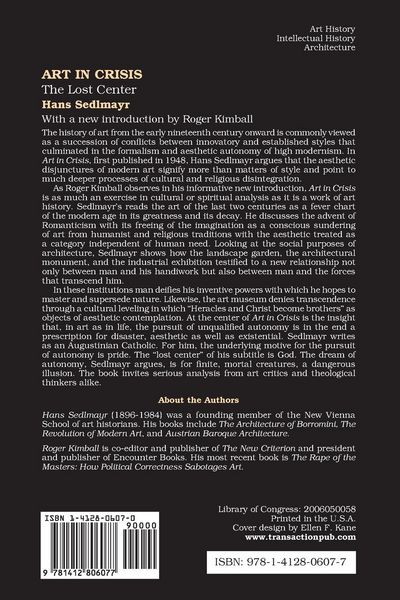
The history of art from the early nineteenth century on- ward is commonly viewed as a succession of conflicts between innovatory and established styles that culminated in the formalism and aesthetic autonomy of high modernism. In Art and Crisis, first published in 1948, Hans Sedlmayr argues that the aesthetic disjunctures of modern art signify more than matters of style and point to much deeper processes of cultural and religious disintegration. As Roger Kimball observes in his informative new introduction, Art in Crisis is as much an exercise in cultural or spiritual analysis as it is a work of art history. Sedlmayr's reads the art of the last two centuries as a fever chart of the modern age in its greatness and its decay. He discusses the advent of Romanticism with its freeing of the imagination as a conscious sundering of art from humanist and religious traditions with the aesthetic treated as a category independent of human need. Looking at the social purposes of architecture, Sedlmayr shows how the landscape garden, the architectural monument, and the industrial exhibition testified to a new relationship not only between man and his handiwork but also between man and the forces that transcend him. In these institutions man deifies his inventive powers with which he hopes to master and supersede nature. Likewise, the art museum denies transcendence through a cultural leveling in which "Heracles and Christ become brothers" as objects of aesthetic contemplation. At the center of Art in Crisis is the insight that, in art as in life, the pursuit of unqualified autonomy is in the end a prescription for disaster, aesthetic as well as existential. Sedlmayr writes as an Augustinian Catholic. For him, the underlying motive for the pursuit of autonomy is pride. The "lost center" of his subtitle is God. The dream of autonomy, Sedlmayr argues, is for finite, mortal creatures, a dangerous illusion. The book invites serious analysis from art critics and theological thinkers alike.
Noch keine Bewertungen vorhanden
Verfassen Sie die erste Bewertung zu diesem Artikel
Helfen Sie anderen Kundinnen und Kunden durch Ihre Meinung.
Kurze Frage zu unserer Seite
Vielen Dank für Ihr Feedback
Wir nutzen Ihr Feedback, um unsere Produktseiten zu verbessern. Bitte haben Sie Verständnis, dass wir Ihnen keine Rückmeldung geben können. Falls Sie Kontakt mit uns aufnehmen möchten, können Sie sich aber gerne an unseren Kund*innenservice wenden.
zum Kundenservice