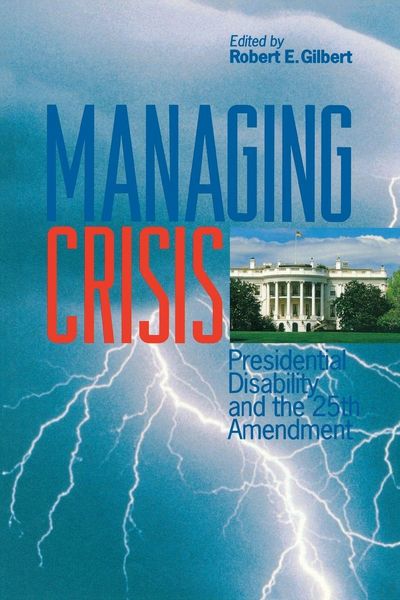
Managing Crisis Presidential Disability and the Twenty-Fifth Amendment
-
- Hardcover ausgewählt
- Taschenbuch
-
Sprache:Englisch
113,99 €
inkl. gesetzl. MwSt.,
Beschreibung
Produktdetails
Einband
Gebundene Ausgabe
Erscheinungsdatum
17.10.2017
Verlag
Fordham University PressSeitenzahl
302
Maße (L/B/H)
24/16,1/2,1 cm
Gewicht
619 g
Sprache
Englisch
ISBN
978-0-8232-2086-1
In Managing Crisis: Presidential Disability and the Twenty-Fifth Amendment, the contributors explore not only the historical beginnings and the subsequent development of the Twenty-Fifth Amendment, but also its contributions to the health of the nation.
The Watergate scandal of 1973-1974 solidified the Amendment's strength when it was invoked after the resignation of Vice President Spiro Agnew, and again after Richard Nixon's resignation. President Reagan's failure to use the Amendment in 1981 after being shot and seriously wounded disappointed those who championed its provisiouns but the strong backlash he received actually strengthened the Amendment and convinced subsequent Administrations to develop plans for its use. The President who takes office in 2001 is likely to devise similar plans.
The Amendment is positioned to be a crucial tool if, as seems inevitable, the country again confronts a case of presidential inability, whether the inability entails illness or even kidnapping. It respects the presidency by making it difficult to oust a Chief Executive from exercising his powers and duties, giving a decisive role to those likely to protect the president and embodying checks and balances at every point in the processs.It avoids a definition of the term "inability" so as to provide decision-makers with flexibility and escapes the legalisms that such a definition could cause in a time of political turmoil. Both a legal and a political document, the Amendment deals with its subjects practically and in a manner consistent with the principle of separation of powers. It is likely to ensure stability and continuity in the event of a national crisis.
The contributors to this essential volume are: Birch Bayh, three-term United States Senator from Indiana, who authored and sponsored both the Twenty-Fifth and Twenty-Sixth Amendments; John D. Feerick, Dean of the Fordham University School of Law and author of The Twenty-Fifth Amendment; Robert E. Gilbert, Professor of Political Science at Northeastern University, and author of The Mortal Presidency, which was designated a 1998 outstanding book by Choice; Jeol K. Goldstein, Professor of Law at St. Louis University School of Law and author of The Modern Vice-Presidency and Understanding Constitutional Law; Robert J. Joynt, Distinguished University Professor of Neurology, Neurobiology, and Anatomy at the University of Rochester; E. Connie Mariano; M.D., Personal Physician to President Clinton and Director of the White House Medical Unit; Lawrence C. Mhr, M.D., White House physician from 1987 to 1993, serving Presidents Reagan, Bush, and Clinton, and currently professor of Medicine and Director of the Environmental Biosciences Program at the Medical University of South Carolina; Jerrold M. Post, M.D., Professor of Psychiatry and Director of the Political Psychology Program at the George Washington University; Robert S. Robbins, Professor of Political Science at Tulane University and co-author of When Illness Strikes the Leader; Kenneth W. Thompson, Director of the Miller Center at the University of Virginia frm 1978 to 1998; James F. Toole, M.D., Teagle Professor of Neurology and Professor of Public Health Sciences at the Bowman Gray School of Medicine at Wake Forest University; Tom Wicker, former Washington Bureau Chief for the New York Times, and James M. Young M.D., White House Physician serving Presidents Kennedy and Johnson, from 1963 to 1966.
Noch keine Bewertungen vorhanden
Verfassen Sie die erste Bewertung zu diesem Artikel
Helfen Sie anderen Kundinnen und Kunden durch Ihre Meinung.
Kurze Frage zu unserer Seite
Vielen Dank für Ihr Feedback
Wir nutzen Ihr Feedback, um unsere Produktseiten zu verbessern. Bitte haben Sie Verständnis, dass wir Ihnen keine Rückmeldung geben können. Falls Sie Kontakt mit uns aufnehmen möchten, können Sie sich aber gerne an unseren Kund*innenservice wenden.
zum Kundenservice