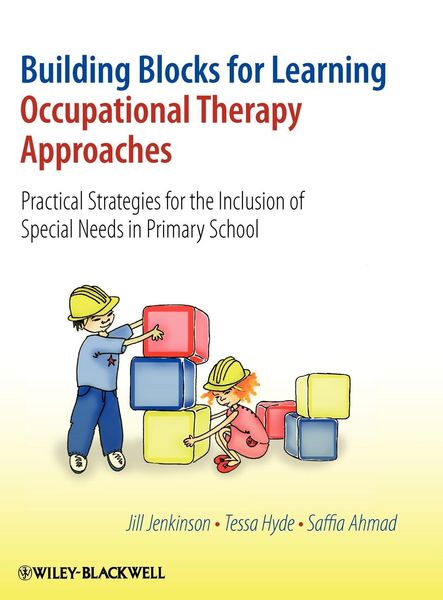
Produktbild: Building Blocks for Learning

Building Blocks for Learning Occupational Therapy Approaches: Practical Strategies for the Inclusion of Special Needs in Primary School

94,99 €

inkl. gesetzl. MwSt., Versandkostenfrei


Beschreibung

Produktdetails

Einband

Gebundene Ausgabe

Erscheinungsdatum

13.10.2008

Verlag

Wiley

Seitenzahl

450

Maße (L/B/H)

28,6/22,1/2,9 cm

Gewicht

1386 g

Sprache

Englisch

ISBN

978-0-470-05857-2

Beschreibung

Produktdetails

Einband

Gebundene Ausgabe

Erscheinungsdatum

13.10.2008

Verlag

Wiley

Seitenzahl

450

Maße (L/B/H)

28,6/22,1/2,9 cm

Gewicht

1386 g

Sprache

Englisch

ISBN

978-0-470-05857-2

Herstelleradresse

Libri GmbH
Europaallee 1
36244 Bad Hersfeld
DE

Email: gpsr@libri.de

Noch keine Bewertungen vorhanden

Verfassen Sie die erste Bewertung zu diesem Artikel

Helfen Sie anderen Kundinnen und Kunden durch Ihre Meinung.

Kundinnen und Kunden meinen

Bewertungen (0)

  • Produktbild: Building Blocks for Learning
  • Foreword ix

    Acknowledgements xi

    Introduction xiii

    Online resources xvii

    Foundation Skills 1

    Introduction to foundation skills 1

    FS 1 Introduction to sensory processing 5

    FS 1A Vestibular processing (movement and balance sense) 11

    FS 1B Tactile sense and tactile processing 15

    FS 1C Proprioceptive processing/sense 19

    FS 1D Auditory processing 23

    FS 1E Visual processing 27

    FS 2 Introduction to gross motor coordination 31

    FS 2A Motor planning 35

    FS 2B Postural stability and balance 39

    FS 2C Spatial and body awareness 43

    FS 2D Bilateral integration 47

    FS 2E Midline crossing and laterality 51

    FS 3 Introduction to fine motor control 55

    FS 3A Visual motor integration 59

    FS 3B Vision and ocular motor control 63

    FS 3C Manual dexterity 69

    FS 4 Introduction to perception 73

    FS 4A Visual discrimination 77

    FS 4B Visual spatial relationships 81

    FS 4C Visual form constancy 85

    FS 4D Visual figure ground discrimination 89

    FS 4E Visual closure 93

    FS 4F Visual memory 97

    FS 5 Introduction to language 101

    FS 5A Attention and listening 103

    FS 5B Receptive language 105

    FS 5C Expressive language 107

    FS 5D Auditory memory 109

    FS 6 Organisation 111

    FS 7 Social and emotional aspects 113

    Subject Areas 119

    Introduction to subject areas 119

    SA 1 General behaviour 122

    SA 2 Literacy 126

    SA 3 Numeracy 130

    SA 4 Science 134

    SA 5 Art and Design 138

    SA 6 Information Communication Technology 144

    SA 7 Physical Education 146

    Subject areas teacher observation summary chart 150

    Personalised profile for child 151

    Medical Conditions 153

    Introduction to medical conditions 153

    MC 1 Attention deficit disorder/attention deficit hyperactivity disorder 155

    MC 2 Autistic spectrum disorders, including Asperger's syndrome 175

    MC 3 Cerebral palsy 197

    MC 4 Developmental coordination disorder including dyspraxia 221

    MC 5 Physical disabilities 243

    Occupational Therapy Approaches 247

    Introduction to occupational therapy approaches 247

    OTA 1 Building firm foundations for spatial and body awareness 249

    OTA 2 Building firm foundations for left/right awareness 253

    General activities 253

    Activities to help with left/right discrimination on oneself 254

    Activities to help with left/right orientation on others 255

    Activities to help with left/right discrimination of objects 255

    Activities to help with left/right orientation and tracking when writing 256

    OTA 3 Building firm foundations for fine motor control 259

    Warm up for the upper limb 259

    Handwriting warm up 261

    Hand gym 263

    Ideas for using therapeutic putty 265

    Pencil aerobics 267

    Doodle games 268

    Hand/finger relaxation strategies 269

    OTA 4 Building firm foundations for handwriting 271

    Handwriting 271

    Development of pencil grasp 273

    Efficient and inefficient grasps 274

    Improving pencil grasp 276

    Three easy stages for teaching pencil grip 277

    Equipment to help develop pencil grasp and fluency 278

    Commercially available equipment 279

    Hand development for handwriting 280

    Ergonomics 281

    Table surface 282

    Texture of writing paper or surface 283

    Paper position 284

    Position in class 284

    Development of pencil skills 285

    Pre-writing skills, based around using your senses 286

    Multi-sensory handwriting approach 288

    Establishing correct pressure 292

    Consolidation for efficient handwriting 293

    Rules for writing tasks 294

    Activities to encourage self-evaluation of handwriting 296

    Copying from the board 297

    Specific advice for left-handed children 298

    OTA 5 Building firm foundations for alternative methods of recording 305

    Complexity of handwriting 305

    Low-tech alternatives 306

    Interactive whiteboards 306

    Digital cameras 307

    Word processing as an alternative 308

    ICT resources 310

    Suggested equipment 310

    Software 310

    Adaptations/strategies to try 311

    Further resources 312

    OTA 6 Building firm foundations for dressing skills 315

    OTA 7 Building firm foundations for scissor development 319

    The 14 steps in scissor skill development 319

    Activities to develop pre-scissor skills 320

    Activities to help with scissor skills 320

    Equipment to help with scissor control 321

    OTA 8 Sensory strategies 323

    OTA 9 Self-organisation approaches 327

    OTA 10 Consolidating foundation skills through group activities 333

    Establishing groups 334

    Non-themed activity groups 336

    Themed activity groups 336

    OTA 10A Gross motor activities for pirate groups 340

    OTA 10B Fine motor activities for pirate groups 344

    OTA 11 Consolidating foundation skills for transition from primary to secondary school 349

    Appendices 359

    A 1 Ages and stages of development 361

    A 2 Alphabet ABC sentences 369

    A 3 Fine motor circuit score sheet 371

    A 4 Handwriting self-evaluation checklist 373

    A 5 Handwriting programmes and fine motor resources 375

    A 6 Information communication technology checklist 379

    A 7 Movement programmes and gross motor resources 381

    A 8 Individual child profile 387

    A 9 Resources for developing social, emotional and behavioural skills 389

    A 10 Teachers' checklist for visual signs 395

    A 11 Thinking skills 397

    A 12 Twelve rules of legibility 401

    A 13 Visual perception resources 403

    A 14 Work system 405

    Equipment Resources 407

    Suppliers' Addresses 413

    Useful Addresses 417

    Further Reading 421

    Glossary 423

    Index 427