KI-Beratung Beta

Gutscheinbedingungen

**Gültig bis 18.11.2026 auf englischsprachige Klassiker (klassiker-32728) online auf thalia.at und in der Thalia App. Einzelne Artikel können ausgeschlossen sein. Ausgenommen sind preisgebundene Artikel & eBooks. Pro Einkauf einmal einlösbar. Click & Collect nur bei Onlinevorabzahlung möglich. Keine Barauszahlung. Nicht kombinierbar mit anderen Aktionen und Gutscheinen. Gutschein wird auf max. 500€ Bestellwert angerechnet. Nicht gültig für Geschenkkarten, Versandkosten und Services.

Produktbild: Organic Synthesis

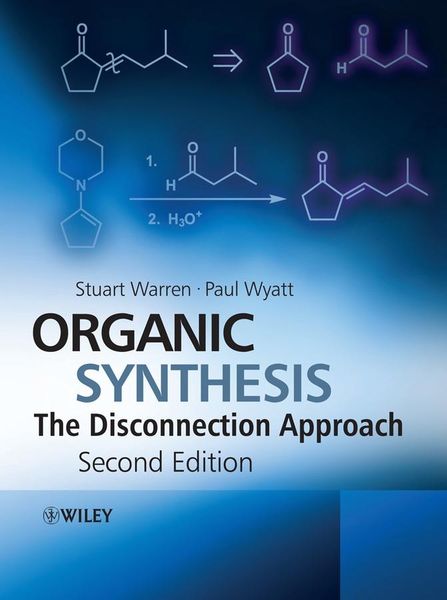
Organic Synthesis The Disconnection Approach

1

144,99 €

inkl. gesetzl. MwSt., Versandkostenfrei


Beschreibung

One approach to organic synthesis is retrosynthetic analysis. With this approach a chemist will start with the structure of their target molecule and progressively cut bonds to create simpler molecules. Reversing this process gives a synthetic route to the target molecule from simpler starting materials....

Beschreibung

One approach to organic synthesis is retrosynthetic analysis. With this approach a chemist will start with the structure of their target molecule and progressively cut bonds to create simpler molecules. Reversing this process gives a synthetic route to the target molecule from simpler starting materials. This "disconnection" approach to synthesis is now a fundamental part of every organic synthesis course.

Organic Synthesis: The Disconnection Approach, 2nd Edition introduces this important technique, to help students to design their own organic syntheses. There are forty chapters: those on the synthesis of given types of molecules alternate with strategy chapters in which the methods just learnt are placed in a wider context. The synthesis chapters cover many ways of making each type of molecule starting with simple aromatic and aliphatic compounds with one functional group and progressing to molecules with many functional groups. The strategy chapters cover questions of selectivity, protection, stereochemistry, and develop more advanced thinking via reagents specifically designed for difficult problems.

Examples are drawn from pharmaceuticals, agrochemicals, natural products, pheromones, perfumery and flavouring compounds, dyestuffs, monomers, and intermediates used in more advanced synthetic work. Reasons for wishing to synthesise each compound are given.

This second edition has been fully revised and updated with a modern look. Recent examples and techniques are included and illustrated additional material has been added to take the student to the level required by the sequel, "Organic Synthesis: Strategy and Control".

Several chapters contain extensive new material based on courses that the authors give to chemists in the pharmaceutical industry.

Organic Synthesis: The Disconnection Approach, 2nd edition provides a full course in retrosynthetic analysis for chemistry and biochemistry students and a refresher for organic chemists working in industry and academia.

Produktdetails

Einband

Gebundene Ausgabe

Erscheinungsdatum

09.01.2009

Verlag John Wiley & Sons
Seitenzahl

352

Produktdetails

Einband

Gebundene Ausgabe

Erscheinungsdatum

09.01.2009

Verlag John Wiley & Sons
Seitenzahl

352

Maße (L/B/H)

25,4/19,5/2,9 cm

Gewicht

897 g

Auflage

2nd edition

Sprache

Englisch

ISBN

978-0-470-71237-5

Herstelleradresse

Libri GmbH
Europaallee 1
36244 Bad Hersfeld
DE

Email: gpsr@libri.de

Kundinnen und Kunden meinen

Informationen zu Bewertungen

Zur Abgabe einer Bewertung ist eine Anmeldung im Konto notwendig. Die Authentizität der Bewertungen wird von uns nicht überprüft. Wir behalten uns vor, Bewertungstexte, die unseren Richtlinien widersprechen, entsprechend zu kürzen oder zu löschen.

Die Bewertungen sind nach Format, Anzahl Sterne und Datum sortiert.

  • Bewertung

    5/5

    01.09.2011

    Buch (Taschenbuch)

    Eine sehr gute Einführung

    Stuart Warren und Paul Wyatt ist mit diesem Buch eine erfreulich gute Einführung in die Retrosynthese gelungen. Das Konzept, relativ einfache Moleküle strategisch geschickt zu zerlegen, geht auf. Der Leser erkennt schnell, daß mit etwas Übung auch das "vom Ziel zum Start" denken machbar ist. Eventuell aufkommende Fragen werden interessanterweise bereits einige Zeilen später geklärt. Die gut gezeichneten Strukturen wahren die Übersichtlichkeit, allerdings ist der Literaturanhang wohl (als kleiner Wermutstropfen) aus dem gleichen Grund etwas klein geraten. Alles in allem aber ist dieses Buch sehr empfehlens- und lesenswert.

Kundinnen und Kunden meinen

5

1

4

0

3

0

2

0

1

0

Bewertungen (1)

Die Leseprobe wird geladen.
  • Produktbild: Organic Synthesis
  • Preface ix

    General References xi

    1. The Disconnection Approach 1

    2. Basic Principles: Synthons and Reagents Synthesis of Aromatic Compounds 7

    3. Strategy I: The Order of Events 17

    4. One-Group C-X Disconnections 23

    5. Strategy II: Chemoselectivity 29

    6. Two-Group C-X Disconnections 35

    7. Strategy III: Reversal of Polarity, Cyclisations, Summary of Strategy 45

    8. Amine Synthesis 53

    9. Strategy IV: Protecting Groups 61

    10. One Group C-C Disconnections I: Alcohols 69

    11. General Strategy A: Choosing a Disconnection 77

    12. Strategy V: Stereoselectivity A 83

    13. One Group C-C Disconnections II: Carbonyl Compounds 93

    14. Strategy VI: Regioselectivity 101

    15. Alkene Synthesis 107

    16. Strategy VII: Use of Acetylenes (Alkynes) 115

    17. Two-Group C-C Disconnections I: Diels-Alder Reactions 121

    18. Strategy VIII: Introduction to Carbonyl Condensations 129

    19. Two-Group C-C Disconnections II: 1,3-Difunctionalised Compounds 133

    20. Strategy IX: Control in Carbonyl Condensations 139

    21. Two-Group C-C Disconnections III: 1,5-Difunctionalised Compounds Conjugate (Michael) Addition and Robinson Annelation 151

    22. Strategy X: Aliphatic Nitro Compounds in Synthesis 161

    23. Two-Group Disconnections IV: 1,2-Difunctionalised Compounds 167

    24. Strategy XI: Radical Reactions in Synthesis 177

    25. Two-Group Disconnections V: 1,4-Difunctionalised Compounds 185

    26. Strategy XII: Reconnection 193

    27. Two-Group C-C Disconnections VI: 1,6-diCarbonyl Compounds 199

    28. General Strategy B: Strategy of Carbonyl Disconnections 207

    29. Strategy XIII: Introduction to Ring Synthesis: Saturated Heterocycles 217

    30. Three-Membered Rings 229

    31. Strategy XIV: Rearrangements in Synthesis 237

    32. Four-Membered Rings: Photochemistry in Synthesis 245

    33. Strategy XV: The Use of Ketenes in Synthesis 251

    34. Five-Membered Rings 255

    35. Strategy XVI: Pericyclic Reactions in Synthesis: Special Methods for Five-Membered Rings 261

    36. Six-Membered Rings 269

    37. General Strategy C: Strategy of Ring Synthesis 279

    38. Strategy XVII: Stereoselectivity B 289

    39. Aromatic Heterocycles 301

    40. General Strategy D: Advanced Strategy 313

    Index 325