Gutscheinbedingungen

**Gültig bis 06.07.2026 auf fremdsprachige Bücher online auf thalia.at, in der Thalia App ab einem Mindestbestellwert von 30€ und in allen Thalia Buchhandlungen in Österreich. In den Buchhandlungen nur gültig auf lagernde Ware. Einzelne Artikel können ausgeschlossen sein. Ausgenommen sind preisgebundene Artikel & eBooks. Pro Einkauf einmal einlösbar. Nur gültig gegen Vorlage oder im Onlineshop hinterlegter Bonuscard. Infos zur Einlösung in der Buchhandlung sind auf der Bonuscard-Vorteilspreisseite zu finden. Click & Collect nur bei Onlinevorabzahlung möglich. Keine Einlösung bei Scan & Go-Bezahlung. Keine Barauszahlung. Nicht kombinierbar mit anderen Aktionen und Gutscheinen. Gutschein wird auf max. 500€ Bestellwert angerechnet. Nicht gültig für Versandkosten und Services.

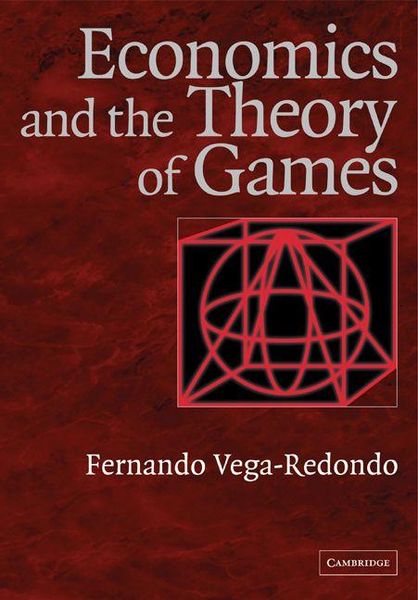
  • Produktbild: Economics and the Theory of Games
  • Produktbild: Economics and the Theory of Games

Economics and the Theory of Games

105,99 €

inkl. gesetzl. MwSt., Versandkostenfrei


Beschreibung

Produktdetails

Einband

Taschenbuch

Erscheinungsdatum

30.01.2010

Verlag

Cambridge University Press Academic

Seitenzahl

528

Maße (L/B/H)

24,4/17/2,8 cm

Gewicht

830 g

Sprache

Englisch

ISBN

978-0-521-77590-8

Beschreibung

Produktdetails

Einband

Taschenbuch

Erscheinungsdatum

30.01.2010

Verlag

Cambridge University Press Academic

Seitenzahl

528

Maße (L/B/H)

24,4/17/2,8 cm

Gewicht

830 g

Sprache

Englisch

ISBN

978-0-521-77590-8

Herstelleradresse

Libri GmbH
Europaallee 1
36244 Bad Hersfeld
DE

Email: gpsr@libri.de

Noch keine Bewertungen vorhanden

Verfassen Sie die erste Bewertung zu diesem Artikel

Helfen Sie anderen Kundinnen und Kunden durch Ihre Meinung.

Kundinnen und Kunden meinen

Bewertungen (0)

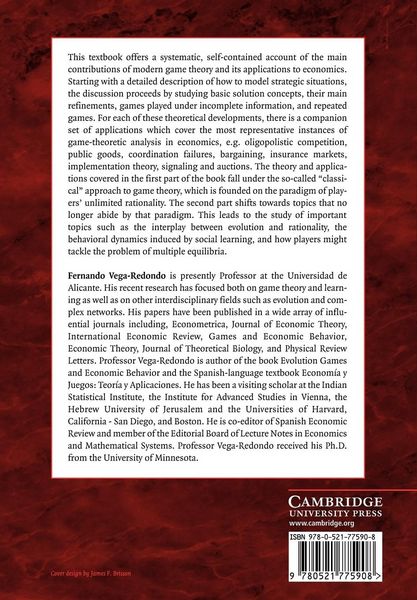
  • Produktbild: Economics and the Theory of Games
  • Produktbild: Economics and the Theory of Games
  • Part I. Theoretical Framework: 1. Introduction and examples; 2. The representation of a game in extensive form; 3. The representation of a game in strategic form; 4. The mixed extension of a game; 5. Mixed and behavioral strategies; 6. Representation in coalition form; Summary; Exercises; Part II. Strategic-Form Analysis: Theory: 7. Dominance and iterative dominance; 8. Nash equilibrium; 9. Zero-sum bilateral games; 10. Nash equilibrium: formal existence results; 11. Strong and coalition-proof equilibrium; 12. Correlated equilibrium; 13. Rationalizability; Summary; Exercises; Part III. Strategic-Form Analysis: Applications: 14. Oligopoly (I): static models; 15. Mechanism design (I): efficient allocation of public goods; 16. Mechanism design (II): Nash implementation; 17. Markets (I): macroeconomic coordination failures; Summary; Exercises; Part IV. Refinements of Nash Equilibrium: Theory: 18. Introduction; 19. Refinements excluding 'incredible threats': examples; 20. Subgame-perfect equilibrium; 21. Weak-perfect Bayesian equilibrium; 22. Refinements excluding 'untenable beliefs': examples; 23. Sequential equilibrium; 24. Perfect and proper equilibria; 25. Strategic-form refinements; Summary; Exercises; Part V. Refinements of Nash Equilibrium: Applications: 26. Oligopoly (II): sequential moves; 27. Markets (II): decentralized price formation; 28. Oligopoly (III): differentiated products; 29. Mechanism design (III): efficient allocation of an indivisible object; Summary, Exercises; Part VI. Incomplete Information: Theory: 30. Introduction and examples; 31. Bayesian games; 32. Bayes-Nash equilibrium; 33. Signalling games; 34. Mixed strategies revisited: a purification approach; 35. Forward induction; Summary; Exercises; Part VII. Incomplete Information: Applications: 36. Markets (III): signalling in the labor market; 37. Markets (IV): insurance markets and adverse selection; 38. Mechanism design (IV): one-sided auctions; 39. Mechanism design (V): buyer-seller trade; Summary; Exercises; Part VIII. Repeated Interaction: Theory: 40. Introduction and examples; 41. Repeated games: basic theoretical framework; 42. Folk theorems: Nash equilibrium; 43. Reputation and 'irrationality': informal discussion; 44. Folk theorems: subgame=perfect equilibrium; 45. Reputation and 'irrationality': formal analysis; Summary; Exercises; Part IX. Repeated Interaction: Applications: 46. Oligopoly (IV): intertemporal collusion in a Cournot scenario; 47. Oligopoly (V): intertemporal collusion in a Bertrand scenario; 48. Markets (V): efficiency, wages and unemployment; Summary; Exercises; Part X. Evolutionary Foundations of Equilibrium: 49. Introduction; 50. Static analysis; 51. Basic dynamic analysis; 52. Evolution in social environments; 53. The evolution of cooperation: an example; Summary; Exercises; Part XI. Learning to Play: 54. Introduction; 55. Reinforcement learning; 56. Static perceptions and Nash equilibrium; 57. Memory, expectations and foresight; Summary; Exercises; Part XII. Social Learning and Equilibrium Selection: 58. Introduction; 59. Evolutionary games: theoretical framework; 60. Evolutionary games: alternative scenarios; 61. Stochastic stability and equilibrium selection; 62. Experimental evidence; 63. Perturbed Markov processes: basic concepts and techniques; 64. Reinforcement learning with flexible aspirations; Summary; Exercises.