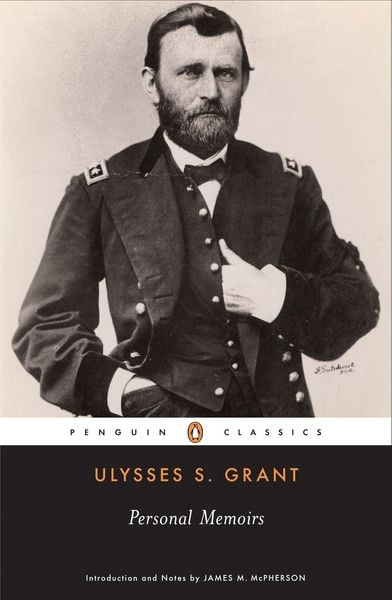
Produktbild: Personal Memoirs of Ulysses S.Grant

Personal Memoirs of Ulysses S.Grant

Aus der Reihe Penguin Classics

16,99 €

inkl. gesetzl. MwSt., zzgl. Versandkosten


  • Kostenlose Lieferung ab 30 € Einkaufswert
  • Versandkostenfrei für Bonuscard-Kund*innen

Beschreibung

Produktdetails

Einband

Taschenbuch

Erscheinungsdatum

24.06.1999

Verlag

Penguin Books UK

Seitenzahl

704

Maße (L/B/H)

19,9/13/3,4 cm

Gewicht

463 g

Farbe

Anthrazit / Lichtgrau

Sprache

Englisch

ISBN

978-0-14-043701-0

Beschreibung

Rezension

"The best [memoirs] of any general's since Caesar."   Mark Twain

"A unique expression of the national character . . . [Grant] has conveyed the suspense which was felt by himself and his army and by all who believed in the Union cause. The reader finds himself . . . on edge to know how the Civil War is coming out."   Edmund Wilson

  Perhaps the most revelatory autobiography of high command to exist in any language. . . . If there is a single contemporary document which explains why the North won the Civil war, that abiding conundrum of American historical inquiry, it is the Personal Memoirs of U. S. Grant. John Keegan

Well observed, often humorous, invariably charming, penetrating and lucid . . . On every page, his narrative has the simple directness of the finest English prose, inspired by the King James Bible on which he had been raised. The overall effect is both intimate and majestic. The Guardian

Produktdetails

Einband

Taschenbuch

Erscheinungsdatum

24.06.1999

Verlag

Penguin Books UK

Seitenzahl

704

Maße (L/B/H)

19,9/13/3,4 cm

Gewicht

463 g

Farbe

Anthrazit / Lichtgrau

Sprache

Englisch

ISBN

978-0-14-043701-0

Herstelleradresse

Libri GmbH
Europaallee 1
36244 Bad Hersfeld
DE

Email: gpsr@libri.de

Noch keine Bewertungen vorhanden

Verfassen Sie die erste Bewertung zu diesem Artikel

Helfen Sie anderen Kundinnen und Kunden durch Ihre Meinung.

Kundinnen und Kunden meinen

Bewertungen (0)

Weitere Artikel finden Sie in

Die Leseprobe wird geladen.
  • Produktbild: Personal Memoirs of Ulysses S.Grant
  • Introduction by James M. McPherson
    Suggestions for Further Reading
    Maps and Illustrations
    Preface
    1. Ancestry—Birth—Boyhood
    2. West Point—Graduation
    3. Army Life—Causes of the Mexican War—Camp Salubrity
    4. Corpus Christi—Mexican Smuggling—Spanish Rule in Mexico—Supplying Transportation
    5. Trip to Austin—Promotion to Full Second Lieutenant—Army of Occupation
    6. Advance of the Army—Crossing the Colorado—The Rio Grande
    7. The Mexican War—The Battle of Palo Alto—The Battle of Resaca de la Palma—Army of Invasion—General Taylor—Movement on Camargo
    8. Advance on Monterey—The Black Fort—The Battle of Monterey—Surrender of the City
    9. Political Intrigue—Buena Vista—Movement against Vera Cruz—Siege and Capture of Vera Cruz
    10. March to Jalapa—Battle of Cerro Gordo—Perote—Puebla—Scott and Taylor
    11. Advance on the City of Mexico—Battle of Contreras—Assault at Churubusco—Negotiations for Peace—Battle of Molino del Rey—Storming of Chapultepec—San Cosme—Evacuation of the City—Halls of the Montezumas
    12. Promotion to First Lieutenant—Capture of the City of Mexico—The Army—Mexican Soldiers—Peace Negotiations
    13. Treaty of Peace—Mexican Bull Fights—Regimental Quartermaster—Trip to Popcatapetl—Trip to the Caves of Mexico
    14. Return of the Army—Marriage—Ordered to the Pacific Coast—Crossing the Isthmus—Arrival at San Francisco
    15. San Francisco—Early California Experiences—Life on the Pacific Coast—Promoted Captain—Flush Times in California
    16. Resignation—Private Life—Life at Galena—The Coming Crisis
    17. Outbreak of the Rebellion—Presiding at a Union Meeting—Mustering Officer of State Troops—Lyon at Camp Jackson—Services Tendered to the Government
    18. Appointed Colonel of the 21st Illinois—Personnel of the Regiment—General Logan—March to Missouri—Movement against Harris at Florida, MO—General Pope in Command—Stationed at Mexico, MO
    19. Commissioned Brigadier-General—Command at Ironton, MO—Jefferson City—Cape Girardeau—General Prentiss—Seizure of Paducah—Headquarters at Cairo
    20. General Fremont in Command—Movement against Belmont—Battle of Belmont—A Narrow Escape—After the Battle
    21. General Halleck in Command—Commanding the District of Cairo—Movement on Fort Henry—Capture of Fort Henry
    22. Investment of Fort Donelson—The Naval Operations—Attack of the Enemy—Assaulting the Works—Surrender of the Fort
    23. Promoted Major-General of Volunteers—Unoccupied Territory—Advance upon Nashville—Situation of the Troops—Confederate Retreat—Relieved of the Command—Restored to the Command—General Smith
    24. The Army at Pittsburg Landing—Injured by a Fall—The Confederate Attack at Shiloh—The First Day's Fight at Shiloh—General Sherman—Condition of the Army—Close of the First Day's Fight—The Second Day's Fight—Retreat and Defeat of the Confederates
    25. Struck by a Bullet—Precipitate Retreat of the Confederates—Intrenchments at Shiloh—General Buell—General Johnston—Remarks on Shiloh
    26. Halleck Assumes Command in the Field—The Advance upon Corinth—Occupation of Corinth—The Army Separated
    27. Headquarters Moved to Memphis—On the Road to Memphis—Escaping Jackson—Complaints and Requests—Halleck Appointed Commander-in-Chief—Return to Corinth—Movements of Bragg—Surrender of Clarksville—The Advance Upon Chattanooga—Sheridan Colonel of a Michigan Regiment
    28. Advance of Van Dorn and Price—Price Enters Iuka—Battle of Iuka
    30. The Campaign against Vicksburg—Employing the Freedmen—Occupation of Holly Springs—Sherman Ordered to Memphis—Sherman's Movements down the Mississippi—Van Dorn Captures Holly Springs—Collecting Forage and Food
    31. Headquarters Moved to Holly Springs—General McClernand in Command—Assuming Command at Young's Point—Operations above Vicksburg—Fortifications about Vicksburg—The Canal—Lake Providence—Operations at Yazoo Pass
    32. The Bayous West of the Mississippi—Criticisms of the Northern Press—Running the Batteries—Loss of the Indianola—Disposition of the Troops
    33. Attack on Grand Gulf—Operations below Vicksburg
    34. Capture of Port Gibson—Grierson's Raid—Occupation of Grand Gulf—Movement up the Big Black—Battle of Raymond
    35. Movement against Jackson—Fall of Jackson—Intercepting the Enemy—Battle of Champion's Hill
    36. Battle of Black River Bridge—Crossing the Big Black—Investment of Vicksburg—Assaulting the Works
    37. Siege of Vicksburg
    38. Johnston's Movements—Fortifications at Haines' Bluff—Explosion of the Mine—Explosion of the Second Mine—Preparing for the Assault—The Flag of Truce—Meeting with Pemberton—Negotiations for Surrender—Accepting the Terms—Surrender of Vicksburg
    39. Retrospect of the Campaign—Sherman's Movements—Proposed Movement upon Mobile—A Painful Accident—Ordered to Report at Cairo
    40. First Meeting with Secretary Stanton—General Rosecrans—Commanding Military Division of Mississippi—Andrew Johnson's Address—Arrival at Chattanooga
    41. Assuming the Command at Chattanooga—Opening a Line of Supplies—Battle of Wauhatchie—On the Picket Line
    42. Condition of the Army—Rebuilding the Railroad—General Burnside's Situation—Orders for Battle—Plans for the Attack—Hooker's Position—Sherman's Movements
    43. Preparations for Battle—Thomas Carries the First Line of the Enemy—Sherman Carries Missionary Ridge—Battle of Lookout Mountain—General Hooker's Fight
    44. Battle of Chattanooga—A Gallant Charge—Complete Rout of the Enemy—Pursuit of the Confederates—General Bragg—Remarks on Chattanooga
    45. The Relief of Knoxville—Headquarters Moved to Nashville—Visiting Knoxville—Cipher Dispatches—Withholding Orders
    46. Operations in Mississippi—Longstreet in East Tennessee—Commissioned Lieutenant-General—Commanding the Armies of the United States—First Interview with President Lincoln
    47. The Military Situation—Plans for the Campaign—Sheridan Assigned to Command of the Cavalry—Flank Movements—Forrest at Fort Pillow—General Banks's Expedition—Colonel Mosby—An Incident of the Wilderness Campaign
    48. Commencement of the Grand Campaign—General Butler's Position—Sheridan's First Raid
    49. Sherman's Campaign in Georgia—Siege of Atlanta—Death of General McPherson—Attempt to Capture Andersonville—Capture of Atlanta
    50. Grand Movement of the Army of the Potomac—Crossing the Rapidan—Entering the Wilderness—Battle of the Wilderness
    51. After the Battle—Telegraph and Signal Service—Movement by the Left Flank
    52. Battle of Spottsylvania—Hancock's Position—Assault of Warren's and Wright's Crops—Upton Promoted on the Field—Good News from Butler and Sheridan
    53. Hancock's Assault—Losses of the Confederates—Promotions Recommended—Discomfiture of the Enemy—Ewell's Attack—Reducing the Artillery
    54. Movement by the Left Flank—Battle of North Anna—An Incident of the March—Moving on Richmond—South of the Pamunkey—Position of the National Army
    55. Advance on Cold Harbor—An Anecdote of the War—Battle of Cold Harbor—Correspondence with Lee—Retrospective
    56. Left Flank Movement across the Chickahominy and James—General Lee—Visit to Butler—The Movement on Petersburg—The Investment of Petersburg
    57. Raid on the Virginia Central Railroad—Raid on the Weldon Railroad—Early's Movement upon Washington—Mining the Works before Petersburg—Explosion of the Mine before Petersburg—Campaign in the Shenandoah Valley—Capture of the Weldon Railroad
    58. Sheridan's Advance—Visit to Sheridan—Sheridan's Victory in the Shenandoah—Sheridan's Ride to Winchester—Close of the Campaign for the Winter
    59. The Campaign in Georgia—Sherman's March to the Sea—War Anecdotes—The March on Savannah—Investment of Savannah—Capture of Savannah
    60. The Battle of Franklin—The Battle of Nashville
    61. Expedition against Fort Fisher—Attack on the Fort—Failure of the Expedition—Second Expedition against the Fort—Capture of Fort Fisher
    62. Sherman's March North—Sheridan Ordered to Lynchburg—Canby Ordered to Move against Mobile—Movements of Schofield and Thomas—Capture of Columbia, South Carolina—Sherman in the Carolinas
    63. Arrival of the Peace Commissioners—Lincoln and the Peace Commissioners—An Anecdote of Lincoln—The Winter before Petersburg—Sheridan Destroys the Railroad—Gordon Carries the Picket Line—Parke Recaptures the Line—The Battle of White Oak Road
    64. Interview with Sheridan—Grand Movement of the Army of the Potomac—Sheridan's Advance on Five Forks—Battle of Five Forks—Parke and Wright Storm the Enemy's Line—Battles before Petersburg
    65. The Capture of Petersburg—Meeting President Lincoln in Petersburg—The Capture of Richmond—Pursuing the Enemy—Visit to Sheridan and Meade
    66. Battle of Sailor's Creek—Engagement at Farmville—Correspondence with General Lee—Sheridan Intercepts the Enemy
    67. Negotiations at Appomattox—Interview with Lee at McLean's House—The Terms of Surrender—Lee's Surrender—Interview with Lee after the Surrender
    68. Morale of the Two Armies—Relative Conditions of the North and South—President Lincoln Visits Richmond—Arrival at Washington—President Lincoln's Assassination—President Johnson's Policy
    69. Sherman and Johnston—Johnston's Surrender to Sherman—Capture of Mobile—Wilson's Expedition—Capture of Jefferson Davis—General Thomas's Qualities—Estimate of General Canby
    70. The End of the War—The March to Washington—One of Lincoln's Anecdotes—Grand Review at Washington—Characteristics of Lincoln and Stanton—Estimate of the Different Corps Commanders
    Conclusion
    Explanatory Notes
    Index