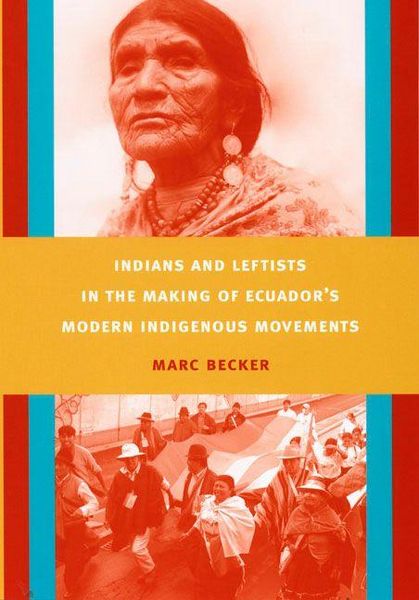
Indians and Leftists in the Making of Ecuador's Modern Indigenous Movements
-
- Hardcover
- Taschenbuch ausgewählt
- eBook
-
Sprache:Englisch
41,99 €
inkl. gesetzl. MwSt.,
Beschreibung
Produktdetails
Einband
Taschenbuch
Erscheinungsdatum
18.08.2008
Verlag
Duke University PressSeitenzahl
336
Maße (L/B/H)
22,6/15,2/2,3 cm
Gewicht
454 g
Sprache
Englisch
ISBN
978-0-8223-4279-3
In June 1990, Indigenous peoples shocked Ecuadorian elites with a powerful uprising that paralyzed the country for a week. Militants insisted that the government address Indigenous demands for land ownership, education, and economic development. This uprising was a milestone in the history of Ecuador’s social justice movements, and it inspired popular organizing efforts across Latin America. While the insurrection seemed to come out of nowhere, Marc Becker demonstrates that it emerged out of years of organizing and developing strategies to advance Indigenous rights. In this richly documented account, he chronicles a long history of Indigenous political activism in Ecuador, from the creation of the first local agricultural syndicates in the 1920s through the galvanizing protests of 1990. In so doing, he reveals the central role of women in Indigenous movements and the history of productive collaborations between rural Indigenous activists and urban leftist intellectuals.
Becker explains how rural laborers and urban activists worked together in Ecuador, merging ethnic and class-based struggles for social justice. Socialists were often the first to defend Indigenous languages, cultures, and social organizations. They introduced rural activists to new tactics, including demonstrations and strikes. Drawing on leftist influences, Indigenous peoples became adept at reacting to immediate, local forms of exploitation while at the same time addressing broader underlying structural inequities. Through an examination of strike activity in the 1930s, the establishment of a national-level Ecuadorian Federation of Indians in 1944, and agitation for agrarian reform in the 1960s, Becker shows that the history of Indigenous mobilizations in Ecuador is longer and deeper than many contemporary observers have recognized.
Noch keine Bewertungen vorhanden
Verfassen Sie die erste Bewertung zu diesem Artikel
Helfen Sie anderen Kundinnen und Kunden durch Ihre Meinung.
Kurze Frage zu unserer Seite
Vielen Dank für Ihr Feedback
Wir nutzen Ihr Feedback, um unsere Produktseiten zu verbessern. Bitte haben Sie Verständnis, dass wir Ihnen keine Rückmeldung geben können. Falls Sie Kontakt mit uns aufnehmen möchten, können Sie sich aber gerne an unseren Kund*innenservice wenden.
zum Kundenservice