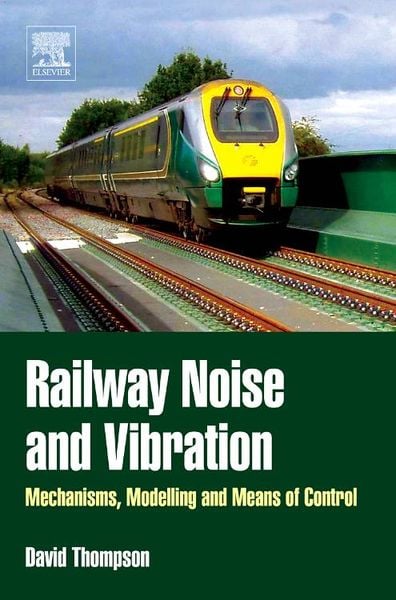
Thompson, D: Railway Noise and Vibration
-
- Hardcover ausgewählt
- Taschenbuch
- eBook
-
Sprache:Englisch
171,99 €
UVP
195,40 €
inkl. gesetzl. MwSt.,
Beschreibung
Produktdetails
Einband
Gebundene Ausgabe
Erscheinungsdatum
04.12.2008
Verlag
Elsevier ScienceSeitenzahl
536
Maße (L/B/H)
22,9/15,2/2,8 cm
Gewicht
934 g
Sprache
Englisch
ISBN
978-0-08-045147-3
Railways are an environmentally friendly means of transport well suited to modern society. However, noise and vibration are key obstacles to further development of the railway networks for high-speed intercity traffic, for freight and for suburban metros and light-rail. All too often noise problems are dealt with inefficiently due to lack of understanding of the problem.
This book brings together coverage of the theory of railway noise and vibration with practical applications of noise control technology at source to solve noise and vibration problems from railways. Each source of noise and vibration is described in a systematic way: rolling noise, curve squeal, bridge noise, aerodynamic noise, ground vibration and ground-borne noise, and vehicle interior noise.
- Theoretical modelling approaches are introduced for each source in a tutorial fashion
- Practical applications of noise control technology are presented using the theoretical models
- Extensive examples of application to noise reduction techniques are included
Railway Noise and Vibration is a hard-working reference and will be invaluable to all who have to deal with noise and vibration from railways, whether working in the industry or in consultancy or academic research.
David Thompson is Professor of Railway Noise and Vibration at the Institute of Sound and Vibration Research, University of Southampton. He has worked in the field of railway noise since 1980, with British Rail Research in Derby, UK, and TNO Institute of Applied Physics in the Netherlands before moving to Southampton in 1996. He was responsible for developing the TWINS software for predicting rolling noise.
Noch keine Bewertungen vorhanden
Verfassen Sie die erste Bewertung zu diesem Artikel
Helfen Sie anderen Kundinnen und Kunden durch Ihre Meinung.
Kurze Frage zu unserer Seite
Vielen Dank für Ihr Feedback
Wir nutzen Ihr Feedback, um unsere Produktseiten zu verbessern. Bitte haben Sie Verständnis, dass wir Ihnen keine Rückmeldung geben können. Falls Sie Kontakt mit uns aufnehmen möchten, können Sie sich aber gerne an unseren Kund*innenservice wenden.
zum Kundenservice