Gutscheinbedingungen

**Gültig bis 17.08.2026 auf Schreibwaren & Office-Artikel online auf thalia.at, in der Thalia App und in teilnehmenden Thalia Buchhandlungen in Österreich mit Schulsortiment. In den Buchhandlungen nur gültig auf lagernde Ware. Einzelne Artikel können ausgeschlossen sein. Ausgenommen sind preisgebundene Artikel. Pro Einkauf einmal einlösbar. Nur gültig gegen Vorlage oder im Onlineshop hinterlegter Bonuscard. Infos zur Einlösung in der Buchhandlung sind auf der Bonuscard-Vorteilspreisseite zu finden. Click & Collect nur bei Onlinevorabzahlung möglich. Keine Einlösung bei Scan & Go-Bezahlung. Keine Barauszahlung. Nicht kombinierbar mit anderen Aktionen und Gutscheinen. Gutschein wird auf max. 500€ Bestellwert angerechnet. Nicht gültig für Geschenkkarten, Versandkosten und Services.

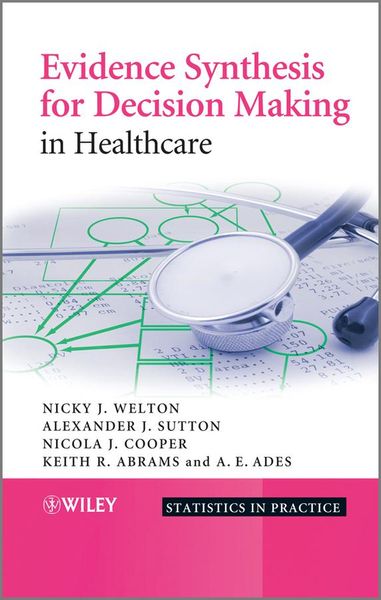
  • Produktbild: Evidence Synthesis for Decision Making in Healthcare
  • Produktbild: Evidence Synthesis for Decision Making in Healthcare

Evidence Synthesis for Decision Making in Healthcare

Aus der Reihe Statistics in Practice

101,99 €

inkl. gesetzl. MwSt., Versandkostenfrei


Beschreibung

Produktdetails

Einband

Gebundene Ausgabe

Erscheinungsdatum

05.06.2012

Verlag

John Wiley & Sons Inc

Seitenzahl

294

Maße (L/B/H)

24,5/15,9/2 cm

Gewicht

503 g

Auflage

1. Auflage

Sprache

Englisch

ISBN

978-0-470-06109-1

Beschreibung

Produktdetails

Einband

Gebundene Ausgabe

Erscheinungsdatum

05.06.2012

Verlag

John Wiley & Sons Inc

Seitenzahl

294

Maße (L/B/H)

24,5/15,9/2 cm

Gewicht

503 g

Auflage

1. Auflage

Sprache

Englisch

ISBN

978-0-470-06109-1

Herstelleradresse

Libri GmbH
Europaallee 1
36244 Bad Hersfeld
DE

Email: GPSR Kontakt

Noch keine Bewertungen vorhanden

Verfassen Sie die erste Bewertung zu diesem Artikel

Helfen Sie anderen Kundinnen und Kunden durch Ihre Meinung.

Kundinnen und Kunden meinen

Bewertungen (0)

Die Leseprobe wird geladen.
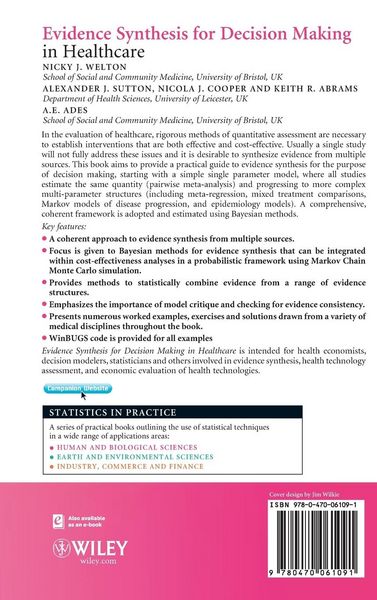
  • Produktbild: Evidence Synthesis for Decision Making in Healthcare
  • Produktbild: Evidence Synthesis for Decision Making in Healthcare
  • Preface xi
     
    1 Introduction 1
     
    1.1 The rise of health economics 1
     
    1.2 Decision making under uncertainty 4
     
    1.2.1 Deterministic models 4
     
    1.2.2 Probabilistic decision modelling 6
     
    1.3 Evidence-based medicine 9
     
    1.4 Bayesian statistics 10
     
    1.5 NICE 11
     
    1.6 Structure of the book 12
     
    1.7 Summary key points 13
     
    1.8 Further reading 13
     
    References 14
     
    2 Bayesian methods and WinBUGS 17
     
    2.1 Introduction to Bayesian methods 17
     
    2.1.1 What is a Bayesian approach? 17
     
    2.1.2 Likelihood 18
     
    2.1.3 Bayes' theorem and Bayesian updating 19
     
    2.1.4 Prior distributions 22
     
    2.1.5 Summarising the posterior distribution 23
     
    2.1.6 Prediction 24
     
    2.1.7 More realistic and complex models 24
     
    2.1.8 MCMC and Gibbs sampling 25
     
    2.2 Introduction to WinBUGS 26
     
    2.2.1 The BUGS language 26
     
    2.2.2 Graphical representation 31
     
    2.2.3 Running WinBUGS 32
     
    2.2.4 Assessing convergence in WinBUGS 33
     
    2.2.5 Statistical inference in WinBUGS 36
     
    2.2.6 Practical aspects of using WinBUGS 39
     
    2.3 Advantages and disadvantages of a Bayesian approach 39
     
    2.4 Summary key points 40
     
    2.5 Further reading 41
     
    2.6 Exercises 41
     
    References 42
     
    3 Introduction to decision models 43
     
    3.1 Introduction 43
     
    3.2 Decision tree models 44
     
    3.3 Model parameters 45
     
    3.3.1 Effects of interventions 45
     
    3.3.2 Quantities relating to the clinical epidemiology of the clinical condition being treated 50
     
    3.3.3 Utilities 52
     
    3.3.4 Resource use and costs 52
     
    3.4 Deterministic decision tree 52
     
    3.5 Stochastic decision tree 56
     
    3.5.1 Presenting the results of stochastic economic decision models 60
     
    3.6 Sources of evidence 66
     
    3.7 Principles of synthesis for decision models (motivation for the rest of the book) 70
     
    3.8 Summary key points 70
     
    3.9 Further reading 71
     
    3.10 Exercises 71
     
    References 72
     
    4 Meta-analysis using Bayesian methods 76
     
    4.1 Introduction 76
     
    4.2 Fixed Effect model 78
     
    4.3 Random Effects model 81
     
    4.3.1 The predictive distribution 83
     
    4.3.2 Prior specification for tau 84
     
    4.3.3 'Exact' Random Effects model for Odds Ratios based on a Binomial likelihood 84
     
    4.3.4 Shrunken study level estimates 86
     
    4.4 Publication bias 87
     
    4.5 Study validity 88
     
    4.6 Summary key points 88
     
    4.7 Further reading 88
     
    4.8 Exercises 89
     
    References 92
     
    5 Exploring between study heterogeneity 94
     
    5.1 Introduction 94
     
    5.2 Random effects meta-regression models 95
     
    5.2.1 Generic random effect meta-regression model 95
     
    5.2.2 Random effects meta-regression model for Odds Ratio (OR) outcomes using a Binomial likelihood 98
     
    5.2.3 Autocorrelation and centring covariates 100
     
    5.3 Limitations of meta-regression 104
     
    5.4 Baseline risk 105
     
    5.4.1 Model for including baseline risk in a meta-regression on the (log) OR scale 107
     
    5.4.2 Final comments on including baseline risk as a covariate 109
     
    5.5 Summary key points 110
     
    5.6 Further reading 110
     
    5.7 Exercises 110
     
    References 113
     
    6 Model critique and evidence consistency in random effects meta-analysis 115
     
    6.1 Introduction 115
     
    6.2 The Random Effects model revisited 117
     
    6.3 Assessing model fit 121