KI-Beratung Beta

Gutscheinbedingungen

**Gültig bis 30.11.2026 auf Spielzeug, Schreibwaren, Filme, Geschenke & Trends, Musik, tolino eReader & Zubehör, Hörbücher und Hörbuch-Downloads, nicht preisgebundene Bücher und Kalender online auf thalia.at und in der Thalia App. Einzelne Artikel können ausgeschlossen sein. Aufgrund der Buchpreisbindung sind deutschsprachige Bücher und eBooks ausgenommen. Zusätzlich ausgenommen sind Abos & Flatrates, Games, Geschenkkarten/-boxen, Shelfies, Software, Zeitschriften sowie einzelne Artikel von tonies®. Pro Einkauf einmal einlösbar. Nur gültig mit im Onlineshop hinterlegter Bonuscard. Click & Collect nur bei Onlinevorabzahlung möglich. Keine Barauszahlung. Nicht kombinierbar mit anderen Aktionen und Gutscheinen. Gutschein wird auf max. 500€ Bestellwert angerechnet. Nicht gültig für Versandkosten und Services.

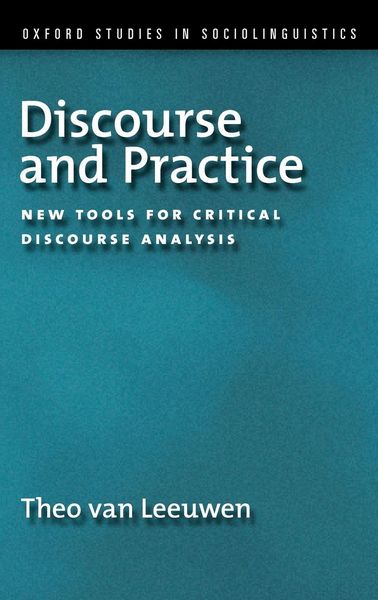
Produktbild: Discourse and Practice

Discourse and Practice New Tools for Critical Analysis

285,99 €

inkl. gesetzl. MwSt., Versandkostenfrei


Beschreibung

Adding a new introduction and two previously unpublished papers, Discourse and Practice: New Tools for Critical Discourse Analysis brings together Van Leeuwen's methodological work on discourse analysis of the last 15 years. Discourse, Van Leeuwen argues, is a resource for representation, a knowledge...

Beschreibung

Adding a new introduction and two previously unpublished papers, Discourse and Practice: New Tools for Critical Discourse Analysis brings together Van Leeuwen's methodological work on discourse analysis of the last 15 years. Discourse, Van Leeuwen argues, is a resource for representation, a knowledge about some aspect of reality which can be drawn upon when that aspect of reality has to be represented, a framework for making sense of things. And they are plural. There can be different discourses, different ways of making sense of the same aspect of reality that serve different interests and will therefore be used in different social contexts. However abstract some discourses are, discourses ultimately always represent doings, Van Leeuwen argues. Doing is the foundation of knowing, and social practices are the foundation of discourses. Studying children's books, newspaper reports, brochures and other texts, as well as photographs and children's toys, Van Leeuwen investigates what can happen when practices are transformed into discourses and provides analytical tools for reconstructing discourses from texts. Throughout the book, Van Leeuwen makes connections between sociological and linguistic or semiotic concepts and methods to ensure the social and critical relevance of his analytical categories. Van Leeuwen's work has already been widely used by critical discourse analysts across the world. This volume will be a welcome guide for anyone looking for a form of discourse analysis that is both explicit and methodical, and critically incisive.

Produktdetails

Einband

Gebundene Ausgabe

Erscheinungsdatum

01.05.2008

Verlag Oxford Academic
Seitenzahl

188

Produktdetails

Einband

Gebundene Ausgabe

Erscheinungsdatum

01.05.2008

Verlag Oxford Academic
Seitenzahl

188

Maße (L/B/H)

24/16,1/1,5 cm

Gewicht

402 g

Sprache

Englisch

ISBN

978-0-19-532330-6

Herstelleradresse

Libri GmbH
Europaallee 1
36244 Bad Hersfeld
DE

Email: gpsr@libri.de

Noch keine Bewertungen vorhanden

Verfassen Sie die erste Bewertung zu diesem Artikel

Helfen Sie anderen Kundinnen und Kunden durch Ihre Meinung.

Kundinnen und Kunden meinen

Bewertungen (0)

Die Leseprobe wird geladen.
  • Produktbild: Discourse and Practice
    • Preface;
    • Chapter 1: Discourse as the recontextualization of social practice;
    • 1. The supersedure of meaning by function;
    • 2. Discourse as the recontextualization of social practice;
    • 3. Social practices;
    • Chapter 2: Representing social actors;
    • 1. A sociosemantic inventory;
    • 2. Our Race Odyssey;
    • 3. Exclusion;
    • 4. Role Allocation;
    • 5. Genericisation and specification;
    • 6. Assimilation;
    • 7. Association and dissociation;
    • 8. Indetermination and differentiation;
    • 9. Nomination and categorization;
    • 10. Functionalisation and identification;
    • 11. Personalisation and impersonalisation;
    • 12. Overdetermination;
    • 13. Conclusion;
    • Chapter 3: Representing social action
    • 1. Introduction;
    • 2. Reactions;
    • 3. Material and semiotic action;
    • 4. Objectivation and descriptivization;
    • 5. De-agenitalization
    • 6. Generalization and abstraction;
    • 7. Overdetermination;
    • 8. Conclusion;
    • Chapter 4: Time in discourse;
    • 1. Introduction;
    • 2. The socio-semantics of location and extent;
    • 2.1. Time summons;
    • 2.2. Synchronisation;
    • 2.3. Punctuality;
    • 2.4. Exact and inexact timing;
    • 2.5. Unique and recurring timing;
    • 3. Experiencing Duration;
    • 4. Managing Time;
    • 5. Two examples;
    • Chapter 5: Space in discourse;
    • 1. Introduction;
    • 2. Locating action;
    • 3. Arranging and interpreting space;
    • 4. Description and legitimation;
    • 5. Subjective and objective space;
    • 6. Word and image;
    • Chapter 6: The discursive construction of legitimation;
    • 1. Introduction;
    • 2. Authorization;
    • 3. Moral evaluation;
    • 4. Rationalization;
    • 5. Mythopoesis;
    • 6. Multimodal legitimation;
    • 7. Legitimation and context;
    • Chapter 7: The discursive construction of purpose;
    • 1. Introduction;
    • 2. Purpose and Legitimation;
    • 3. The grammar of purpose;
    • Chapter 8: The visual representation of social actors;
    • 1. Word and image;
    • 2. The image and the viewer;
    • 3. Depicting people;
    • Chapter 9: Representing social actors with toys;
    • 1. Introduction;
    • 2. Roles, identities, meanings;
    • 3. Preschool Playmobil;
    • 4. Playing with Playmobil