KI-Beratung Beta

Gutscheinbedingungen

**Gültig am 20.11.2026 ab einem Mindestbestellwert von 30€ auf Spielzeug, Schreibwaren, Filme, Geschenke & Trends, Musik, tolino eReader & Zubehör, Hörbücher und Hörbuch-Downloads, nicht preisgebundene Bücher und Kalender online auf thalia.at und in der Thalia App. Einzelne Artikel können ausgeschlossen sein. Aufgrund der Buchpreisbindung sind deutschsprachige Bücher und eBooks ausgenommen. Zusätzlich ausgenommen sind Abos & Flatrates, Games, Geschenkkarten/-boxen, Shelfies, Software, Zeitschriften sowie einzelne Artikel von tonies®. Pro Einkauf einmal einlösbar. Click & Collect nur bei Onlinevorabzahlung möglich. Keine Barauszahlung. Nicht kombinierbar mit anderen Aktionen und Gutscheinen. Gutschein wird auf max. 500€ Bestellwert angerechnet. Nicht gültig für Versandkosten und Services. Preisgebundene Artikel sind vom Mindestbestellwert ausgeschlossen.

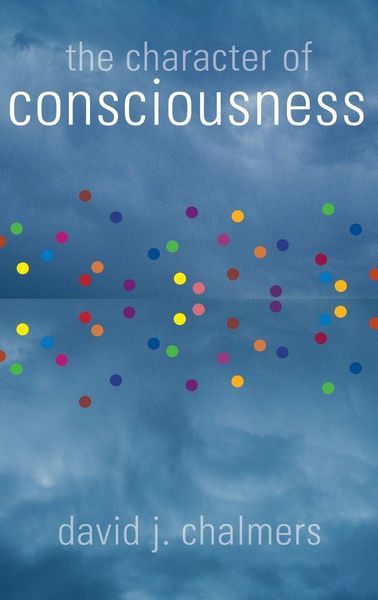
  • Produktbild: The Character of Consciousness
  • Produktbild: The Character of Consciousness

The Character of Consciousness

Aus der Reihe Academic

276,99 €

inkl. gesetzl. MwSt., Versandkostenfrei


Beschreibung

What is consciousness? How does the subjective character of consciousness fit into an objective world? How can there be a science of consciousness? In this sequel to his groundbreaking and controversial The Conscious Mind, David Chalmers develops a unified framework that addresses these questions and...

Beschreibung

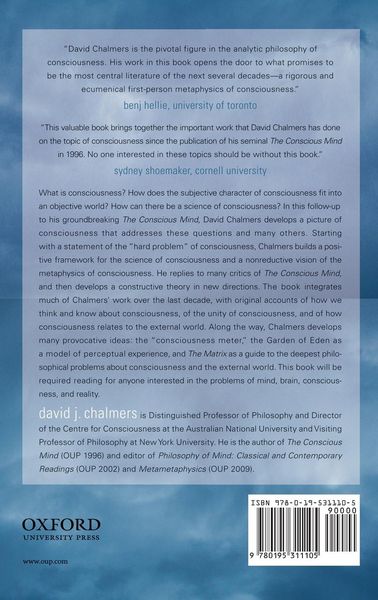
What is consciousness? How does the subjective character of consciousness fit into an objective world? How can there be a science of consciousness? In this sequel to his groundbreaking and controversial The Conscious Mind, David Chalmers develops a unified framework that addresses these questions and many others. Starting with a statement of the "hard problem" of consciousness, Chalmers builds a positive framework for the science of consciousness and a nonreductive vision of the metaphysics of consciousness. He replies to many critics of The Conscious Mind, and then develops a positive theory in new directions. The book includes original accounts of how we think and know about consciousness, of the unity of consciousness, and of how consciousness relates to the external world. Along the way, Chalmers develops many provocative ideas: the "consciousness meter", the Garden of Eden as a model of perceptual experience, and The Matrix as a guide to the deepest philosophical problems about consciousness and the external world. This book will be required reading for anyone interested in the problems of mind, brain, consciousness, and reality.

Produktdetails

Einband

Gebundene Ausgabe

Erscheinungsdatum

16.08.2017

Verlag Oxford Academic
Seitenzahl

626

Produktdetails

Einband

Gebundene Ausgabe

Erscheinungsdatum

16.08.2017

Verlag Oxford Academic
Seitenzahl

626

Maße (L/B/H)

24/16,1/3,8 cm

Gewicht

1045 g

Sprache

Englisch

ISBN

978-0-19-531110-5

Herstelleradresse

Libri GmbH
Europaallee 1
36244 Bad Hersfeld
DE

Email: gpsr@libri.de

Noch keine Bewertungen vorhanden

Verfassen Sie die erste Bewertung zu diesem Artikel

Helfen Sie anderen Kundinnen und Kunden durch Ihre Meinung.

Kundinnen und Kunden meinen

Bewertungen (0)

Die Leseprobe wird geladen.
  • Produktbild: The Character of Consciousness
  • Produktbild: The Character of Consciousness
    • Introduction

    • Acknowledgments

    • 1.: The Problems of Consciousness

    • 2.: Facing Up to the Problem of Consciousness

    • Afterword: From "Moving Forward on the Problem of Consciousness"

    • II. The Science of Consciousness

    • 3.: How Can We Construct a Science of Consciousness?

    • Afterword: First-Person Data and First-Person Science

    • 4.: What is a Neural Correlate of Consciousness?

    • 5.: On the Search for the Neural Correlate of Consciousness

    • III. The Metaphysics of Consciousness

    • 6.: Consciousness and its Place in Nature

    • 7.: The Two-Dimensional Argument Against Materialism

    • Afterword: Other Anti-Materialist Arguments

    • 8.: Conceptual Analysis and Reductive Explanation (with Frank Jackson)

    • IV. Concepts of Consciousness

    • 9.: The Content of Phenomenal Concepts

    • 10.: The Epistemology of Phenomenal Belief

    • 11.: Phenomenal Concepts and the Explanatory Gap

    • V. The Contents of Consciousness

    • 12.: The Representational Character of Experience

    • Afterword: The Two-Dimensional Contents of Perception

    • 13.: Perception and the Fall From Eden

    • 14.: The Matrix as Metaphysics

    • Afterword: Philosophical Notes

    • VI. The Unity of Consciousness

    • 15.: What is the Unity of Consciousness (with Tim Bayne)

    • Appendix: Two-Dimensional Semantics