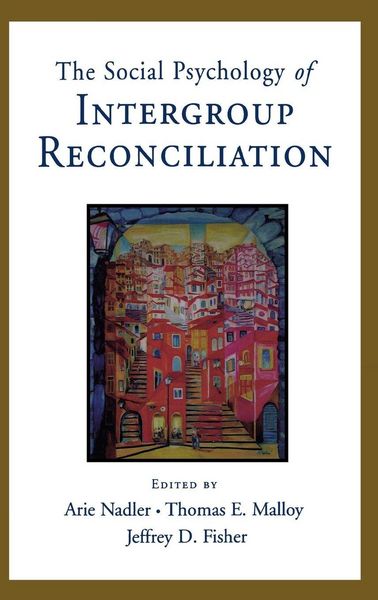
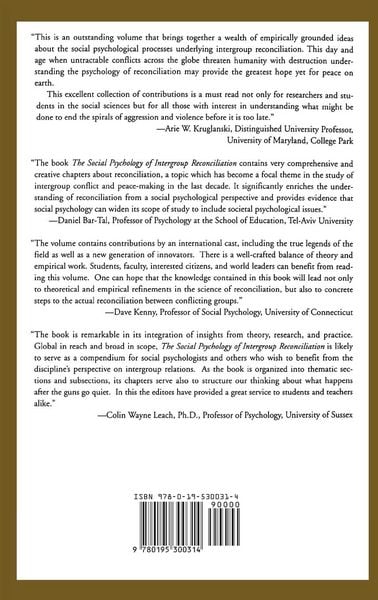
• Produktbild: Social Psychology of Intergroup Reconciliation
  • Produktbild: Social Psychology of Intergroup Reconciliation

Social Psychology of Intergroup Reconciliation From Violent Conflict to Peaceful Co-Existence

137,99 €

inkl. gesetzl. MwSt., Versandkostenfrei


Beschreibung

Produktdetails

Einband

Gebundene Ausgabe

Erscheinungsdatum

01.03.2008

Abbildungen

5 halftones, 5 line illustrations

Herausgeber

Nadler Arie + weitere

Verlag

Oxford University Press

Seitenzahl

514

Maße (L/B/H)

24/16,1/3,2 cm

Gewicht

894 g

Sprache

Englisch

ISBN

978-0-19-530031-4

Beschreibung

Produktdetails

Einband

Gebundene Ausgabe

Erscheinungsdatum

01.03.2008

Abbildungen

5 halftones, 5 line illustrations

Herausgeber

Verlag

Oxford University Press

Seitenzahl

514

Maße (L/B/H)

24/16,1/3,2 cm

Gewicht

894 g

Sprache

Englisch

ISBN

978-0-19-530031-4

Herstelleradresse

Libri GmbH
Europaallee 1
36244 Bad Hersfeld
DE

Email: gpsr@libri.de

Noch keine Bewertungen vorhanden

Verfassen Sie die erste Bewertung zu diesem Artikel

Helfen Sie anderen Kundinnen und Kunden durch Ihre Meinung.

Kundinnen und Kunden meinen

Bewertungen (0)

Die Leseprobe wird geladen.
  • Produktbild: Social Psychology of Intergroup Reconciliation
  • Produktbild: Social Psychology of Intergroup Reconciliation
    • Introduction: Intergroup Reconciliation - Dimensions and Themes

    • Part A: Intergroup Reconciliation: Its Nature

    • 1: Herbert C. Kelman: Reconciliation From a Social Psychological Perspective

    • Part B: Socio-Emotional Reconciliation: Moving Beyond Victimhood, Guilt, and Humiliation

    • (1) Guilt, Victimhood, and Forgiveness

    • 2: Arie Nadler and Nurit Shnabel: Instrumental and Socio-Emotional Paths to Intergroup Reconciliation and the Need-Based Model of Socio-Emotional Reconciliation

    • 3: Pumla Gobodo-Madikizela: Transforming Trauma in the Aftermath of Gross Human Rights Abuses: Making Public Spaces Intimate through the South African Truth and Reconciliation Commission

    • 4: Anca M. Miron and Nyla R. Branscombe: Social Categorization, Standards of Justice, and Collective Guilt

    • 5: Masi Noor, Rubert Brown, and Garry Prentice: Prospects for Intergroup Reconciliation: Social Psychological Predictors of Intergroup Forgiveness and Reparation in Northern Ireland and Chile

    • (2) Restoring Respect and Esteem

    • 6: Felicia Pratto and Demis E. Glasford: How Needs Can Motivate Intergroup Reconciliation in the Face of Intergroup Conflict

    • 7: Ronnie Janoff-Bulman and Amelie Werther: The Social Psychology of Respect: Implications for Delegitimization and Reconciliation

    • 8: Jennifer Crocker, Julie A. Garcia and Noah Nuer: From Egosystem to Ecosystem in Intergroup Interactions: Implications for Intergroup Reconciliation

    • Part C: Instrumental Reconciliation: Contact, Common Identity, and Equality

    • 9: Miles Hewstone, Catherine Pinder, Jared Kenworthy, Ed Cairns, Nicole Tausch, Joanne Hughes, Tania Tam, Alberto Voci and Ulrich von Hecker: Stepping Stones to Reconciliation in Northern Ireland: Intergroup Contact, Forgiveness and Trust

    • 10: John F. Dovidio, Samuel L. Gaertner, Melissa-Sue John, Samer Halabi, Tamar Saguy, Adam R. Pearson and Blake M. Riek: Majority and Minority Perspectives in Intergroup Relations: The Role of Contact, Group Representations, Threat, and Trust in Intergroup Conflict and Reconciliation

    • 11: Blake M. Riek, Samuel L. Gaertner, John F. Dovidio, Marilynn B. Brewer, Eric W. Mania, and Marika J. Lamoreaux: A Social Psychological Approach to Post-Conflict Reconciliation

    • 12: Reuben M. Baron: Reconciliation, Trust and Cooperation: Using Bottom-Up and Top-Down Strategies to Achieve Peace in the Israeli-Palestinian Conflict

    • (4) Equality and Differential Power

    • 13: Lasana T. Harris and Susan T. Fiske: Diminishing Vertical Distance: Power and Social Status as Barriers to Inter-group Reconciliation

    • 14: Russell Spears: Social Identity, Legitimacy and Intergroup Conflict: The Rocky Road to Reconciliation

    • 15: Thomas E. Malloy: Intergroup Relations and Reconciliation: Theoretical Analysis and Methodological Implications

    • Part D: Programs to Promote Intergroup Reconciliation

    • 16: Walter G. Stephan: The road to reconciliation

    • 17: Ervin Staub: Promoting Reconciliation After Genocide and Mass Killing in Rwanda - and Other Post-Conflict Settings: Understanding the Roots of Violence, Healing, Shared History, and General Principles

    • 18: Stephen Worchel and Dawna K. Coutant: Between Conflict and Reconciliation: Toward a Theory of Peaceful Co-existance

    • 19: Jeffrey D. Fisher, Arie Nadler, Jessica S. Little and Tamar Saguy: Help as a Vehicle to Reconciliation, With Particular Reference to Help for Extreme Health Needs

    • Part E: Intergroup Reconciliation: An Overall View

    • 20: Morton Deutsch: Reconciliation After Destructive Intergroup Conflict