KI-Beratung Beta

Gutscheinbedingungen

**Gültig am 27.11.2026 auf Spielzeug, Schreibwaren, Filme, Geschenke & Trends, Musik, tolino eReader & Zubehör, Hörbücher und Hörbuch-Downloads, nicht preisgebundene Bücher und Kalender online auf thalia.at und in der Thalia App. Einzelne Artikel können ausgeschlossen sein. Aufgrund der Buchpreisbindung sind deutschsprachige Bücher und eBooks ausgenommen. Zusätzlich ausgenommen sind Abos & Flatrates, Games, Geschenkkarten/-boxen, Shelfies, Software, Zeitschriften sowie einzelne Artikel von tonies®. Pro Einkauf einmal einlösbar. Click & Collect nur bei Onlinevorabzahlung möglich. Keine Barauszahlung. Nicht kombinierbar mit anderen Aktionen und Gutscheinen. Gutschein wird auf max. 500€ Bestellwert angerechnet. Nicht gültig für Versandkosten und Services.

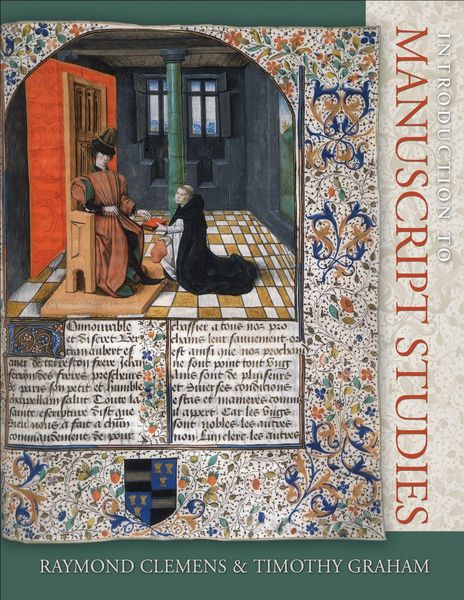
Produktbild: Introduction to Manuscript Studies

Introduction to Manuscript Studies

57,99 €

inkl. gesetzl. MwSt., Versandkostenfrei


Beschreibung

Providing a comprehensive and accessible orientation to the field of medieval manuscript studies, this lavishly illustrated book by Raymond Clemens and Timothy Graham is unique among handbooks on paleography, codicology, and manuscript illumination in its scope and level of detail. 

It will be of immeasurable...

Beschreibung

Providing a comprehensive and accessible orientation to the field of medieval manuscript studies, this lavishly illustrated book by Raymond Clemens and Timothy Graham is unique among handbooks on paleography, codicology, and manuscript illumination in its scope and level of detail. 

It will be of immeasurable help to students in history, art history, literature, and religious studies who are encountering medieval manuscripts for the first time, while also appealing to advanced scholars and general readers interested in the history of the book before the age of print.

Introduction to Manuscript Studies features three sections:

• Part 1, "Making the Medieval Manuscript," offers an in-depth examination of the process of manuscript production, from the preparation of the writing surface through the stages of copying the text, rubrication, decoration, glossing, and annotation to the binding and storage of the completed codex.

• Part 2, "Reading the Medieval Manuscript," focuses on the skills necessary for the successful study of manuscripts, with chapters on transcribing and editing; reading texts damaged by fire, water, insects, and other factors; assessing evidence for origin and provenance; and describing and cataloguing manuscripts. This part ends with a survey of sixteen medieval scripts dating from the eighth to the fifteenth century.

• Part 3, "Some Manuscript Genres," provides an analysis of several of the most frequently encountered types of medieval manuscripts, including Bibles and biblical concordances, liturgical service books, Books of Hours, charters and cartularies, maps, and rolls and scrolls. The book concludes with an extensive glossary, a guide to dictionaries of medieval Latin, and a bibliography subdivided and keyed to the subsections of the volume's chapters. 

Every chapter in this magisterial guidebook features numerous color plates that exemplify each aspect described in the text and are drawn primarily from the collections of the Newberry Library in Chicago and the Parker Library of Corpus Christi College, Cambridge.

Produktdetails

Einband

Taschenbuch

Erscheinungsdatum

15.01.2008

Verlag Cornell University Press
Seitenzahl

320

Produktdetails

Einband

Taschenbuch

Erscheinungsdatum

15.01.2008

Verlag Cornell University Press
Seitenzahl

320

Maße (L/B/H)

30,8/23/2,9 cm

Gewicht

1504 g

Sprache

Englisch

ISBN

978-0-8014-8708-8

Herstelleradresse

Libri GmbH
Europaallee 1
36244 Bad Hersfeld
DE

Email: gpsr@libri.de

Noch keine Bewertungen vorhanden

Verfassen Sie die erste Bewertung zu diesem Artikel

Helfen Sie anderen Kundinnen und Kunden durch Ihre Meinung.

Kundinnen und Kunden meinen

Bewertungen (0)

Weitere Artikel finden Sie in

  • Produktbild: Introduction to Manuscript Studies
  • Part I: Making the Medieval Manuscript
    Chapter 1. Writing Supports
    Chapter 2. Text and Decoration
    Chapter 3. Correction, Glossing, and Annotation
    Chapter 4. Assembling, Binding, and Storing the Completed ManuscriptPart II. Reading the Medieval Manuscript
    Chapter 5. Working with Medieval Manuscripts
    Chapter 6. Punctuation and Abbreviation
    Chapter 7. Encounters with Damaged Manuscripts
    Chapter 8, Assessing Manuscript Origin and Provenance
    Chapter 9. Manuscript Description
    Chapter 10. Selected ScriptsPart III: Some Manuscript Genres
    Chapter 11, The Bible and Related Texts
    Chapter 12. Liturgical Books and Their Calendars
    Chapter 13. Books of Hours
    Chapter 14. Charters and Cartularies
    Chapter 15. Maps
    Chapter 16. Rolls and ScrollsAppendix: Tools for the Study of Medieval Latin
    by Anders WinrothGlossary
    Bibliography
    Index