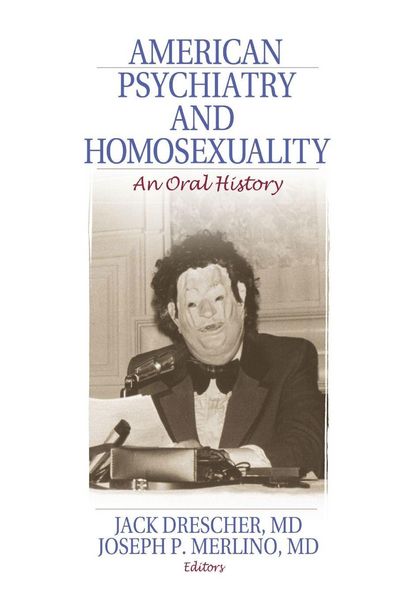
American Psychiatry and Homosexuality An Oral History
-
- Taschenbuch ausgewählt
- eBook
-
Sprache:Englisch
45,99 €
inkl. gesetzl. MwSt.,
Beschreibung
Produktdetails
Einband
Taschenbuch
Erscheinungsdatum
25.04.2007
Herausgeber
Jack Drescher + weitereVerlag
Taylor & FrancisSeitenzahl
322
Maße (L/B/H)
22,9/15,2/1,7 cm
Gewicht
435 g
Sprache
Englisch
ISBN
978-1-56023-739-6
Through the personal accounts of those who were there, American Psychiatry and Homosexuality: An Oral History examines the 1973 decision by the American Psychiatric Association (APA) to remove homosexuality from its diagnostic and statistical manual of mental disorders (DSM). This unique book includes candid one-on-one interviews with key mental health professionals who played a role in the APA's decision, those who helped organize gay, lesbian, and bisexual psychiatrists after the decision, and others who have made significant contributions in this area within the mental health field.
American Psychiatry and Homosexuality presents an insider's view of how homosexuality was removed from the DSM, the gradual organization of gay and lesbian psychiatrists within the APA, and the eventual formation of the APA-allied Association of Gay & Lesbian Psychiatrists (AGLP). The book profiles 17 individuals, both straight and gay, who made important contributions to organized psychiatry and the mental health needs of lesbian and gay patients, and illustrates the role that gay and lesbian psychiatrists would later play in the mental health field when they no longer had to hide their identities.
Individuals profiled in American Psychiatry and Homosexuality include:
- Dr. John Fryer, who disguised his identity to speak before the APA's annual meeting in 1972 on the discrimination gay psychiatrists faced in their own profession
- Dr. Charles Silverstein, who saw the diagnosis of homosexuality as a means of social control
- Dr. Lawrence Hartmann, who helped reform the APA and later served as its President in 1991-92
- Dr. Robert J. Campbell, who helped persuade the APA's Nomenclature Committee to hear scientific data presented by gay activists
- Dr. Judd Marmor, an early psychoanalytic critic of theories that pathologized homosexuality
- Dr. Robert Spitzer, who chaired the APA's Nomenclature Committee
- Dr. Frank Rundle, who helped organize the first meeting of what would become the APA Caucus of Gay, Lesbian and Bisexual Psychiatrists
- Dr. David Kessler, AGLP President from 1980-82
- Dr. Nanette Gartrell, a pioneer of feminist issues within the APA
- Dr. Stuart Nichols, President of the AGLP in 1983-84 and a founding member of the Gay and Lesbian Psychiatrists of New York (GLPNY)
- Dr. Emery Hetrick, a founding member of both AGLP and GLPNY
- Dr. Bertram Schaffner, who was instrumental in providing group psychotherapy for physicians with AIDS
- Dr. Martha Kirkpatrick, a long-time leader in psychiatry and psychoanalysis, both as a woman and an "out" lesbian
- Dr. Richard Isay, the first openly gay psychoanalyst in the American Psychoanalytic Association
- Dr. Richard Pillard, best known for studying the incidence of homosexuality in families of twins
- Dr. Edward Hanin, former Speaker of the APA Assembly
- Dr. Ralph Roughton, the first openly gay Training and Supervising Psychoanalyst to be recognized within the American and International Psychoanalytic Associations
Noch keine Bewertungen vorhanden
Verfassen Sie die erste Bewertung zu diesem Artikel
Helfen Sie anderen Kundinnen und Kunden durch Ihre Meinung.
Kurze Frage zu unserer Seite
Vielen Dank für Ihr Feedback
Wir nutzen Ihr Feedback, um unsere Produktseiten zu verbessern. Bitte haben Sie Verständnis, dass wir Ihnen keine Rückmeldung geben können. Falls Sie Kontakt mit uns aufnehmen möchten, können Sie sich aber gerne an unseren Kund*innenservice wenden.
zum Kundenservice