KI-Beratung Beta

Gutscheinbedingungen

**Gültig bis 30.11.2026 auf Spielzeug, Schreibwaren, Filme, Geschenke & Trends, Musik, tolino eReader & Zubehör, Hörbücher und Hörbuch-Downloads, nicht preisgebundene Bücher und Kalender online auf thalia.at und in der Thalia App. Einzelne Artikel können ausgeschlossen sein. Aufgrund der Buchpreisbindung sind deutschsprachige Bücher und eBooks ausgenommen. Zusätzlich ausgenommen sind Abos & Flatrates, Games, Geschenkkarten/-boxen, Shelfies, Software, Zeitschriften sowie einzelne Artikel von tonies®. Pro Einkauf einmal einlösbar. Nur gültig mit im Onlineshop hinterlegter Bonuscard. Click & Collect nur bei Onlinevorabzahlung möglich. Keine Barauszahlung. Nicht kombinierbar mit anderen Aktionen und Gutscheinen. Gutschein wird auf max. 500€ Bestellwert angerechnet. Nicht gültig für Versandkosten und Services.

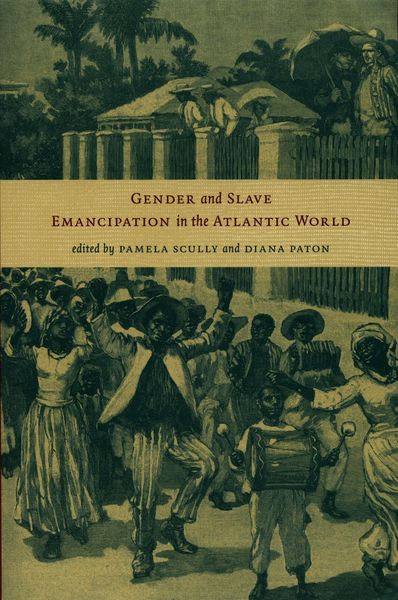
Produktbild: Gender and Slave Emancipation in the Atlantic World

Gender and Slave Emancipation in the Atlantic World

53,99 €

inkl. gesetzl. MwSt., Versandkostenfrei


Beschreibung

This groundbreaking collection provides the first comparative history of gender and emancipation in the Atlantic world. Bringing together essays on the United States, Brazil, Cuba, Puerto Rico, West Africa and South Africa, and the Francophone and Anglophone Caribbean, it shows that emancipation was...

Beschreibung

This groundbreaking collection provides the first comparative history of gender and emancipation in the Atlantic world. Bringing together essays on the United States, Brazil, Cuba, Puerto Rico, West Africa and South Africa, and the Francophone and Anglophone Caribbean, it shows that emancipation was a profoundly gendered process, produced through connections between race, gender, sexuality, and class. Contributors from the United States, Canada, Europe, the Caribbean, and Brazil explore how the processes of emancipation involved the re-creation of gender identities-the production of freed men and freed women with different rights, responsibilities, and access to citizenship.

Offering detailed analyses of slave emancipation in specific societies, the contributors discuss all of the diverse actors in emancipation: slaves, abolitionists, free people of color, state officials, and slave owners. Whether considering the construction of a postslavery masculine subjectivity in Jamaica, the work of two white U.S. abolitionist women with the Freedmen’s Bureau after the Civil War, freedwomen’s negotiations of labor rights in Puerto Rico, slave women’s contributions to the slow unraveling of slavery in French West Africa, or the ways that Brazilian abolitionists deployed representations of femininity as virtuous and moral, these essays demonstrate the gains that a gendered approach offers to understanding the complex processes of emancipation. Some chapters also explore theories and methodologies that enable a gendered reading of postslavery archives. The editors’ substantial introduction traces the reasons for and patterns of women’s and men’s different experiences of emancipation throughout the Atlantic world.

Contributors. Martha Abreu, Sheena Boa, Bridget Brereton, Carol Faulkner, Roger Kittleson, Martin Klein, Melanie Newton, Diana Paton, Sue Peabody, Richard Roberts, Ileana M. Rodriguez-Silva, Hannah Rosen, Pamela Scully, Mimi Sheller, Marek Steedman, Michael Zeuske

Produktdetails

Einband

Taschenbuch

Erscheinungsdatum

04.10.2005

Herausgeber Pamela Scully
Verlag Duke University Press

Produktdetails

Einband

Taschenbuch

Erscheinungsdatum

04.10.2005

Herausgeber Pamela Scully
Verlag Duke University Press
Seitenzahl

392

Maße (L/B/H)

23,6/16,1/2,3 cm

Gewicht

572 g

Sprache

Englisch

ISBN

978-0-8223-3594-8

Herstelleradresse

Libri GmbH
Europaallee 1
36244 Bad Hersfeld
DE

Email: gpsr@libri.de

Noch keine Bewertungen vorhanden

Verfassen Sie die erste Bewertung zu diesem Artikel

Helfen Sie anderen Kundinnen und Kunden durch Ihre Meinung.

Kundinnen und Kunden meinen

Bewertungen (0)

  • Produktbild: Gender and Slave Emancipation in the Atlantic World
  • Acknowledgments vii
    Maps vii
    Introduction: Gender and Slave Emancipation in Comparative Perspective / Diana Paton and Pamela Scully 1
    Part I. Men, Women, Citizens 35
    Masculinity, Citizenship, and the Production of Knowledge in the Postemancipation Cape Colony, 1834–1844 / Pamela Scully 37
    NÉgresse, MulÂtresse, Citoyenne: Gender and Emancipation in the French Caribbean, 1650–1848 / Sue Peabody 56
    Acting as Free Men: Subaltern Masculinities and Citizenship in Postslavery Jamaica / Mimi Sheller 79
    Women and Notions of Womanhood in Brazilian Abolitionism / Roger A. Kittleson 99
    A Nation’s Sin: White Women and U.S. Policy toward Freedpeople / Carol Faulkner 121
    Part II. Families, Land, and Labor 141
    Family Strategies, Gender, and the Shift to Wage Labor in the British Caribbean / Bridget Brereton 143
    Gender and Emancipation in French West Africa / Martin Klein and Richard Roberts 162
    Two Stories of Gender and Slave Emancipation in Cienfuegos and Santa Clara, Central Cuba: A Microhistorical Approach to the Atlantic World / Michael Zeuske 181
    Libertos and Libertas in the Construction of the Free Worker in Postemancipation Puerto Rico / Ileana Rodriguez-Silva 199
    Part III. The Public Sphere in the Age of Emancipation 223
    Philanthropy, Gender, and the Production of Public Life in Barbados, ca. 1790–ca. 1850 / Melanie Newton 225
    Young Ladies and Dissolute Women: Conflicting Views of Culture and Gender in Public Entertainment, Kingstown, St. Vincent, 1838–1888 / Sheena Boa 247
    Mulatas, Crioulos, and Morenas: Racial Hierarchy, Gender Relations, and National Identity in Postabolition Popular Song: Southeastern Brazil, 1890-1920 / Martha Abreu (translated from the Portuguese by Amy Chazkel and Junia Claudia Zaidan) 267
    The Rhetoric of Miscegenation and the Reconstruction of Race: Debating Marriage, Sex, and Citizenship in Postemancipation Arkansas / Hannah Rosen 289
    Gender and the Politics of the Household in Reconstruction Louisiana, 1865–1878 / Marek Steedman 310
    Bibliographic Essay / Diana Paton 328
    Contributors 357
    Index 361