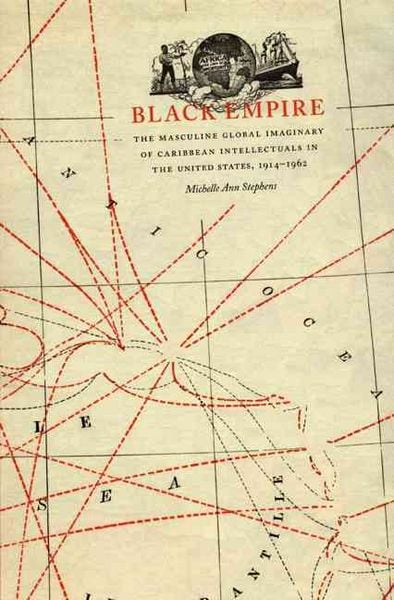
Black Empire The Masculine Global Imaginary of Caribbean Intellectuals in the United States, 1914-1962
-
- Hardcover
- Taschenbuch ausgewählt
- eBook
-
Sprache:Englisch
51,99 €
inkl. gesetzl. MwSt.,
Beschreibung
Produktdetails
Einband
Taschenbuch
Erscheinungsdatum
18.07.2005
Verlag
Duke University PressSeitenzahl
384
Maße (L/B/H)
23,6/16/2,8 cm
Gewicht
608 g
Sprache
Englisch
ISBN
978-0-8223-3588-7
In
Black Empire, Michelle Ann Stephens examines the ideal of “transnational blackness” that emerged in the work of radical black intellectuals from the British West Indies in the early twentieth century. Focusing on the writings of Marcus Garvey, Claude McKay, and C. L. R. James, Stephens shows how these thinkers developed ideas of a worldwide racial movement and federated global black political community that transcended the boundaries of nation-states. Stephens highlights key geopolitical and historical events that gave rise to these writers’ intellectual investment in new modes of black political self-determination. She describes their engagement with the fate of African Americans within the burgeoning U.S. empire, their disillusionment with the potential of post–World War I international organizations such as the League of Nations to acknowledge, let alone improve, the material conditions of people of color around the world, and the inspiration they took from the Bolshevik Revolution, which offered models of revolution and community not based on nationality.
Stephens argues that the global black political consciousness she identifies was constituted by both radical and reactionary impulses. On the one hand, Garvey, McKay, and James saw freedom of movement as the basis of black transnationalism. The Caribbean archipelago-a geographic space ideally suited to the free movement of black subjects across national boundaries-became the metaphoric heart of their vision. On the other hand, these three writers were deeply influenced by the ideas of militarism, empire, and male sovereignty that shaped global political discourse in the early twentieth century. As such, their vision of transnational blackness excluded women’s political subjectivities. Drawing together insights from American, African American, Caribbean, and gender studies, Black Empire is a major contribution to ongoing conversations about nation and diaspora.
Noch keine Bewertungen vorhanden
Verfassen Sie die erste Bewertung zu diesem Artikel
Helfen Sie anderen Kundinnen und Kunden durch Ihre Meinung.
Kurze Frage zu unserer Seite
Vielen Dank für Ihr Feedback
Wir nutzen Ihr Feedback, um unsere Produktseiten zu verbessern. Bitte haben Sie Verständnis, dass wir Ihnen keine Rückmeldung geben können. Falls Sie Kontakt mit uns aufnehmen möchten, können Sie sich aber gerne an unseren Kund*innenservice wenden.
zum Kundenservice