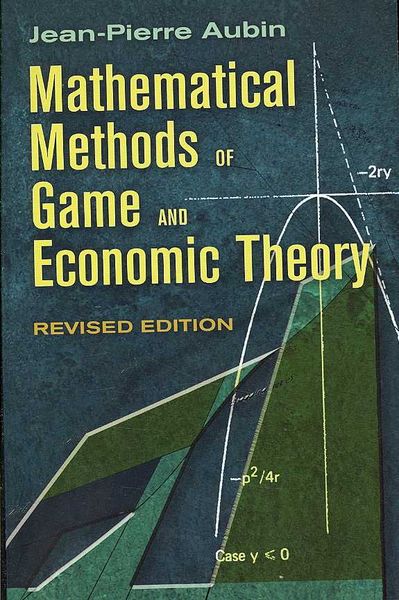
Produktbild: Mathematical Methods of Game and Economic Theory

Mathematical Methods of Game and Economic Theory

29,99 €

inkl. gesetzl. MwSt., zzgl. Versandkosten


  • Kostenlose Lieferung ab 30 € Einkaufswert
  • Versandkostenfrei für Bonuscard-Kund*innen

Beschreibung

Produktdetails

Einband

Taschenbuch

Erscheinungsdatum

02.11.2007

Verlag

Courier Corporation

Seitenzahl

656

Maße (L/B/H)

23,3/16/3,1 cm

Gewicht

812 g

Sprache

Englisch

ISBN

978-0-486-46265-3

Beschreibung

Produktdetails

Einband

Taschenbuch

Erscheinungsdatum

02.11.2007

Verlag

Courier Corporation

Seitenzahl

656

Maße (L/B/H)

23,3/16/3,1 cm

Gewicht

812 g

Sprache

Englisch

ISBN

978-0-486-46265-3

Herstelleradresse

Libri GmbH
Europaallee 1
36244 Bad Hersfeld
DE

Email: gpsr@libri.de

Noch keine Bewertungen vorhanden

Verfassen Sie die erste Bewertung zu diesem Artikel

Helfen Sie anderen Kundinnen und Kunden durch Ihre Meinung.

Kundinnen und Kunden meinen

Bewertungen (0)

  • Produktbild: Mathematical Methods of Game and Economic Theory
  • Preface to the Dover Edition Preface (1982) Summary of Results Contents of Other Possible Courses Notations I. Optimization and convex analysis 1. Minimization problems and convexity 2. Existence, uniqueness and stability of optimal solutions 3. Compactness and continuity properties 4. Differentiability and subdifferentiability: characterization of optimal solutions 5. Introduction to duality theory II. Game theory and the Walras model of allocation of resources 6. Two-person games: an introduction 7. Two-person zero-sum games: existence theorems 8. The fundamental economic model: Walras equilibria 9. Non-cooperative n-person games 10. Main solution concepts of cooperative games 11. Games with side-payments 12. Games without side-payments III. Non-linear analysis and optimal control theory 13. Minimax type inequalities, monotone correspondences and gamma-convex functions 14. Introduction to calculus of variations and optimal control 15. Fixed point theorems, quasi-variational inequalities and correspondences Appendix A. Summary of linear functional analysis Appendix B. The Knaster-Kuratowski-Mazurkiewicz lemma Appendix C. Lyapunov's theorem on the range of a vector valued measure Comments References Subject index