Gutscheinbedingungen

**Gültig bis 15.06.2026 auf Spiele & Spielzeug online auf thalia.at, in der Thalia App ab einem Mindestbestellwert von 30€ und in allen Thalia Buchhandlungen in Österreich. In den Buchhandlungen nur gültig auf lagernde Ware. Einzelne Artikel können ausgeschlossen sein. Ausgenommen sind preisgebundene Artikel sowie online auf thalia.at und in der Thalia App einzelne Artikel von tonies®. Pro Einkauf einmal einlösbar. Nur gültig gegen Vorlage oder im Onlineshop hinterlegter Bonuscard. Infos zur Einlösung in der Buchhandlung sind auf der Bonuscard-Vorteilspreisseite zu finden. Click & Collect nur bei Onlinevorabzahlung möglich. Keine Einlösung bei Scan & Go-Bezahlung. Keine Barauszahlung. Nicht kombinierbar mit anderen Aktionen und Gutscheinen. Gutschein wird auf max. 500€ Bestellwert angerechnet. Nicht gültig für Geschenkkarten, Versandkosten und Services.

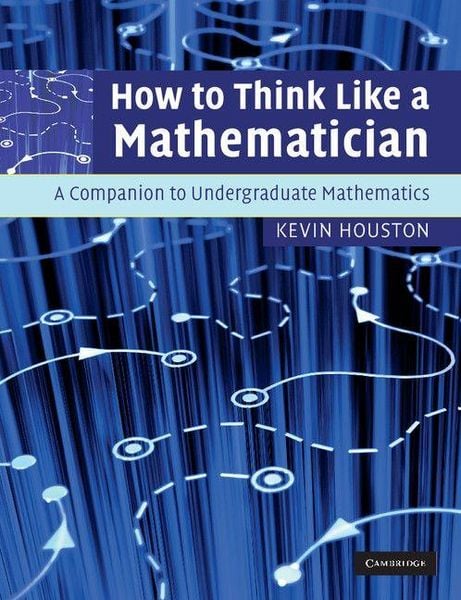
  • Produktbild: How to Think Like a Mathematician
  • Produktbild: How to Think Like a Mathematician

How to Think Like a Mathematician A Companion to Undergraduate Mathematics

53,99 €

inkl. gesetzl. MwSt., Versandkostenfrei


Beschreibung

Produktdetails

Einband

Taschenbuch

Erscheinungsdatum

02.12.2009

Verlag

Cambridge University Press

Seitenzahl

274

Maße (L/B/H)

24,6/18,9/1,6 cm

Gewicht

560 g

Sprache

Englisch

ISBN

978-0-521-71978-0

Beschreibung

Rezension

"In this book, Houston has created a primer on the fundamental abstract ideas of mathematics; the primary emphasis is on demonstrating the many principles and tactics used in proofs. The material is explained in ways that are comprehensible, which will be a great help for people who seem to hit the wall regarding what to do when confronted with the creation of a proof... In this book, Houston takes a systematic and gentle approach to explaining the ideas of mathematics and how tactics of reasoning can be combined with those ideas to generate what would be considered a convincing proof."
Charles Ashbacher, Journal of Recreational Mathematics

Produktdetails

Einband

Taschenbuch

Erscheinungsdatum

02.12.2009

Verlag

Cambridge University Press

Seitenzahl

274

Maße (L/B/H)

24,6/18,9/1,6 cm

Gewicht

560 g

Sprache

Englisch

ISBN

978-0-521-71978-0

Herstelleradresse

Libri GmbH
Europaallee 1
36244 Bad Hersfeld
DE

Email: gpsr@libri.de

Kundinnen und Kunden meinen

0 Bewertungen

Informationen zu Bewertungen

Zur Abgabe einer Bewertung ist eine Anmeldung im Konto notwendig. Die Authentizität der Bewertungen wird von uns nicht überprüft. Wir behalten uns vor, Bewertungstexte, die unseren Richtlinien widersprechen, entsprechend zu kürzen oder zu löschen.

Die Bewertungen sind nach Format, Anzahl Sterne und Datum sortiert.

Verfassen Sie die erste Bewertung zu diesem Artikel

Helfen Sie anderen Kund*innen durch Ihre Meinung

Kundinnen und Kunden meinen

0 Bewertungen filtern

Die Leseprobe wird geladen.
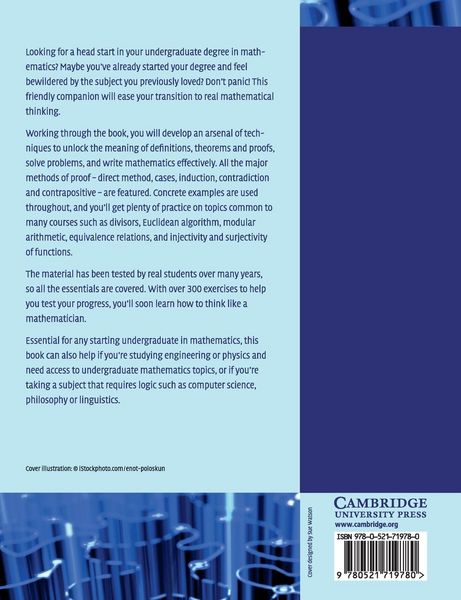
  • Produktbild: How to Think Like a Mathematician
  • Produktbild: How to Think Like a Mathematician
  • Preface; Part I. Study Skills For Mathematicians: 1. Sets and functions; 2. Reading mathematics; 3. Writing mathematics I; 4. Writing mathematics II; 5. How to solve problems; Part II. How To Think Logically: 6. Making a statement; 7. Implications; 8. Finer points concerning implications; 9. Converse and equivalence; 10. Quantifiers - For all and There exists; 11. Complexity and negation of quantifiers; 12. Examples and counterexamples; 13. Summary of logic; Part III. Definitions, Theorems and Proofs: 14. Definitions, theorems and proofs; 15. How to read a definition; 16. How to read a theorem; 17. Proof; 18. How to read a proof; 19. A study of Pythagoras' Theorem; Part IV. Techniques of Proof: 20. Techniques of proof I: direct method; 21. Some common mistakes; 22. Techniques of proof II: proof by cases; 23. Techniques of proof III: Contradiction; 24. Techniques of proof IV: Induction; 25. More sophisticated induction techniques; 26. Techniques of proof V: contrapositive method; Part V. Mathematics That All Good Mathematicians Need: 27. Divisors; 28. The Euclidean Algorithm; 29. Modular arithmetic; 30. Injective, surjective, bijective - and a bit about infinity; 31. Equivalence relations; Part VI. Closing Remarks: 32. Putting it all together; 33. Generalization and specialization; 34. True understanding; 35. The biggest secret; Appendices: A. Greek alphabet; B. Commonly used symbols and notation; C. How to prove that ...; Index.