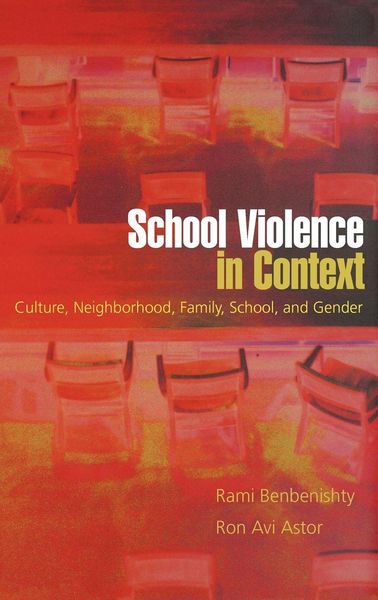
School Violence in Context Culture, Neighborhood, Family, School, and Gender
116,99 €
inkl. gesetzl. MwSt.,
Beschreibung
Produktdetails
Einband
Gebundene Ausgabe
Erscheinungsdatum
01.01.2005
Abbildungen
numerous tables and line drawings
Verlag
Oxford University PressSeitenzahl
248
Maße (L/B/H)
24/16,1/1,8 cm
Gewicht
540 g
Sprache
Englisch
ISBN
978-0-19-515780-2
Drawing on one of the most comprehensive and representative studies of school violence ever conducted, Benbenishty and Astor explore and differentiate the many manifestations of victimization in schools, providing a new model for understanding school violence in context. The authors make
striking use of the geopolitical climate of the Middle East to model school violence in terms of its context within as well as outside of the school site. This pioneering new work is unique in that it uses empirical data to show which variables and factors are similar across different cultures and
which variables appear unique to different cultures. This empirical contrast of universal with culturally specific patterns is sorely needed in the school violence literature. The authors' innovative research maps the contours of verbal, social, physical, and sexual victimization and weapons
possession, as well as staff-initiated violence against students, presenting some startling findings along the way. When comparing schools in Israel with schools in California, the authors demonstrate for the first time that for most violent events the patterns of violent behaviors have the same
relationship for different age groups, genders, and nations. Conversely, they highlight specific kinds of violence that are strongly influenced by culture. They reveal, for example, how Arab boys encounter much more boy-to-boy sexual harassment than their Jewish peers, and that teacher-initiated
victimization of students constitutes a significant and often overlooked type of school violence, especially among certain cultural groups. Crucially, the authors expand the paradigm of understanding school violence toencompass the intersection of cultural, ethnic, neighborhood, and family
characteristics with intra-school factors such as teacher-student dynamics, anti-violence policies, student participation, grade level, and religious and gender divisions. It is only by understanding the
Noch keine Bewertungen vorhanden
Verfassen Sie die erste Bewertung zu diesem Artikel
Helfen Sie anderen Kundinnen und Kunden durch Ihre Meinung.
Kurze Frage zu unserer Seite
Vielen Dank für Ihr Feedback
Wir nutzen Ihr Feedback, um unsere Produktseiten zu verbessern. Bitte haben Sie Verständnis, dass wir Ihnen keine Rückmeldung geben können. Falls Sie Kontakt mit uns aufnehmen möchten, können Sie sich aber gerne an unseren Kund*innenservice wenden.
zum Kundenservice