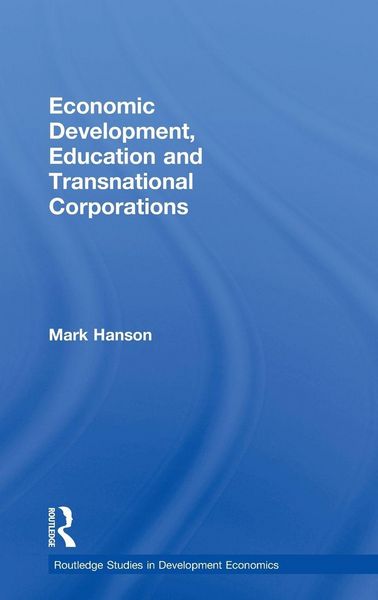

Economic Development, Education and Transnational Corporations
-
- Hardcover ausgewählt
- Taschenbuch
- eBook
-
Sprache:Englisch
239,99 €
inkl. gesetzl. MwSt.,
Beschreibung
Produktdetails
Einband
Gebundene Ausgabe
Erscheinungsdatum
09.08.2007
Abbildungen
schwarz-weiss Illustrationen, Zeichnungen, schwarz-weiss, Tabellen, schwarz-weiss
Verlag
Taylor and FrancisSeitenzahl
192
Maße (L/B/H)
24/16,1/1,5 cm
Gewicht
458 g
Sprache
Englisch
ISBN
978-0-415-77116-0
This book focuses on the questions of: why do some economically disadvantaged nations develop significantly faster than others, and what roles do their educational systems play? In the early 1960s Mexico and South Korea were both equally underdeveloped agrarian societies. Since that time, the development strategies pursued by each country resulted in dramatically different results. By the turn of the century South Korea possessed one of the finest educational systems in the world and was a world-class producer of high-tech products. Mexico, on the other hand, was still graduating less than half of its secondary school-age students and bogged down in assembling products owned by others. This book addresses the issues of what happened and why, and frames the consequences for other developing nations facing similar challenges. Professor Hanson argues that the key to understanding involves the manner and intensity in which these countries engaged their educational, governmental and business institutions to acquire manufacturing knowledge from offshored transnational corporations, and how they used these insights to grow their own local industries. Whereas South Korea studied the foreign outsourced plants as if they were educational systems and pursued with tenacity the new knowledge they possessed, Mexico viewed them as 'cash cows' that generated wages and reduced unemployment. The author emphasizes that significant educational reform will only break down the barriers of institutional bureaucracies when responding to the pressures and demands of industrialization. This is one of the first books of its kind to compare South-East Asian and Latin American economies and their links to educational systems.
Noch keine Bewertungen vorhanden
Verfassen Sie die erste Bewertung zu diesem Artikel
Helfen Sie anderen Kundinnen und Kunden durch Ihre Meinung.
Kurze Frage zu unserer Seite
Vielen Dank für Ihr Feedback
Wir nutzen Ihr Feedback, um unsere Produktseiten zu verbessern. Bitte haben Sie Verständnis, dass wir Ihnen keine Rückmeldung geben können. Falls Sie Kontakt mit uns aufnehmen möchten, können Sie sich aber gerne an unseren Kund*innenservice wenden.
zum Kundenservice