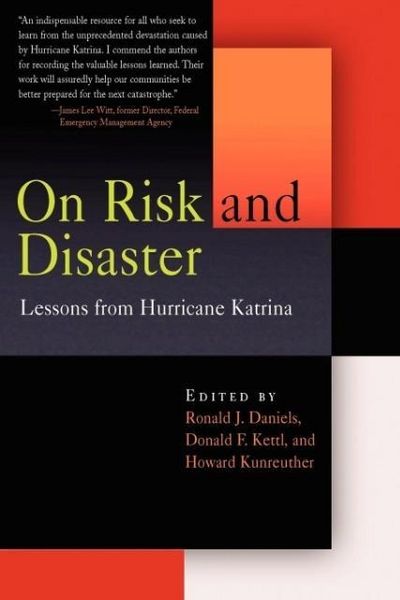
On Risk and Disaster Lessons from Hurricane Katrina
-
- Taschenbuch ausgewählt
- eBook
-
Sprache:Englisch
39,99 €
inkl. gesetzl. MwSt.,
Beschreibung
Produktdetails
Einband
Taschenbuch
Erscheinungsdatum
06.02.2006
Herausgeber
Ronald J. Daniels + weitereVerlag
University Of Pennsylvania PressSeitenzahl
304
Maße (L/B/H)
22,9/15/2,3 cm
Gewicht
454 g
Sprache
Englisch
ISBN
978-0-8122-1959-3
"This volume provides important insights from the nation's leading experts on how we, as a community and nation, should be rethinking disaster assessment, prevention, and mitigation. Policymakers, legislators, business leaders, and scholars: this is a must-read."--Jon Huntsman, Jr., Governor of Utah
"An indispensable resource for all who seek to learn from the unprecedented devastation caused by Hurricane Katrina. I commend the authors for recording the valuable lessons learned. Their work will assuredly help our communities be better prepared for the next catastrophe."--James Lee Witt, former Director, Federal Emergency Management Agency
"An enormously important volume that comes at just the right time. In the wake of Katrina, new thinking is urgently needed on how to manage catastrophic risk most effectively--especially regarding prevention and recovery. This precious volume offers insights on both fronts, with contributions from many of the nation's leading authorities on risk and disaster. It is a must-read for scholars and policymakers alike."--David A. Moss, Harvard Business School
Hurricane Katrina not only devastated a large area of the nation's Gulf coast, it also raised fundamental questions about ways the nation can, and should, deal with the inevitable problems of economic risk and social responsibility. This volume gathers leading experts to examine lessons that Hurricane Katrina teaches us about better assessing, perceiving, and managing risks from future disasters.
The 20 contributors to this volume address questions of public and private roles in assessing, managing, and dealing with risk in American society and suggest strategies for moving ahead in rebuilding the Gulf coast.
Contributors: Matthew Adler, Vicki Bier, Baruch Fischhoff, Kenneth R. Foster, Robert Giegengack, Peter Gosselin, Scott E. Harrington, Carolyn Kousky, Robert Meyer, Harvey G. Ryland, Brian L. Strom, Kathleen Tierney, Michael J. Trebilcock, Detlof von Winterfeldt, Jonathan Walters, Richard J. Zeckhauser.
Ronald J. Daniels is Provost and Professor of Law at the University of Pennsylvania. He has published widely, including Rethinking the Welfare State: The Prospects for Government by Voucher (with Michael Trebilcock) and The Security of Freedom: Essays on Canada's Anti-Terrorism Bill (coedited with Patrick Macklem and Kent Roach).
Donald F. Kettl, Professor of Political Science and Director of the Fels Institute of Government at the University of Pennsylvania, has written or edited System under Stress: Homeland Security and American Politics, The Global Public Management Revolution, The Politics of the Administrative Process (with James W. Fesler), The Transformation of Governance: Public Administration for the 21st Century, among many other books.
Howard Kunreuther is Professor and Codirector of the Risk Management and Decision Processes Center at the University of Pennsylvania's Wharton School. His has written or coedited a number of books, including Catastrophe Modeling: A New Approach to Managing Risk (with Patricia Grossi) and Wharton on Making Decisions (with Stephen Hoch).
Amy Gutmann is the eighth President of the University of Pennsylvania and the author of Why Deliberative Democracy? (with Dennis Thompson), Identity in Democracy, Democr
Noch keine Bewertungen vorhanden
Verfassen Sie die erste Bewertung zu diesem Artikel
Helfen Sie anderen Kundinnen und Kunden durch Ihre Meinung.
Kurze Frage zu unserer Seite
Vielen Dank für Ihr Feedback
Wir nutzen Ihr Feedback, um unsere Produktseiten zu verbessern. Bitte haben Sie Verständnis, dass wir Ihnen keine Rückmeldung geben können. Falls Sie Kontakt mit uns aufnehmen möchten, können Sie sich aber gerne an unseren Kund*innenservice wenden.
zum Kundenservice