KI-Beratung Beta

Gutscheinbedingungen

**Gültig bis 11.11.2026 auf Spielzeug, Schreibwaren, Filme, Geschenke & Trends, Musik, tolino eReader & Zubehör, Hörbücher und Hörbuch-Downloads, nicht preisgebundene Bücher und Kalender online auf thalia.at und in der Thalia App. Einzelne Artikel können ausgeschlossen sein. Aufgrund der Buchpreisbindung sind deutschsprachige Bücher und eBooks ausgenommen. Zusätzlich ausgenommen sind Abos & Flatrates, Games, Geschenkkarten/-boxen, Shelfies, Software, Zeitschriften sowie einzelne Artikel von tonies®. Pro Einkauf einmal einlösbar. Click & Collect nur bei Onlinevorabzahlung möglich. Keine Barauszahlung. Nicht kombinierbar mit anderen Aktionen und Gutscheinen. Gutschein wird auf max. 500€ Bestellwert angerechnet. Nicht gültig für Versandkosten und Services.

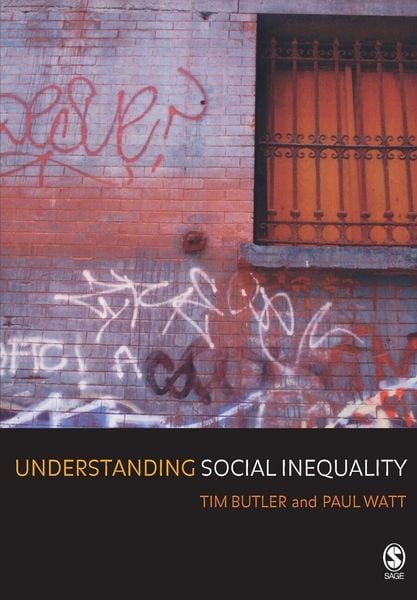
  • Produktbild: Understanding Social Inequality
  • Produktbild: Understanding Social Inequality

Understanding Social Inequality

111,99 €

inkl. gesetzl. MwSt., Versandkostenfrei


Beschreibung

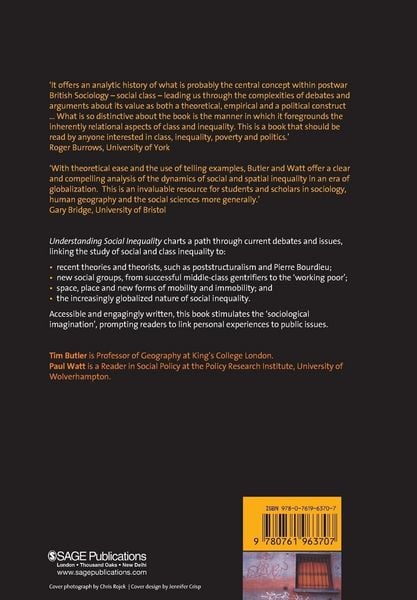
"This is a book that should be read by anyone interested in class, inequality, poverty and politics. Actually, probably more importantly it should be read by people who think that those things do not matter! It provides a wonderful summation of the huge amount of work on these topics that now exists...

Beschreibung

"This is a book that should be read by anyone interested in class, inequality, poverty and politics. Actually, probably more importantly it should be read by people who think that those things do not matter! It provides a wonderful summation of the huge amount of work on these topics that now exists and it also offers its own distinctive perspectives on a set of issues that are - despite the claims of some influential commentators - still central to the sociological enterprise and, indeed to political life."
- Roger Burrows, University of York

"A clear and compelling analysis of the dynamics of social and spatial inequality in an era of globalisation. This is an invaluable resource for students and scholars in sociology, human geography and the social sciences more generally."
- Gary Bridge, University of Bristol

With the declining attention paid to social class in sociology, how can we analyze continuing and pervasive socio-economic inequality? What is the impact of recent developments in sociology on how we should understand disadvantage?

Moving beyond the traditional dichotomies of social theory, this book brings the study of social stratification and inequality into the 21st century. Starting with the widely agreed ¿fact¿ that the world is becoming more unequal, this book brings together the ¿identity of displacement¿ in sociology and the ¿spaces of flow¿ of geography to show how place has become an increasingly important focus for understanding new trends in social inquality.

Produktdetails

Einband

Taschenbuch

Erscheinungsdatum

01.01.2007

Verlag O'Reilly
Seitenzahl

234

Produktdetails

Einband

Taschenbuch

Erscheinungsdatum

01.01.2007

Verlag O'Reilly
Seitenzahl

234

Maße (L/B/H)

24,4/17/1,3 cm

Gewicht

412 g

Sprache

Englisch

ISBN

978-0-7619-6370-7

Herstelleradresse

Libri GmbH
Europaallee 1
36244 Bad Hersfeld
DE

Email: gpsr@libri.de

Noch keine Bewertungen vorhanden

Verfassen Sie die erste Bewertung zu diesem Artikel

Helfen Sie anderen Kundinnen und Kunden durch Ihre Meinung.

Kundinnen und Kunden meinen

Bewertungen (0)

Die Leseprobe wird geladen.
  • Produktbild: Understanding Social Inequality
  • Produktbild: Understanding Social Inequality
  • Chapter 1: Introduction
    Chapter 2: Modernity, Postmodernity and Globalization
    The end of certainty
    The Enlightenment ¿project¿, modernity and postmodernity
    Globalization
    Models of globalization
    Globalization and migration
    Chapter 3: The Collar Line and Urban Boundaries
    Collars and classes
    Work and stratification in post-war Britain
    Class theory in British post-war sociology
    The Marxist response to sociology
    Urban boundaries
    Chapter 4: The Aftermath of Affluence
    Dual labour markets
    Marxism and the labour process
    Restructuring and the collapse of work
    The new space economy
    Emerging spatial divisions of labour and capitalist transformations
    Whatever happened to the collar line?
    Chapter 5: New Spatial and Social Divisions of Labour
    World cities
    Los Angeles and the ¿LA School¿
    Social polarization
    Gentrification and the urban-seeking middle classes
    The ghetto and the urban underclass
    Methodology and urban social polarization
    Chapter 6: Poverty, Social Exclusion and the Welfare State
    Welfare state regimes
    Poverty and social exclusion
    Poverty in the United States
    Poverty and social exclusion in Britain
    Poverty and social exclusion in Europe
    Towards a liberal welfare convergence?
    Chapter 7: New Work and New Workers
    New work
    Fast food workers - flipping burgers in the globally branded restaurant
    Call centres - taking calls in the interactive service factory
    Paid domestic workers - caring and cleaning in global cities
    Cash-in-hand jobs - informal work in marginal localities
    Young people - working and playing in a restructured region
    Chapter 8: Class Identity
    Class interests
    From class consciousness to class identity
    The French connection - Bourdieu
    Debating class identity
    Identity and organization