KI-Beratung Beta

Gutscheinbedingungen

**Gültig am 27.11.2026 auf Spielzeug, Schreibwaren, Filme, Geschenke & Trends, Musik, tolino eReader & Zubehör, Hörbücher und Hörbuch-Downloads, nicht preisgebundene Bücher und Kalender online auf thalia.at und in der Thalia App. Einzelne Artikel können ausgeschlossen sein. Aufgrund der Buchpreisbindung sind deutschsprachige Bücher und eBooks ausgenommen. Zusätzlich ausgenommen sind Abos & Flatrates, Games, Geschenkkarten/-boxen, Shelfies, Software, Zeitschriften sowie einzelne Artikel von tonies®. Pro Einkauf einmal einlösbar. Click & Collect nur bei Onlinevorabzahlung möglich. Keine Barauszahlung. Nicht kombinierbar mit anderen Aktionen und Gutscheinen. Gutschein wird auf max. 500€ Bestellwert angerechnet. Nicht gültig für Versandkosten und Services.

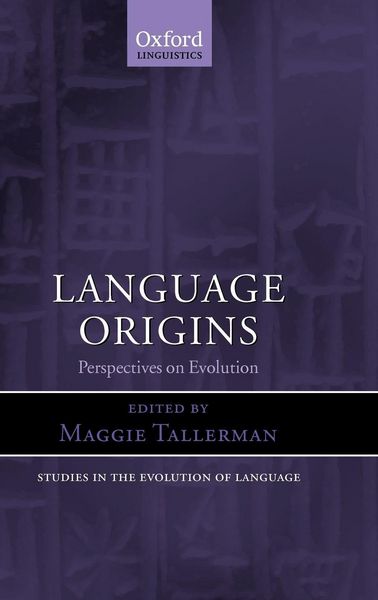
  • Produktbild: Language Origins
  • Produktbild: Language Origins

Language Origins Perspectives on Evolution

348,99 €

inkl. gesetzl. MwSt., Versandkostenfrei


Produktdetails

Einband

Gebundene Ausgabe

Erscheinungsdatum

26.05.2005

Abbildungen

numerous figures

Herausgeber Maggie Tallerman

Produktdetails

Einband

Gebundene Ausgabe

Erscheinungsdatum

26.05.2005

Abbildungen

numerous figures

Herausgeber Maggie Tallerman
Verlag Oxford University Press
Seitenzahl

448

Maße (L/B/H)

24/16,1/2,9 cm

Gewicht

834 g

Sprache

Englisch

ISBN

978-0-19-927903-6

Herstelleradresse

Libri GmbH
Europaallee 1
36244 Bad Hersfeld
DE

Email: gpsr@libri.de

Noch keine Bewertungen vorhanden

Verfassen Sie die erste Bewertung zu diesem Artikel

Helfen Sie anderen Kundinnen und Kunden durch Ihre Meinung.

Kundinnen und Kunden meinen

Bewertungen (0)

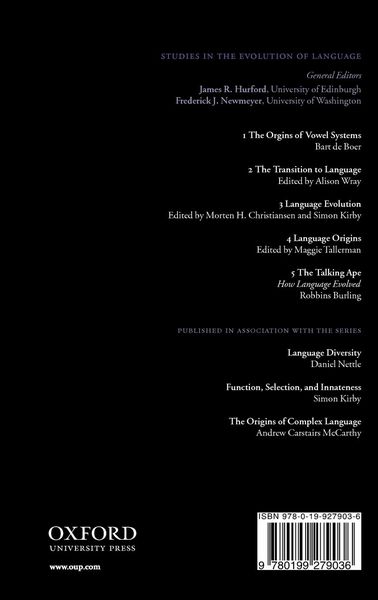
  • Produktbild: Language Origins
  • Produktbild: Language Origins

    • 1: Introduction


    • PART I Evolution of Speech and Speech Sounds: How did spoken language emerge?


    • Introduction to Part I: How did links between perception and production emerge for spoken language?


    • 2: Michael Arbib: The Mirror System Hypothesis: How did protolanguage evolve?


    • 3: Michael Studdert-Kennedy: How Did Language go Discrete?


    • 4: Pierre-Yves Oudeyer: From Holistic to Discrete Speech Sounds: The blind snowflake maker hypothesis


    • 5: Bart de Boer: Infant-Directed Speech and Evolution of Language


    • PART II Evolution of Grammar: How did syntax and morphology emerge?


    • Introduction to Part II: Protolanguage and the Development of Complexity


    • 6: Maggie Tallerman: Initial Syntax and Modern Syntax: Did the clause evolve from the syllable?


    • 7: Dana McDaniel: The Potential Role of Production in the Evolution of Syntax


    • 8: Andrew Carstairs-McCarthy: The Evolutionary Origin of Morphology


    • 9: Bernard Comrie and Tania Kuteva: The Evolution of Grammatical Structures and 'Functional Need' Explanations


    • 10: Bradley Franks and Kate Rigby: Deception and Mate Selection: Some implications for relevance and the evolution of language


    • PART III Analogous and Homologous Traits: What can we learn from other species?


    • Introductin to Part III: The Broadening Scope of Animal Communication Research


    • 11: Irene Maxine Pepperberg: An Avian Perspective on Language Evolution: Implications of simultaneous development of vocal and physical object combinations by a Grey parrot (Psittacus erithacus)


    • 12: Klaus Zuberbÿhler: Linguistic Prerequisites in the Primate Lineage


    • PART IV Learnability and Diversity: How did languages emerge and diverge?


    • Introduction to Part IV: Computer Modelling Widens the Focus of Language Study


    • 13: Henry Brighton, Simon Kirby, and Kenny Smith: Cultural Selection for Learnability: Three principles underlying the view that language adapts to be learnable


    • 14: Ted Briscoe: Coevolution of the Language Faculty and Language(s) With Decorrelated Encodings


    • 15: Matthew Roberts, Luca Onnis, and Nick Chater: Acquisition and Evolution of Quasi-regular Languages: Two puzzles for the price of one


    • 16: Zach Solan, Eytan Ruppin, David Horn, and Shimon Edelman: Evolution of Language Diversity: Why fitness counts


    • 17: Andrew D. M. Smith: Mutual Exclusivity: Communicative success despite conceptual divergence