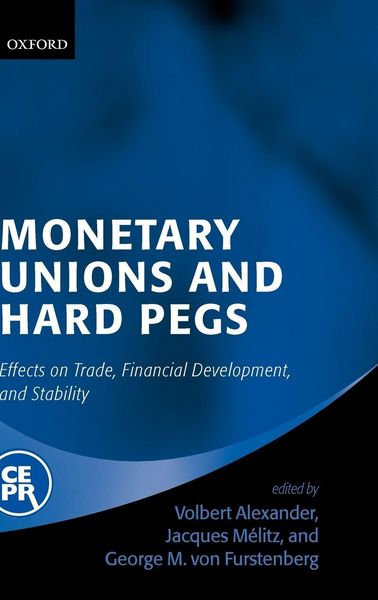
Monetary Unions and Hard Pegs Effects on Trade, Financial Development, and Stability
-
- Englisch ausgewählt
104,99 €
inkl. gesetzl. MwSt.,
Beschreibung
Produktdetails
Einband
Gebundene Ausgabe
Erscheinungsdatum
25.03.2004
Herausgeber
Alexander Volbert + weitereVerlag
Oxford AcademicSeitenzahl
400
Maße (L/B/H)
24/16,1/2,6 cm
Gewicht
744 g
Sprache
Englisch
ISBN
978-0-19-927140-5
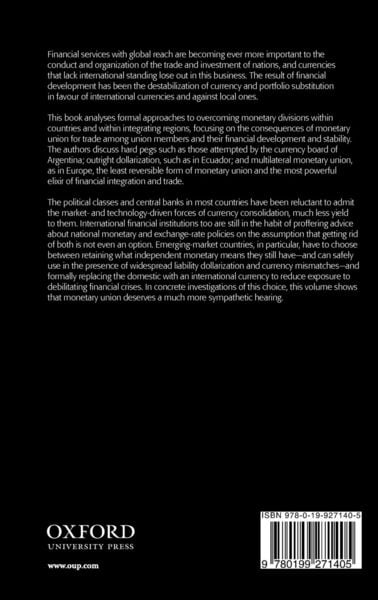
Financial services with global reach are becoming ever more important in the conduct and organization of the trade and investment of nations, and currencies that lack international standing lose out in this business. The result of financial development has been destabilizing currency and portfolio substitution -- in favour of international currencies and against local ones.
This book analyses formal approaches to overcoming monetary divisions within countries and within integrating regions, focusing on the consequences of monetary union for trade among union members and their financial development and stability. The authors discuss hard pegs such as those attempted by the currency board of Argentina, outright dollarization, such as in Ecuador, and multilateral monetary union, as in Europe, the least reversible form of monetary union and the most powerful elixir of financial integration and trade.
The political classes and central banks in most countries have been reluctant to admit the market- and technology-driven forces of currency consolidation, much less yield to them. International financial institutions too are still in the habit of proffering advice about national monetary and exchange-rate policies on the assumption that getting rid of both is not even an option. Emerging-market countries, in particular, have to choose between retaining what independent monetary means they still have -- and can safely use in the presence of widespread liability dollarization and currency mismatches -- and formally replacing the domestic with an international currency to reduce exposure to debilitating financial crises. In concrete investigations of this choice, this volume shows that monetary union deserves a much more sympathetic hearing.
Noch keine Bewertungen vorhanden
Verfassen Sie die erste Bewertung zu diesem Artikel
Helfen Sie anderen Kundinnen und Kunden durch Ihre Meinung.
Kurze Frage zu unserer Seite
Vielen Dank für Ihr Feedback
Wir nutzen Ihr Feedback, um unsere Produktseiten zu verbessern. Bitte haben Sie Verständnis, dass wir Ihnen keine Rückmeldung geben können. Falls Sie Kontakt mit uns aufnehmen möchten, können Sie sich aber gerne an unseren Kund*innenservice wenden.
zum Kundenservice