• Produktbild: Resilience Engineering
  • Produktbild: Resilience Engineering

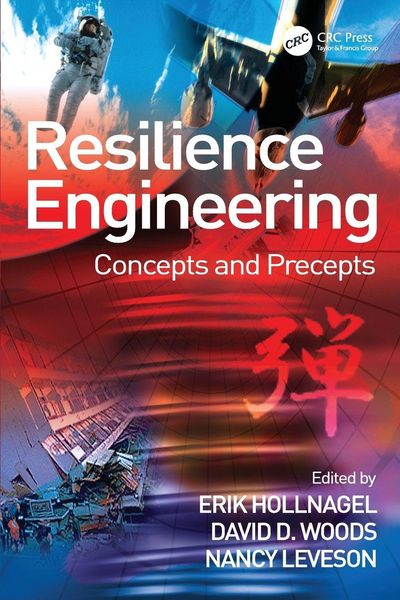
Resilience Engineering Concepts and Precepts

91,99 €

inkl. gesetzl. MwSt., Versandkostenfrei


Beschreibung

Produktdetails

Einband

Taschenbuch

Erscheinungsdatum

19.09.2006

Herausgeber

Erik Hollnagel + weitere

Verlag

Taylor & Francis

Seitenzahl

416

Maße (L/B/H)

23,4/15,6/2,3 cm

Gewicht

629 g

Sprache

Englisch

ISBN

978-0-7546-4904-5

Beschreibung

Rezension

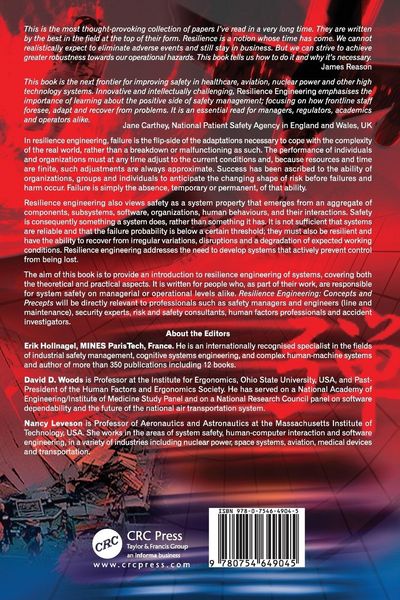
'This is the most thought-provoking collection of papers I've read in a very long time. They are written by the best in the field at the top of their form. Resilience is a notion whose time has come. We cannot realistically expect to eliminate adverse events and still stay in business. But we can strive to achieve greater robustness towards our operational hazards. This book tells us how to do it and why it's necessary.' James Reason 'This book is the next frontier for improving safety in healthcare, aviation, nuclear power and other high technology systems. Innovative and intellectually challenging, Resilience Engineering emphasises the importance of learning about the positive side of safety management; focusing on how frontline staff foresee, adapt and recover from problems. It is an essential read for managers, regulators, academics and operators alike.' Jane Carthey, National Patient Safety Agency in England and Wales, UK 'From my point of view the main achievement of the book is that it provides a turn in the perspective on system safety, from a mainly reactive "hindsight" perspective reflected in the numerous attempts to learn from events and accidents to a more proactive one focusing on the interrelation of safety and the characteristics of organizations as dynamic systems. Although I would hesitate to share the view of Dave Woods that this already represents a paradigm shift in safety research, I am at least convinced that the views and ideas presented in the book provide very important contributions to the understanding of high reliability organizations.' Human Factors and Ergonomics Society Newsletter. 2006 Featured in list 'Selected Works on Resilience, 2001-12' in Chronicle of Higher Education's The Chronicle Review, May 10, 2013

Produktdetails

Einband

Taschenbuch

Erscheinungsdatum

19.09.2006

Herausgeber

Verlag

Taylor & Francis

Seitenzahl

416

Maße (L/B/H)

23,4/15,6/2,3 cm

Gewicht

629 g

Sprache

Englisch

ISBN

978-0-7546-4904-5

EU-Ansprechpartner

Taylor & Francis Verlag GmbH
Kaufingerstraße 24
80331 München
DE
GPSR@taylorandfrancis.com

Herstelleradresse

Taylor & Francis Group
5 Howick Place
SW1P 1WG London
UK
GPSR@taylorandfrancis.com

Noch keine Bewertungen vorhanden

Verfassen Sie die erste Bewertung zu diesem Artikel

Helfen Sie anderen Kundinnen und Kunden durch Ihre Meinung.

Kundinnen und Kunden meinen

Bewertungen (0)

Die Leseprobe wird geladen.
  • Produktbild: Resilience Engineering
  • Produktbild: Resilience Engineering
  • Contents: Preface; Prologue: resilience engineering concepts, David D. Woods and Erik Hollnagel. Emergence: Resilience: the challenge of the unstable, Erik Hollnagel; Systems are ever-changing, Yushi Fujita; Essential characteristics of resilience, David D. Woods; Defining resilience, Andrew Hale and Tom Heijer; Nature of changes in systems, Yushi Fujita; Complexity, emergence, resilience, Jean Pariès; A typology of resilience situations, Ron Westrum; Resilient systems, Yushi Fujita; Incidents - markers of resilience or brittleness?, David D. Woods and Richard I. Cook; Resilience engineering: chronicling the emergence of confused consensus, Sidney Dekker. Cases and Processes: Engineering resilience into safety-critical systems, Nancy Leveson, Nicolas Dulac, David Zipkin, Joel Cutcher-Gershenfeld, John Carroll and Betty Barrett; Is resilience really necessary? the case of railways, Andrew Hale and Tom Heijer; Systems are never perfect, Yushi Fujita; Structure for management of weak and diffuse signals, Lars Axelsson; Organisational resilience and industrial risk, Nick McDonald; An evil chain mechanism leading to failures, Yushi Fujita; Safety management in airlines, Arthur Dijkstra; Taking things in one's stride: cognitive features of two resilient performances, Richard I. Cook and Christopher Nemeth; Erosion of managerial resilience: from Vasa to NASA, Rhona Flin; Learning how to create resilience in business systems, Gunilla Sundström and Erik Hollnagel; Optimum system safety and optimum system resilience: agonistic or antagonistic concepts?, René Amalberti. Challenges for a Practice of Resilience Engineering: Properties of resilient organisations: an initial view, John Wreathall; Remedies, Yushi Fujita; Auditing resilience in risk control and safety management systems, Andrew Hale, Frank Guldenmund and Louis Goossens; How to design a safety organization: test case for resilience engineering, David D. Woods; Rules and procedures, Yushi Fujita; Distancing throu