
KI-Beratung Beta

Gutscheinbedingungen

**Gültig am 27.11.2026 auf Spielzeug, Schreibwaren, Filme, Geschenke & Trends, Musik, tolino eReader & Zubehör, Hörbücher und Hörbuch-Downloads, nicht preisgebundene Bücher und Kalender online auf thalia.at und in der Thalia App. Einzelne Artikel können ausgeschlossen sein. Aufgrund der Buchpreisbindung sind deutschsprachige Bücher und eBooks ausgenommen. Zusätzlich ausgenommen sind Abos & Flatrates, Games, Geschenkkarten/-boxen, Shelfies, Software, Zeitschriften sowie einzelne Artikel von tonies®. Pro Einkauf einmal einlösbar. Click & Collect nur bei Onlinevorabzahlung möglich. Keine Barauszahlung. Nicht kombinierbar mit anderen Aktionen und Gutscheinen. Gutschein wird auf max. 500€ Bestellwert angerechnet. Nicht gültig für Versandkosten und Services.

  • Produktbild: The Political Philosophy of Needs
  • Produktbild: The Political Philosophy of Needs

The Political Philosophy of Needs

65,99 €

inkl. gesetzl. MwSt., Versandkostenfrei


Beschreibung

This ambitious and lively book argues for a rehabilitation of the concept of 'human needs' as central to politics and political theory. Contemporary political philosophy has focused on issues of justice and welfare to the exclusion of the important issues of political participation, democratic sovereignty,...

Beschreibung

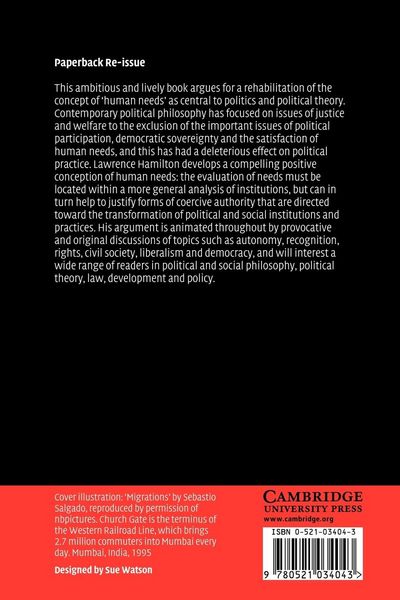
This ambitious and lively book argues for a rehabilitation of the concept of 'human needs' as central to politics and political theory. Contemporary political philosophy has focused on issues of justice and welfare to the exclusion of the important issues of political participation, democratic sovereignty, and the satisfaction of human needs, and this has had a deleterious effect on political practice. Lawrence Hamilton develops a compelling positive conception of human needs: the evaluation of needs must be located within a more general analysis of institutions, but can in turn help to justify forms of coercive authority that are directed toward the transformation of political and social institutions and practices. His argument is animated throughout by provocative and original discussions of topics such as autonomy, recognition, rights, civil society, liberalism and democracy, and will interest a wide range of readers in political and social philosophy, political theory, law, development and policy.

Produktdetails

Einband

Taschenbuch

Erscheinungsdatum

24.01.2007

Verlag Cambridge Academic
Seitenzahl

220

Produktdetails

Einband

Taschenbuch

Erscheinungsdatum

24.01.2007

Verlag Cambridge Academic
Seitenzahl

220

Maße (L/B/H)

22,9/15,2/1,3 cm

Gewicht

338 g

Sprache

Englisch

ISBN

978-0-521-03404-3

Herstelleradresse

Libri GmbH
Europaallee 1
36244 Bad Hersfeld
DE

Email: gpsr@libri.de

Noch keine Bewertungen vorhanden

Verfassen Sie die erste Bewertung zu diesem Artikel

Helfen Sie anderen Kundinnen und Kunden durch Ihre Meinung.

Kundinnen und Kunden meinen

Bewertungen (0)

  • Produktbild: The Political Philosophy of Needs
  • Produktbild: The Political Philosophy of Needs
  • Preface; Introduction; 1. Liberalism's rights-preferences couple; 2. Beyond the rights-preferences couple; 3. The form and outline of the argument; Part I. The Nature of Needs: 4. Need categories; 5. Vital needs; 6. Particular social needs; 7. Agency needs; 8. The natures of needs: historical, normative, political; Part II. The Formation and Interpretation of Needs: 9. Generation and legitimation; 10. Normative power and the institution of private property; 11. Perception and interpretation; 12. Oppression and need; 13. True interests; 14. The concepts of true interest; Part III. The Political Evaluation of Needs: 15. Freedom and rights: a critique of the concept of 'civil society'; 16. Practices, institutions, and the evaluation of institutions; 17. Roles: reclaiming the census; 18. Practical reason and practical imperatives; Part IV. The State of Needs: 19. The state; 20. The modern state, coercion and power; 21. The state as ultimate evaluator and guarantor for meeting needs; 22. Need priority: practical not theoretical; 23. Political participation: procedural and institutional proposals; 24. Legitimacy and paternalism; 25. States of needs; Conclusion: What needs to be done? The case of South Africa; Bibliography; Index.