KI-Beratung Beta

Gutscheinbedingungen

**Gültig bis 05.10.2026 ab einem Mindestbestellwert von 30€ auf Spielzeug, Schreibwaren, Filme, Geschenke & Trends, Musik, tolino eReader & Zubehör, Hörbücher und Hörbuch-Downloads, nicht preisgebundene Bücher und Kalender online auf thalia.at und in der Thalia App. Einzelne Artikel können ausgeschlossen sein. Aufgrund der Buchpreisbindung sind deutschsprachige Bücher und eBooks ausgenommen. Zusätzlich ausgenommen sind Abos & Flatrates, Games, Geschenkkarten/-boxen, Shelfies, Software, Zeitschriften sowie einzelne Artikel von tonies®. Pro Einkauf einmal einlösbar. Nur gültig mit im Onlineshop hinterlegter Bonuscard. Click & Collect nur bei Onlinevorabzahlung möglich. Keine Barauszahlung. Nicht kombinierbar mit anderen Aktionen und Gutscheinen. Gutschein wird auf max. 500€ Bestellwert angerechnet. Nicht gültig für Versandkosten und Services. Preisgebundene Artikel sind vom Mindestbestellwert ausgeschlossen.

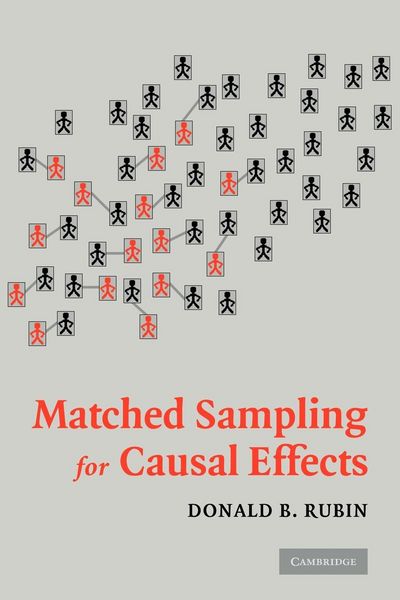
  • Produktbild: Matched Sampling for Causal Effects
  • Produktbild: Matched Sampling for Causal Effects

Matched Sampling for Causal Effects

73,99 €

inkl. gesetzl. MwSt., Versandkostenfrei


Beschreibung

Produktdetails

Einband

Taschenbuch

Erscheinungsdatum

30.06.2010

Verlag

Cambridge Academic

Seitenzahl

502

Maße (L/B/H)

23,4/15,6/2,7 cm

Gewicht

676 g

Sprache

Englisch

ISBN

978-0-521-67436-2

Beschreibung

Produktdetails

Einband

Taschenbuch

Erscheinungsdatum

30.06.2010

Verlag

Cambridge Academic

Seitenzahl

502

Maße (L/B/H)

23,4/15,6/2,7 cm

Gewicht

676 g

Sprache

Englisch

ISBN

978-0-521-67436-2

Noch keine Bewertungen vorhanden

Verfassen Sie die erste Bewertung zu diesem Artikel

Helfen Sie anderen Kundinnen und Kunden durch Ihre Meinung.

Kundinnen und Kunden meinen

Bewertungen (0)

  • Produktbild: Matched Sampling for Causal Effects
  • Produktbild: Matched Sampling for Causal Effects
  • Part I. The Early Years and the Influence of William G. Cochran: 1. William G. Cochran's contributions to the design, analysis, and evaluation of observational studies; 2. Controlling bias in observational studies: a review William G. Cochran; Part II. Univariate Matching Methods and the Dangers of Regression Adjustment: 3. Matching to remove bias in observational studies; 4. The use of matched sampling and regression adjustment to remove bias in observational studies; 5. Assignment to treatment group on the basis of a covariate; Part III. Basic Theory of Multivariate Matching: 6. Multivariate matching methods that are equal percent bias reducing, I: Some examples; 7. Multivariate matching methods that are equal percent bias reducing, II: Maximums on bias reduction for fixed sample sizes; 8. Using multivariate matched sampling and regression adjustment to control bias in observational studies; 9. Bias reduction using Mahalanobis-metric matching; Part IV. Fundamentals of Propensity Score Matching: 10. The central role of the propensity score in observational studies for causal effects Paul R. Rosenbaum; 11. Assessing sensitivity to an unobserved binary covariate in an observational study with binary outcome Paul R. Rosenbaum; 12. Reducing bias in observational studies using subclassification on the propensity score Paul R. Rosenbaum; 13. Constructing a control group using multivariate matched sampling methods that incorporate the propensity score Paul Rosenbaum; 14. The bias due to incomplete matching Paul R. Rosenbaum; Part V: Affinely Invariant Matching Methods with Ellipsoidally Symmetric Distributions, Theory and Methodology: 15. Affinely invariant matching methods with ellipsoidal distributions Neal Thomas; 16. Characterizing the effect of matching using linear propensity score methods with normal distributions Neal Thomas; 17. Matching using estimated propensity scores: relating theory to practice Neal Thomas; 18. Combining propensity score matching with additional adjustments for prognostic covariates; Part VI. Some Applied Contributions: 19. Causal inference in retrospective studies Paul Holland; 20. The design of the New York school choice scholarships program evaluation Jennifer Hill and Neal Thomas; 21. Estimating and using propensity scores with partially missing data Ralph D'Agostino Jr.; 22. Using propensity scores to help design observational studies: application to the tobacco litigation; Part VII. Some Focused Applications: 23. Criminality, aggression and intelligence in XYY and XXY men H. A. Witkin; 24. Practical implications of modes of statistical inference for causal effects and the critical role of the assignment mechanism; 25. In utero exposure to phenobarbital and intelligence deficits in adult men June Reinisch, Stephanie Sanders, and Erik Mortensen; 26. Estimating causal effects from large data sets using propensity scores; 27. On estimating the causal effects of DNR orders Martin McIntosh.