KI-Beratung Beta

Gutscheinbedingungen

**Gültig bis 11.11.2026 auf Spielzeug, Schreibwaren, Filme, Geschenke & Trends, Musik, tolino eReader & Zubehör, Hörbücher und Hörbuch-Downloads, nicht preisgebundene Bücher und Kalender online auf thalia.at und in der Thalia App. Einzelne Artikel können ausgeschlossen sein. Aufgrund der Buchpreisbindung sind deutschsprachige Bücher und eBooks ausgenommen. Zusätzlich ausgenommen sind Abos & Flatrates, Games, Geschenkkarten/-boxen, Shelfies, Software, Zeitschriften sowie einzelne Artikel von tonies®. Pro Einkauf einmal einlösbar. Click & Collect nur bei Onlinevorabzahlung möglich. Keine Barauszahlung. Nicht kombinierbar mit anderen Aktionen und Gutscheinen. Gutschein wird auf max. 500€ Bestellwert angerechnet. Nicht gültig für Versandkosten und Services.

  • Produktbild: Learning with Animation
  • Produktbild: Learning with Animation

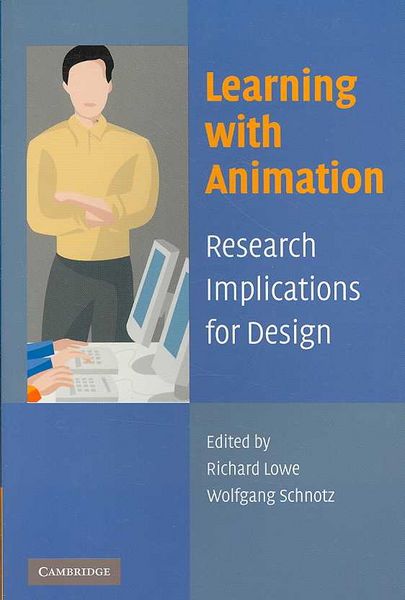
Learning with Animation Research Implications for Design

62,99 €

inkl. gesetzl. MwSt., Versandkostenfrei


Beschreibung

The use of animations has recently become very common in multimedia teaching and learning. Animations are assumed to increase interest and motivation, to direct attention, to illustrate procedures, and to explain how things work. Recent research shows that the educational effectiveness of animations...

Beschreibung

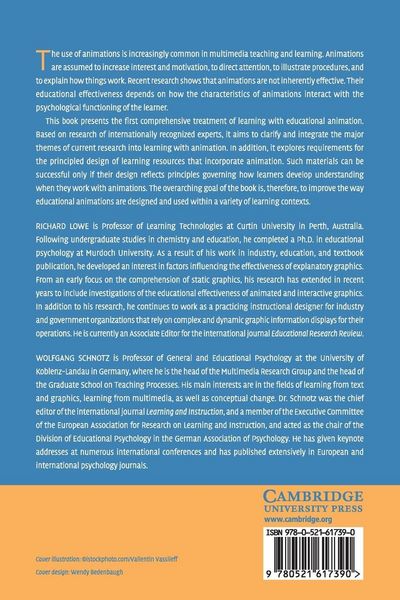
The use of animations has recently become very common in multimedia teaching and learning. Animations are assumed to increase interest and motivation, to direct attention, to illustrate procedures, and to explain how things work. Recent research shows that the educational effectiveness of animations depends on how their characteristics interact with the psychological functioning of the learner. This is the first comprehensive treatment of learning with educational animation, based on research of internationally recognized experts. The authors clarify and integrate the major themes of current research into learning with animation, exploring requirements for the principled design of learning resources that incorporate animation. Such materials can only be successful if their design reflects principles governing how learners develop understandings when they work with animations. The overarching goal of the book is therefore to improve the way educational animations are designed and used within a variety of learning contexts.

Produktdetails

Einband

Taschenbuch

Erscheinungsdatum

12.10.2018

Herausgeber Richard Lowe + weitere
Verlag Cambridge Academic

Produktdetails

Einband

Taschenbuch

Erscheinungsdatum

12.10.2018

Herausgeber
Verlag Cambridge Academic
Seitenzahl

402

Maße (L/B/H)

22,9/15,2/2,2 cm

Gewicht

546 g

Sprache

Englisch

ISBN

978-0-521-61739-0

Herstelleradresse

Libri GmbH
Europaallee 1
36244 Bad Hersfeld
DE

Email: gpsr@libri.de

Noch keine Bewertungen vorhanden

Verfassen Sie die erste Bewertung zu diesem Artikel

Helfen Sie anderen Kundinnen und Kunden durch Ihre Meinung.

Kundinnen und Kunden meinen

Bewertungen (0)

  • Produktbild: Learning with Animation
  • Produktbild: Learning with Animation
  • Preface Richard Lowe and Wolfgang Schnotz; Part I. Information Search and Processing: 1. Effects of knowledge and spatial ability on learning from animation Mary Hegarty and Sarah Kriz; 2. Research-based principles for learning with animation Richard Mayer; 3. Learning from animation: where to look, when to look Richard Lowe; Part II. Individual Differences and Strategies: 4. Successful and less successful use of dynamic visualizations in instructional texts Rolf Ploetzner, Daniel Bodemer and Sieglinde Neudert; 5. Functions of animation in comprehension and learning Wolfgang Schnotz and Thorsten Rasch; 6. Animations of thought: interactivity in the teachable agent paradigm Daniel L. Schwartz, Kristen P. Blair, Gautam Biswas, Krittaya Leelawong and Joan Davis; 7. Making sense of animation: how do children explore multimedia instruction? Mireille Bétrancourt and Alain Chassot; 8. Commentary on Parts I and II John R. Kirby; Part III. Interactivity and Learning: 9. Animated pedagogical agents: how do they help students construct knowledge from interactive multimedia games? Roxana Moreno; 10. Young learners' control of technical animations Jean-Michel Boucheix; 11. Turning the tables: investigating characteristics and efficacy of student-authored animations and multimedia N. Hari Narayanan and Theresa Hübscher-Younger; Part IV. Instructional Issues: 12. Enriching animations Barbara Tversky, Julie Heiser, Rachel Mackenzie, Sandra Lozano and Julie Morrison; 13. A comparison of how animation has been used to support formal, informal, and playful learning Yvonne Rogers; 14. A unified view of learning from animated and static graphics Wolfgang Schnotz and Richard Lowe; 15. Commentary on Parts III and IV Susan R. Goldman.