KI-Beratung Beta

Gutscheinbedingungen

**Gültig bis 09.11.2026 auf tolino shine color (4016621130473), tolino vision color (4016621130183) und tolino vision color weiß (4016621131456) online auf thalia.at, in der Thalia App und in allen Thalia Buchhandlungen in Österreich. In den Buchhandlungen nur gültig auf lagernde Ware. Pro Einkauf einmal einlösbar. Nur gültig gegen Vorlage oder im Onlineshop hinterlegter Bonuscard. Infos zur Einlösung in der Buchhandlung sind auf der Bonuscard-Vorteilspreisseite zu finden. Click & Collect nur bei Onlinevorabzahlung möglich. Keine Einlösung bei Scan & Go-Bezahlung. Keine Barauszahlung. Nicht kombinierbar mit anderen Aktionen und Gutscheinen. Nicht gültig für Geschenkkarten, Versandkosten und Services. Nur solange der Vorrat reicht.

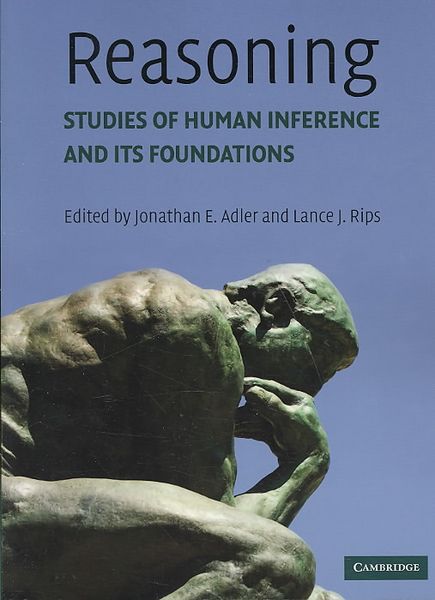
  • Produktbild: Reasoning
  • Produktbild: Reasoning

Reasoning Studies of Human Inference and its Foundations

112,99 €

inkl. gesetzl. MwSt., Versandkostenfrei


Beschreibung

Produktdetails

Einband

Taschenbuch

Erscheinungsdatum

27.07.2018

Herausgeber

Adler Jonathan E. + weitere

Verlag

Cambridge Academic

Seitenzahl

1072

Maße (L/B/H)

25,4/17,8/5,7 cm

Gewicht

1820 g

Sprache

Englisch

ISBN

978-0-521-61274-6

Beschreibung

Produktdetails

Einband

Taschenbuch

Erscheinungsdatum

27.07.2018

Herausgeber

Verlag

Cambridge Academic

Seitenzahl

1072

Maße (L/B/H)

25,4/17,8/5,7 cm

Gewicht

1820 g

Sprache

Englisch

ISBN

978-0-521-61274-6

Herstelleradresse

Libri GmbH
Europaallee 1
36244 Bad Hersfeld
DE

Email: gpsr@libri.de

Noch keine Bewertungen vorhanden

Verfassen Sie die erste Bewertung zu diesem Artikel

Helfen Sie anderen Kundinnen und Kunden durch Ihre Meinung.

Kundinnen und Kunden meinen

Bewertungen (0)

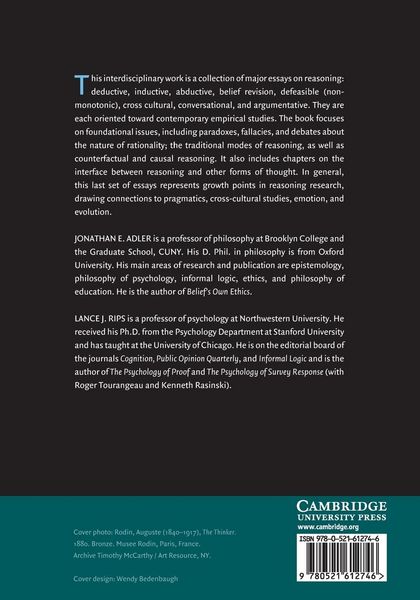
  • Produktbild: Reasoning
  • Produktbild: Reasoning
  • Preface; List of contributors; Introduction: philosophical foundations; Part I. Foundations of Reasoning: Section 1. Some Philosophical Viewpoints: 1. Change in view: principles of reasoning; 2. Belief and the will; 3. Internal and external reasons; 4. Paradoxes; Section 2. Fallacies and Rationality: 5. When rationality fails; 6. Extensional versus intuitive reasoning: the conjunction fallacy in probability judgment; 7. Can human irrationality be experimentally demonstrated?; 8. Breakdown of will; Part II. Modes of Reasoning: Section 3. Deductive Reasoning: 9. Logical approaches to human deductive reasoning; 10. Mental modes and deductive reasoning; 11. Interpretation, representation, and deductive reasoning; 12. Reasoning with quantifiers; 13. The problem of deduction; Section 4. Induction: 14. Patterns, rules, and inferences; 15. Inductive logic and inductive reasoning; 16. Reasoning in conceptual spaces; 17. Category-based induction; 18. When explanations compete: the role of explanatory coherence on judgments of likelihood; 19. Properties of inductive reasoning; Section 5. Dual and Integrative Approaches: 20. Human reasoning and argumentation: the probabalistic approach; 21. Individual differences in reasoning and the algorithmic/intentional level distinction in cognitive science; 22. Reasoning, decision making, and rationality; Section 6. Abduction and Belief Change: 23. Defeasible reasoning; 24. Explanatory coherence; 25. Belief revision; 26. Belief, doubt, and evidentialism; 27. Reflections on conscious reflection: mechanisms of impairment by reasons analysis; 28. Belief change as propositional update; Section 7. Causal and Counterfactual Reasoning: 29. Causal thinking; 30. Causation; 31. Propensities and counterfactuals: the loser that almost won; Section 8. Argumentation: 32. The layout of arguments; 33. The skills of argument; 34. Reasoning and conversation; Part III. Interactions of Reasoning in Human Thought: Section 9. Reasoning and Pragmatics: 35. Specificationism; 36. Presupposition, attention, and why-questions; 37. Further notes on logic and conversation; 38. The social context of reasoning: conversational inference and rational judgment; Section 10. Domain-Specific, Goal-Based, and Evolutionary Approaches: 39. Domain-specific knowledge and conceptual change; 40. Pragmatic reasoning schemas; 41. Beyond intuition and instinct blindness: toward an evolutionarily rigorous cognitive science; 42. Use or misuse of the selection task? Rejoinder to Fiddick, Cosmides, and Tooby; 43. Why we are so good at catching cheaters; 44. The modularity of mind: an essay on faculty psychology; 45. Commitment Brian Skyrms; 46. Evolution of inference; Section 11. Reasoning across Cultures: 47. Reasoning across cultures; 48. Culture and systems of thought: holistic versus analytic cognition; 49. On the very idea of a conceptual scheme; 50. The truth in relativism; Section 12. Biology, Emotions, and Reasoning: 51. Logic and biology: emotional inference and emotions in reasoning; 52. Distinct brain loci in deductive versus probabilistic reasoning; 53. The emotional dog and its rational tail: a social intuitionist approach to moral judgment; Index.