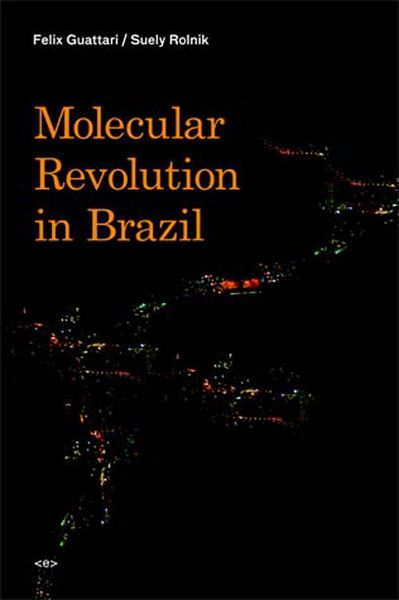
Molecular Revolution in Brazil
-
- Englisch ausgewählt
18,99 €
inkl. gesetzl. MwSt.,
- Kostenlose Lieferung ab 30 € Einkaufswert
- Versandkostenfrei für Bonuscard-Kund*innen
Beschreibung
Produktdetails
Einband
Taschenbuch
Altersempfehlung
ab 18 Jahr(e)
Erscheinungsdatum
01.12.2007
Verlag
Random House N.Y.Seitenzahl
496
Maße (L/B/H)
22,7/15,3/3,6 cm
Gewicht
726 g
Übersetzt von
Clapshow Karel + weitere
Sprache
Englisch
ISBN
978-1-58435-051-4
Yes, I believe that there is a multiple people, a people of mutants, a people of potentialities that appears and disappears, that is embodied in social, literary, and musical events.... I think that we're in a period of productivity, proliferation, creation, utterly fabulous revolutions from the viewpoint of this emergence of a people. That's molecular revolution: it isn't a slogan or a program, it's something that I feel, that I live....—from Molecular Revolution in Brazil
Following Brazil's first democratic election after two decades of military dictatorship, French philosopher Félix Guattari traveled through Brazil in 1982 with Brazilian psychoanalyst Suely Rolnik and discovered an exciting, new political vitality. In the infancy of its new republic, Brazil was moving against traditional hierarchies of control and totalitarian regimes and founding a revolution of ideas and politics. Molecular Revolution in Brazil documents the conversations, discussions, and debates that arose during the trip, including a dialogue between Guattari and Brazil's future President Luis Ignacia Lula da Silva, then a young gubernatorial candidate. Through these exchanges, Guattari cuts through to the shadowy practices of globalization gone awry and boldly charts a revolution in practice.
Assembled and edited by Rolnik, Molecular Revolution in Brazil is organized thematically; aphoristic at times, it presents a lesser-known, more overtly political aspect of Guattari's work. Originally published in Brazil in 1986 as Micropolitica: Cartografias do desejo, the book became a crucial reference for political movements in Brazil in the 1980s and 1990s. It now provides English-speaking readers with an invaluable picture of the radical thought and optimism that lies at the root of Lula's Brazil.
Noch keine Bewertungen vorhanden
Verfassen Sie die erste Bewertung zu diesem Artikel
Helfen Sie anderen Kundinnen und Kunden durch Ihre Meinung.
Kurze Frage zu unserer Seite
Vielen Dank für Ihr Feedback
Wir nutzen Ihr Feedback, um unsere Produktseiten zu verbessern. Bitte haben Sie Verständnis, dass wir Ihnen keine Rückmeldung geben können. Falls Sie Kontakt mit uns aufnehmen möchten, können Sie sich aber gerne an unseren Kund*innenservice wenden.
zum Kundenservice