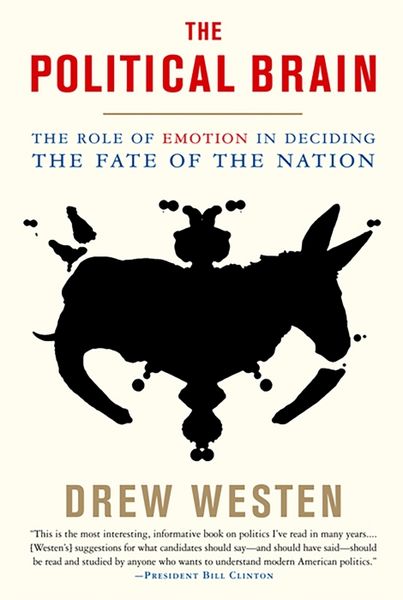
Political Brain The Role of Emotion in Deciding the Fate of the Nation
-
- Taschenbuch ausgewählt
- eBook
-
Sprache:Englisch
23,99 €
inkl. gesetzl. MwSt.,
- Kostenlose Lieferung ab 30 € Einkaufswert
- Versandkostenfrei für Bonuscard-Kund*innen
Beschreibung
Produktdetails
Verkaufsrang
18047
Einband
Taschenbuch
Erscheinungsdatum
01.05.2008
Verlag
Little, Brown and CompanySeitenzahl
496
Maße (L/B/H)
21/14/3 cm
Gewicht
674 g
Sprache
Englisch
ISBN
978-1-58648-573-3
The Political Brain is a groundbreaking investigation into the role of emotion in determining the political life of the nation. For two decades Drew Westen, professor of psychology and psychiatry at Emory University, has explored a theory of the mind that differs substantially from the more "dispassionate" notions held by most cognitive psychologists, political scientists, and economists -- and Democratic campaign strategists. The idea of the mind as a cool calculator that makes decisions by weighing the evidence bears no relation to how the brain actually works. When political candidates assume voters dispassionately make decisions based on "the issues," they lose. That's why only one Democrat has been re-elected to the presidency since Franklin Roosevelt -- and only one Republican has failed in that quest.
In politics, when reason and emotion collide, emotion invariably wins. Elections are decided in the marketplace of emotions, a marketplace filled with values, images, analogies, moral sentiments, and moving oratory, in which logic plays only a supporting role. Westen shows, through a whistle-stop journey through the evolution of the passionate brain and a bravura tour through fifty years of American presidential and national elections, why campaigns succeed and fail. The evidence is overwhelming that three things determine how people vote, in this order: their feelings toward the parties and their principles, their feelings toward the candidates, and, if they haven't decided by then, their feelings toward the candidates' policy positions.
Westen turns conventional political analyses on their head, suggesting that the question for Democratic politics isn't so much about moving to the right or the left but about moving the electorate. He shows how it can be done through examples of what candidates have said -- or could have said -- in debates, speeches, and ads. Westen's discoveries could utterly transform electoral arithmetic, showing how a different view of the mind and brain leads to a different way of talking with voters about issues that have tied the tongues of Democrats for much of forty years -- such as abortion, guns, taxes, and race. You can't change the structure of the brain. But you can change the way you appeal to it. And here's how
Noch keine Bewertungen vorhanden
Verfassen Sie die erste Bewertung zu diesem Artikel
Helfen Sie anderen Kundinnen und Kunden durch Ihre Meinung.
Kurze Frage zu unserer Seite
Vielen Dank für Ihr Feedback
Wir nutzen Ihr Feedback, um unsere Produktseiten zu verbessern. Bitte haben Sie Verständnis, dass wir Ihnen keine Rückmeldung geben können. Falls Sie Kontakt mit uns aufnehmen möchten, können Sie sich aber gerne an unseren Kund*innenservice wenden.
zum Kundenservice