Produktbild: Theory of Games and Economic Behavior

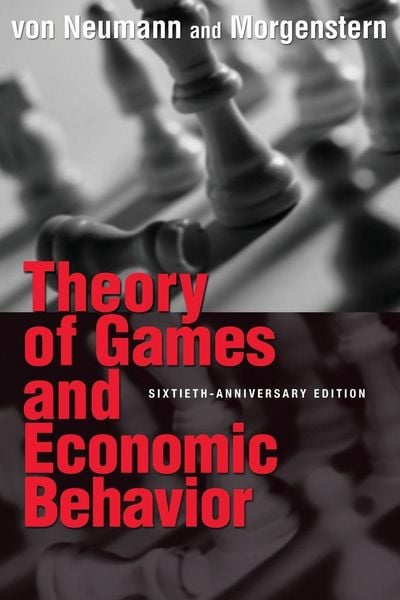
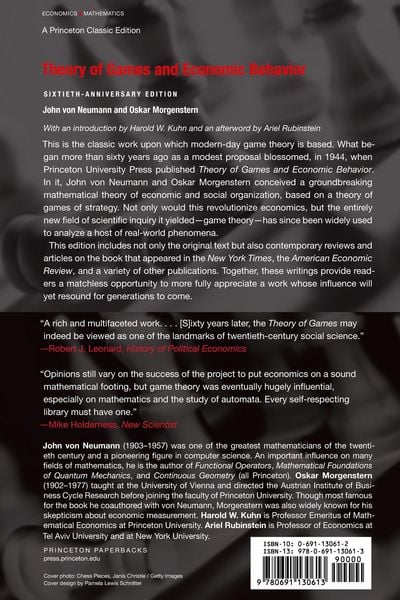
Theory of Games and Economic Behavior 60th Anniversary Commemorative Edition

86,99 €

inkl. gesetzl. MwSt., Versandkostenfrei


Beschreibung

Produktdetails

Einband

Taschenbuch

Erscheinungsdatum

08.04.2007

Abbildungen

105 line illus. 9 tables.

Verlag

Princeton University Press

Seitenzahl

776

Maße (L/B/H)

23,4/15,6/4,6 cm

Gewicht

1298 g

Farbe

Anthrazit / Seidengrau

Auflage

60th Anniversary Commemorative Edition

Sprache

Englisch

ISBN

978-0-691-13061-3

Beschreibung

Produktdetails

Einband

Taschenbuch

Erscheinungsdatum

08.04.2007

Abbildungen

105 line illus. 9 tables.

Verlag

Princeton University Press

Seitenzahl

776

Maße (L/B/H)

23,4/15,6/4,6 cm

Gewicht

1298 g

Farbe

Anthrazit / Seidengrau

Auflage

60th Anniversary Commemorative Edition

Sprache

Englisch

ISBN

978-0-691-13061-3

Herstelleradresse

Libri GmbH
Europaallee 1
36244 Bad Hersfeld
DE

Email: GPSR Kontakt

Noch keine Bewertungen vorhanden

Verfassen Sie die erste Bewertung zu diesem Artikel

Helfen Sie anderen Kundinnen und Kunden durch Ihre Meinung.

Kundinnen und Kunden meinen

Bewertungen (0)

  • Produktbild: Theory of Games and Economic Behavior
    • PREFACE
    • TECHNICAL NOTE
    • ACKNOWLEDGMENT
    • CHAPTER I
    • FORMULATION OF THE ECONOMIC PROBLEM
    • 1. THE MATHEMATICAL METHOD IN ECONOMICS
      • 1.1. Introductory remarks
      • 1.2. Difficulties of the application of the mathematical method
      • 1.3. Necessary limitations of the objectives
      • 1.4. Concluding remarks
    • 2. QUALITATIVE DISCUSSION OF THE PROBLEM OF RATIONAL BEHAVIOR
      • 2.1. The problem of rational behavior
      • 2.2. “Robinson Crusoe” economy and social exchange economy
      • 2.3. The number of variables and the number of participants
      • 2.4. The case of many participants: Free competition
      • 2.5. The “Lausanne” theory
    • 3. THE NOTION OF UTILITY
      • 3.1. Preferences and utilities
      • 3.2. Principles of measurement: Preliminaries
      • 3.3. Probability and numerical utilities
      • 3.4. Principles of measurement: Detailed discussion
      • 3.5. Conceptual structure of the axiomatic treatment of numerical utilities
      • 3.6. The axioms and their interpretation
      • 3.7. General remarks concerning the axioms
      • 3.8. The role of the concept of marginal utility
    • 4. STRUCTURE OF THE THEORY: SOLUTIONS AND STANDARDS OF BEHAVIOR
      • 4.1. The simplest concept of a solution for one participant
      • 4.2. Extension to all participants
      • 4.3. The solution as a set of imputations
      • 4.4. The intransitive notion of “superiority” or “domination”
      • 4.5. The precise definition of a solution
      • 4.6. Interpretation of our definition in terms of “standards of behavior”
      • 4.7. Games and social organizations
      • 4.8. Concluding remarks
    • CHAPTER II
    • GENERAL FORMAL DESCRIPTION OF GAMES OF STRATEGY
    • 5. INTRODUCTION
      • 5.1. Shift of emphasis from economics to games
      • 5.2. General principles of classification and of procedure
    • 6. THE SIMPLIFIED CONCEPT OF A GAME
      • 6.1. Explanation of the termini technici
      • 6.2. The elements of the game
      • 6.3. Information and preliminary
      • 6.4. Preliminarity, transitivity, and signaling
    • 7. THE COMPLETE CONCEPT OF A GAME
      • 7.1. Variability of the characteristics of each move
      • 7.2. The general description
    • 8. SETS AND PARTITIONS
      • 8.1. Desirability of a set-theoretical description of a game
      • 8.2. Sets, their properties, and their graphical representation
      • 8.3. Partitions, their properties, and their graphical representation
      • 8.4. Logistic interpretation of sets and partitions
    • *9. THE SET-THEORETICAL DESCRIPTION OF A GAME
      • *9.1. The partitions which describe a game
      • *9.2. Discussion of these partitions and their properties
    • *10. AXIOMATIC FORMULATION
      • *10.1. The axioms and their interpretations
      • *10.2. Logistic discussion of the axioms
      • *10.3. General remarks concerning the axioms
      • *10.4. Graphical representation
    • 11. STRATEGIES AND THE FINAL SIMPLIFICATION OF THE DESCRIPTION OF A GAME
      • 11.1. The concept of a strategy and its formalization
      • 11.2. The final simplification of the description of a game
      • 11.3. The role of strategies in the simplified form of a game
      • 11.4. The meaning of the zero-sum restriction
    • CHAPTER III
    • ZERO-SUM TWO-PERSON GAMES: THEORY
    • 12. PRELIMINARY SURVEY
      • 12.1. General viewpoints
      • 12.2. The one-person game
      • 12.3. Chance and probability
      • 12.4. The next objective
    • 13. FUNCTIONAL CALCULUS
      • 13.1. Basic definitions
      • 13.2. The operations Max and Min
      • 13.3 Commutativity questions
      • 13.4. The mixed case. Saddle points
      • 13.5. Proofs of the main facts
    • 14. STRICTLY DETERMINED GAMES
      • 14 1. Formulation of the problem
      • 14.2. The minorant and the majorant games
      • 14.3. Discussion of the auxiliary games
      • 14.4. Conclusions
      • 14.5. Analysis of strict determinateness
      • 14.6. The interchange of players. Symmetry
      • 14.7. Non strictly determined games
      • 14.8. Program of a detailed analysis of strict determinateness
    • *15. GAMES WITH PERFECT INFORMATION
      • *15.1. Statement of purpose. Induction
      • *15.2. The exact condition (First step)
      • *15.3. The exact condition (Entire induction)
      • *15.4. Exact discussion of the inductive step
      • *15.5. Exact discussion of the inductive step (Continuation)
      • *15.6. The result in the case of perfect information
      • *15.7. Application to Chess
      • *15.8. The alternative, verbal discussion
    • 16. LINEARITY AND CONVEXITY
      • 16.1. Geometrical background
      • 16.2. Vector operations
      • 16.3. The theorem of the supporting hyperplanes
      • 16.4. The theorem of the alternative for matrices
    • 17. MIXED STRATEGIES. THE SOLUTION FOR ALL GAMES
      • 17.1. Discussion of two elementary examples
      • 17.2. Generalization of this viewpoint
      • 17.3. Justification of the procedure as applied to an individual play
      • 17.4. The minorant and the majorant games. (For mixed strategies)
      • 17.5. General strict determinateness
      • 17.6. Proof of the main theorem
      • 17.7. Comparison of the treatment by pure and by mixed strategies
      • 17.8. Analysis of general strict determinateness
      • 17.9. Further characteristics of good strategies
      • 17.10. Mistakes and their consequences. Permanent optimality
      • 17.11. The interchange of players. Symmetry
    • CHAPTER IV
    • ZERO-SUM TWO-PERSON GAMES: EXAMPLES
    • 18. SOME ELEMENTARY GAMES
      • 18.1. The simplest games
      • 18.2. Detailed quantitative discussion of these games
      • 18.3. Qualitative characterizations
      • 18.4. Discussion of some specific games. (Generalized forms of Matching Pennies)
      • 18.5. Discussion of some slightly more complicated games
      • 18.6. Chance and imperfect information
      • 18.7. Interpretation of this result
    • *19. POKER AND BLUFFING
      • *19.1. Description of Poker
      • *19.2. Bluffing
      • *19.3. Description of Poker (Continued)
      • *19.4. Exact formulation of the rules
      • *19.5. Description of the strategy
      • *19.6. Statement of the problem
      • *19.7. Passage from the discrete to the continuous problem
      • *19.8. Mathematical determination of the solution
      • *19.9. Detailed analysis of the solution
      • *19.10. Interpretation of the solution
      • *19.11. More general forms of Poker
      • *19.12. Discrete hands
      • *19.13. m possible bids
      • *19.14. Alternate bidding
      • *19.15. Mathematical description of all solutions
      • *19.16. Interpretation of the solutions. Conclusions
    • CHAPTER V
    • ZERO-SUM THREE-PERSON GAMES
    • 20. PRELIMINARY SURVEY
      • 20.1. General viewpoints
      • 20.2. Coalitions
    • 21. THE SIMPLE MAJORITY GAME OF THREE PERSONS
      • 21.1. Definition of the game
      • 21.2. Analysis of the game: Necessity of “understandings”
      • 21.3. Analysis of the game: Coalitions. The role of symmetry
    • 22. FURTHER EXAMPLES
      • 22.1. Unsymmetric distributions. Necessity of compensations
      • 22.2. Coalitions of different strength. Discussion
      • 22.3. An inequality. Formulae
    • 23. THE GENERAL CASE
      • 23.1. Detailed discussion. Inessential and essential games
      • 23.2. Complete formulae
    • 24. DISCUSSION OF AN OBJECTION
      • 24.1. The case of perfect information and its significance
      • 24.2. Detailed discussion. Necessity of compensations between three or more players
    • CHAPTER VI
    • FORMULATION OF THE GENERAL THEORY: ZERO-SUM n-PERSON GAMES
    • 25. THE CHARACTERISTIC FUNCTION
      • 25.1. Motivation and definition
      • 25.2. Discussion of the concept
      • 25.3. Fundamental properties
      • 25.4. Immediate mathematical consequences
    • 26. CONSTRUCTION OF A GAME WITH A GIVEN CHARACTERISTIC FUNCTION
      • 26.1. The construction
      • 26.2. Summary
    • 27. STRATEGIC EQUIVALENCE. INESSENTIAL AND ESSENTIAL GAMES
      • 27.1. Strategic equivalence. The reduced form
      • 27.2. Inequalities. The quantity γ
      • 27.3. Inessentiality and essentiality
      • 27.4. Various criteria. Non additive utilities
      • 27.5. The inequalities in the essential case
      • 27.6. Vector operations on characteristic functions
    • 28. GROUPS, SYMMETRY AND FAIRNESS
      • 28.1. Permutations, their groups and their effect on a game
      • 28.2. Symmetry and fairness
    • 29. RECONSIDERATION OF THE ZERO-SUM THREE-PERSON GAME
      • 29.1. Qualitative discussion
      • 29.2. Quantitative discussion
    • 30. THE EXACT FORM OF THE GENERAL DEFINITIONS
      • 30.1. The definitions
      • 30.2. Discussion and recapitulation
      • *30.3. The concept of saturation
      • 30.4. Three immediate objectives
    • 31. FIRST CONSEQUENCES
      • 31.1. Convexity, flatness, and some criteria for domination
      • 31.2. The system of all imputations. One element solutions
      • 31.3. The isomorphism which corresponds to strategic equivalence
    • 32. DETERMINATION OF ALL SOLUTIONS OF THE ESSENTIAL ZERO-SUM THREE-PERSON GAME
      • 32.1. Formulation of the mathematical problem. The graphical method
      • 32.2. Determination of all solutions
    • 33. CONCLUSIONS
      • 33.1. The multiplicity of solutions. Discrimination and its meaning
      • 33.2. Statics and dynamics
    • CHAPTER VII
    • ZERO-SUM FOUR-PERSON GAMES
    • 34. PRELIMINARY SURVEY
      • 34.1. General viewpoints
      • 34.2. Formalism of the essential zero sum four person games
      • 34.3. Permutations of the players
    • 35. DISCUSSION OF SOME SPECIAL POINTS IN THE CUBE Q
      • 35.1. The corner I. (and V., VI., VII.)
      • 35.2. The corner VIII. (and II., III., IV.,). The three person game and a “Dummy”
      • 35.3. Some remarks concerning the interior of Q
    • 36. DISCUSSION OF THE MAIN DIAGONALS
      • 36.1. The part adjacent to the corner VIII.: Heuristic discussion
      • 36.2. The part adjacent to the corner VIII.: Exact discussion
      • *36.3. Other parts of the main diagonals
    • 37. THE CENTER AND ITS ENVIRONS
      • 37.1. First orientation about the conditions around the center
      • 37.2. The two alternatives and the role of symmetry
      • 37.3. The first alternative at the center
      • 37.4. The second alternative at the center
      • 37.5. Comparison of the two central solutions
      • 37.6. Unsymmetrical central solutions
    • *38. A FAMILY OF SOLUTIONS FOR A NEIGHBORHOOD OF THE CENTER
      • *38.1. Transformation of the solution belonging to the first alternative at the center
      • *38.2. Exact discussion
      • *38.3. Interpretation of the solutions
    • CHAPTER VIII
    • SOME REMARKS CONCERNING n ≥ 5 PARTICIPANTS
    • 39. THE NUMBER OF PARAMETERS IN VARIOUS CLASSES OF GAMES
      • 39.1. The situation for n = 3, 4
      • 39.2. The situation for all n ≥ 3
    • 40. THE SYMMETRIC FIVE PERSON GAME
      • 40.1. Formalism of the symmetric five person game
      • 40.2. The two extreme cases
      • 40.3. Connection between the symmetric five person game and the 1, 2, 3-symmetric four person game
    • CHAPTER IX
    • COMPOSITION AND DECOMPOSITION OF GAMES
    • 41. COMPOSITION AND DECOMPOSITION
      • 41.1. Search for n-person games for which all solutions can be determined
      • 41.2. The first type. Composition and decomposition
      • 41.3. Exact definitions
      • 41.4. Analysis of decomposability
      • 41.5. Desirability of a modification
    • 42. MODIFICATION OF THE THEORY
      • 42.1. No complete abandonment of the zero sum restriction
      • 42.2. Strategic equivalence. Constant sum games
      • 42.3. The characteristic function in the new theory
      • 42.4. Imputations, domination, solutions in the new theory
      • 42.5. Essentiality, inessentiality and decomposability in the new theory
    • 43. THE DECOMPOSITION PARTITION
      • 43.1. Splitting sets. Constituents
      • 43.2. Properties of the system of all splitting sets
      • 43.3. Characterization of the system of all splitting sets. The decomposition partition
      • 43.4. Properties of the decomposition partition
    • 44. DECOMPOSABLE GAMES. FURTHER EXTENSION OF THE THEORY
      • 44.1. Solutions of a (decomposable) game and solutions of its constituents
      • 44.2. Composition and decomposition of imputations and of sets of imputations
      • 44.3. Composition and decomposition of solutions. The main possibilities and surmises
      • 44.4. Extension of the theory. Outside sources
      • 44.5. The excess
      • 44.6. Limitations of the excess. The non-isolated character of a game in the new setup
      • 44.7. Discussion of the new setup. E(e0), F(e0)
    • 45. LIMITATIONS OF THE EXCESS. STRUCTURE OF THE EXTENDED THEORY
      • 45.1. The lower limit of the excess
      • 45.2. The upper limit of the excess. Detached and fully detached imputations
      • 45.3. Discussion of the two limits, |Γ|1. |Γ|2. Their ratio
      • 45.4. Detached imputations and various solutions. The theorem connecting E(e0), F(e0)
      • 45.5. Proof of the theorem
      • 45.6. Summary and conclusions
    • 46. DETERMINATION OF ALL SOLUTIONS OF A DECOMPOSABLE GAME
      • 46.1. Elementary properties of decompositions
      • 46.2. Decomposition and its relation to the solutions: First results concerning F(e0)
      • 46.3. Continuation
      • 46.4. Continuation
      • 46.5. The complete result in F(e0)
      • 46.6. The complete result in E(e0)
      • 46.7. Graphical representation of a part of the result
      • 46.8. Interpretation: The normal zone. Heredity of various properties
      • 46.9. Dummies
      • 46.10. Imbedding of a game
      • 46.11. Significance of the normal zone
      • 46.12. First occurrence of the phenomenon of transfer: n = 6
    • 47. THE ESSENTIAL THREE-PERSON GAME IN THE NEW THEORY
      • 47.1. Need for this discussion
      • 47.2. Preparatory considerations
      • 47.3. The six cases of the discussion. Cases (I)−(III)
      • 47.4. Case (IV): First part
      • 47.5. Case (IV): Second part
      • 47.6. Case (V)
      • 47.7. Case (VI)
      • 47.8. Interpretation of the result: The curves (one dimensional parts) in the solution
      • 47.9. Continuation: The areas (two dimensional parts) in the solution
    • CHAPTER X
    • SIMPLE GAMES
    • 48. WINNING AND LOSING COALITIONS AND GAMES WHERE THEY OCCUR
      • 48.1. The second type of 41.1. Decision by coalitions
      • 48.2. Winning and Losing Coalitions
    • 49. CHARACTERIZATION OF THE SIMPLE GAMES
      • 49.1. General concepts of winning and losing coalitions
      • 49.2. The special role of one element sets
      • 49.3. Characterization of the systems W, L of actual games
      • 49.4. Exact definition of simplicity
      • 49.5. Some elementary properties of simplicity
      • 49.6. Simple games and their W, L. The Minimal winning coalitions: Wm
      • 49.7. The solutions of simple games
    • 50. THE MAJORITY GAMES AND THE MAIN SOLUTION
      • 50.1. Examples of simple games: The majority games
      • 50.2. Homogeneity
      • 50.3. A more direct use of the concept of imputation in forming solutions
      • 50.4. Discussion of this direct approach
      • 50.5. Connections with the general theory. Exact formulation
      • 50.6. Reformulation of the result
      • 50.7. Interpretation of the result
      • 50.8. Connection with the Homogeneous Majority game.
    • 51. METHODS FOR THE ENUMERATION OF ALL SIMPLE GAMES
      • 51.1. Preliminary Remarks
      • 51.2. The saturation method: Enumeration by means of W
      • 51.3. Reasons for passing from W to Wm. Difficulties of using Wm
      • 51.4. Changed Approach: Enumeration by means of Wm
      • 51.5. Simplicity and decomposition
      • 51.6. Inessentiality, Simplicity and Composition. Treatment of the excess
      • 51.7. A criterium of decomposability in terms of Wm
    • 52. THE SIMPLE GAMES FOR SMALL n
      • 52.1. Program. n = 1, 2 play no role. Disposal of n = 3
      • 52.2. Procedure for n ≥ 4: The two element sets and their role in classifying the Wm
      • 52.3. Decomposability of cases C*, Cn−2, Cn−1
      • 52.4. The simple games other than [1, • • •, 1, n − 2]h (with dummies): The Cases Ck, k = 0, 1, • • •, n − 3
      • 52.5. Disposal of n = 4, 5
    • 53. THE NEW POSSIBILITIES OF SIMPLE GAMES FOR n ≥ 6
      • 53.1. The Regularities observed for n ≥ 6
      • 53.2. The six main counter examples (for n = 6, 7)
    • 54. DETERMINATION OF ALL SOLUTIONS IN SUITABLE GAMES
      • 54.1. Reasons to consider other solutions than the main solution in simple games
      • 54.2. Enumeration of those games for which all solutions are known
      • 54.3. Reasons to consider the simple game [1, • • •, 1, n – 2]h
    • *55. THE SIMPLE GAME [1, • • •, 1, n – 2]h
      • *55.1. Preliminary Remarks
      • *55.2. Domination. The chief player. Cases (I) and (II)
      • *55.3. Disposal of Case (I)
      • *55.4. Case (II): Determination of Ṿ
      • *55.5. Case (II): Determination of Ṿ
      • *55.6. Case (II): a and S*
      • *55.7. Case (II′) and (II″). Disposal of Case (II′)
      • *55.8. Case (II″): a and V′. Domination
      • *55.9. Case (II″): Determination of V′
      • *55.10. Disposal of Case (II″)
      • *55.11. Reformulation of the complete result
      • *55.12. Interpretation of the result
    • CHAPTER XI
    • GENERAL NON-ZERO-SUM GAMES
    • 56. EXTENSION OF THE THEORY
      • 56.1. Formulation of the problem
      • 56.2. The fictitious player. The zero sum extension Γ
      • 56.3. Questions concerning the character of Γ
      • 56.4. Limitations of the use of Γ
      • 56.5. The two possible procedures
      • 56.6. The discriminatory solutions
      • 56.7. Alternative possibilities
      • 56.8. The new setup
      • 56.9. Reconsideration of the case when Γ is a zero sum game
      • 56.10. Analysis of the concept of domination
      • 56.11. Rigorous discussion
      • 56.12. The new definition of a solution
    • 57. THE CHARACTERISTIC FUNCTION AND RELATED TOPICS
      • 57.1. The characteristic function: The extended and the restricted form
      • 57.2. Fundamental properties
      • 57.3. Determination of all characteristic functions
      • 57.4. Removable sets of players
      • 57.5. Strategic equivalence. Zero-sum and constant-sum games
    • 58. INTERPRETATION OF THE CHARACTERISTIC FUNCTION
      • 58.1. Analysis of the definition
      • 58.2. The desire to make a gain vs. that to inflict a loss
      • 58.3. Discussion
    • 59. GENERAL CONSIDERATIONS
      • 59.1. Discussion of the program
      • 59.2. The reduced forms. The inequalities
      • 59.3. Various topics
    • 60. THE SOLUTIONS OF ALL GENERAL GAMES WITH n ≦ 3
      • 60.1. The case n = 1
      • 60.2. The case n = 2
      • 60.3. The case n = 3
      • 60.4. Comparison with the zero sum games
    • 61. ECONOMIC INTERPRETATION OF THE RESULTS FOR n = 1, 2
      • 61.1. The case n = 1
      • 61.2. The case n = 2. The two person market
      • 61.3. Discussion of the two person market and its characteristic function
      • 61.4. Justification of the standpoint of 58
      • 61.5. Divisible goods. The “marginal pairs”
      • 61.6. The price. Discussion
    • 62. ECONOMIC INTERPRETATION OF THE RESULTS FOR n = 3: SPECIAL CASE
      • 62.1. The case n = 3, special case. The three person market
      • 62.2. Preliminary discussion
      • 62.3. The solutions: First subcase
      • 62.4. The solutions: General form
      • 62.5. Algebraical form of the result
      • 62.6. Discussion
    • 63. ECONOMIC INTERPRETATION OF THE RESULTS FOR n = 3: GENERAL CASE
      • 63.1. Divisible goods
      • 63.2. Analysis of the inequalities
      • 63.3. Preliminary discussion
      • 63.4. The solutions
      • 63.5. Algebraical form of the result
      • 63.6. Discussion
    • 64. THE GENERAL MARKET
      • 64.1. Formulation of the problem
      • 64.2. Some special properties. Monopoly and monopsony
    • CHAPTER XII
    • EXTENSION OF THE CONCEPTS OF DOMINATION AND SOLUTION
    • 65. THE EXTENSION. SPECIAL CASES
      • 65.1. Formulation of the problem
      • 65.2. General remarks
      • 65.3. Orderings, transitivity, acyclicity
      • 65.4. The solutions: For a symmetric relation. For a complete ordering
      • 65.5. The solutions: For a partial ordering
      • 65.6. Acyclicity and strict acyclicity
      • 65.7. The solutions: For an acyclic relation
      • 65.8. Uniqueness of solutions, acyclicity and strict acyclicity
      • 65.9. Application to games: Discreteness and continuity
    • 66. GENERALIZATION OF THE CONCEPT OF UTILITY
      • 66.1. The generalization. The two phases of the theoretical treatment
      • 66.2. Discussion of the first phase
      • 66.3. Discussion of the second phase
      • 66.4. Desirability of unifying the two phases
    • 67. DISCUSSION OF AN EXAMPLE
      • 67.1. Description of the example
      • 67.2. The solution and its interpretation
      • 67.3. Generalization: Different discrete utility scales
      • 67.4. Conclusions concerning bargaining
    • APPENDIX: THE AXIOMATIC TREATMENT OF UTILITY