
KI-Beratung Beta

Gutscheinbedingungen

**Gültig am 20.11.2026 ab einem Mindestbestellwert von 30€ auf Spielzeug, Schreibwaren, Filme, Geschenke & Trends, Musik, tolino eReader & Zubehör, Hörbücher und Hörbuch-Downloads, nicht preisgebundene Bücher und Kalender online auf thalia.at und in der Thalia App. Einzelne Artikel können ausgeschlossen sein. Aufgrund der Buchpreisbindung sind deutschsprachige Bücher und eBooks ausgenommen. Zusätzlich ausgenommen sind Abos & Flatrates, Games, Geschenkkarten/-boxen, Shelfies, Software, Zeitschriften sowie einzelne Artikel von tonies®. Pro Einkauf einmal einlösbar. Click & Collect nur bei Onlinevorabzahlung möglich. Keine Barauszahlung. Nicht kombinierbar mit anderen Aktionen und Gutscheinen. Gutschein wird auf max. 500€ Bestellwert angerechnet. Nicht gültig für Versandkosten und Services. Preisgebundene Artikel sind vom Mindestbestellwert ausgeschlossen.

  • Produktbild: Delegation and Agency in International Organizations
  • Produktbild: Delegation and Agency in International Organizations

Delegation and Agency in International Organizations

64,99 €

inkl. gesetzl. MwSt., Versandkostenfrei


Beschreibung

Why do states delegate certain tasks and responsibilities to international organizations rather than acting unilaterally or cooperating directly? Furthermore, to what extent do states continue to control IOs once authority has been delegated? Examining a variety of different institutions including the...

Beschreibung

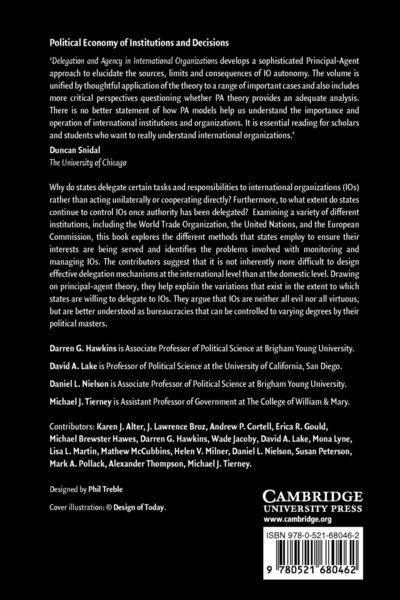
Why do states delegate certain tasks and responsibilities to international organizations rather than acting unilaterally or cooperating directly? Furthermore, to what extent do states continue to control IOs once authority has been delegated? Examining a variety of different institutions including the World Trade Organization, the United Nations and the European Commission, this book explores the different methods that states employ to ensure their interests are being served, and identifies the problems involved with monitoring and managing IOs. The contributors suggest that it is not inherently more difficult to design effective delegation mechanisms at international level than at domestic level and, drawing on principal-agent theory, help explain the variations that exist in the extent to which states are willing to delegate to IOs. They argue that IOs are neither all evil nor all virtuous, but are better understood as bureaucracies that can be controlled to varying degrees by their political masters.

Produktdetails

Einband

Taschenbuch

Erscheinungsdatum

04.01.2011

Herausgeber Hawkins Darren G. + weitere
Verlag Cambridge Academic

Produktdetails

Einband

Taschenbuch

Erscheinungsdatum

04.01.2011

Herausgeber
Verlag Cambridge Academic
Seitenzahl

426

Maße (L/B/H)

22,9/15,2/2,6 cm

Gewicht

620 g

Sprache

Englisch

ISBN

978-0-521-68046-2

Herstelleradresse

Libri GmbH
Europaallee 1
36244 Bad Hersfeld
DE

Email: gpsr@libri.de

Noch keine Bewertungen vorhanden

Verfassen Sie die erste Bewertung zu diesem Artikel

Helfen Sie anderen Kundinnen und Kunden durch Ihre Meinung.

Kundinnen und Kunden meinen

Bewertungen (0)

  • Produktbild: Delegation and Agency in International Organizations
  • Produktbild: Delegation and Agency in International Organizations
  • Part I. Introduction: 1. Delegation under anarchy: states, international organizations, and principal-agent theory Darren G. Hawkins, David A. Lake, Daniel L. Nielson and Michael J. Tierney; Part II. Variation in Principal Preferences, Structure, Decision Rules, and Private Benefits: 2. A problem of principals: common agency and social lending at the multilateral development banks Mona Lyne, Daniel L. Nielson and Michael J. Tierney; 3. US domestic politics and international monetary fund policy J. Lawrence Broz and Michael Brewster Hawes; 4. Why multilateralism? Foreign aid and domestic principal-agent problems Helen V. Milner; 5. Distribution, information, and delegation to international organizations: the case of IMF conditionality Lisa L. Martin; 6. Delegation and discretion in the European Union Mark A. Pollack; Part III. Variation in Agent Preferences, Legitimacy, Tasks, and Permeability: 7. How agents matter Darren G. Hawkins and Wade Jacoby; 8. Screening power: international organizations as informative agents Alexander Thompson; 9. Dutiful agents, rogue actors, or both? Staffing, voting rules, and slack in the WHO and WTO Andrew P. Cortell and Susan Peterson; 10. Delegating IMF conditionality: understanding variations in control and conformity Erica R. Gould; 11. Delegation to international courts and the limits of recontracting political power Karen J. Alter; Part IV. Directions for Future Research: 12. The logic of delegation to international organizations David A. Lake and Mathew McCubbins.