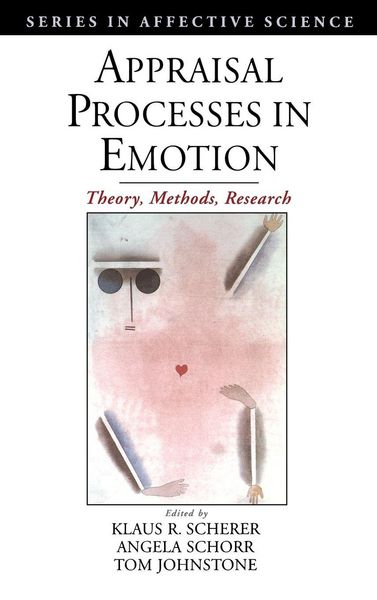
Appraisal Processes in Emotion Theory, Methods, Research
269,99 €
inkl. gesetzl. MwSt.,
Beschreibung
Produktdetails
Einband
Gebundene Ausgabe
Erscheinungsdatum
03.05.2001
Abbildungen
numerous figures and tables
Herausgeber
Scherer K. + weitereVerlag
Oxford University PressSeitenzahl
496
Maße (L/B/H)
23,5/15,7/3,4 cm
Gewicht
949 g
Sprache
Englisch
ISBN
978-0-19-513007-2
The scientific study of emotion has long been dominated by theories emphasizing the subjective experience of emotions and their accompanying expressive and physiological responses. The processes by which different emotions are elicited has received less attention, the implicit assumption being
that certain emotions arise automatically in response to certain types of events or situations. Such an assumption is incompatible with data showing that similar situations can provoke a range of emotions in different individuals, or even the same individual at different times. Appraisal theory,
first suggested by Magda Arnold and Richard Lazarus, was formulated to address this shortcoming in our understanding of emotion. The central tenet of appraisal theory is that emotions are elicited according to an individual's subjective interpretation or evaluation of important events or situations.
Appraisal research focuses on identifying the evaluative dimensions or criteria that predict which emotion will be elicited in an individual, as well as linking the appraisal process with the production of emotional responses. This book represents the first full-scale summary of the current state of
appraisal research. Separate sections cover the history of apraisal theory and its fundamental ideas, the views of some of the major theorists currently active in the field, theoretical and methodological problems with the appraisal approach including suggestions for their resolution, social,
cultural and individual differences and the application of appraisal theory to understanding and treating emotional pathology, and the methodology used in appraisal research including measuring and analyzingself-report, physiological, facial, and vocal indicators of appraisal, and simulating
appraisal processes via computational models. Intended for advanced students and researchers in emotion psychology, it provides an authoritative assessment and critique of the current sta
Noch keine Bewertungen vorhanden
Verfassen Sie die erste Bewertung zu diesem Artikel
Helfen Sie anderen Kundinnen und Kunden durch Ihre Meinung.
Kurze Frage zu unserer Seite
Vielen Dank für Ihr Feedback
Wir nutzen Ihr Feedback, um unsere Produktseiten zu verbessern. Bitte haben Sie Verständnis, dass wir Ihnen keine Rückmeldung geben können. Falls Sie Kontakt mit uns aufnehmen möchten, können Sie sich aber gerne an unseren Kund*innenservice wenden.
zum Kundenservice