
KI-Beratung Beta

  • Produktbild: Hall-Effect Sensors
  • Produktbild: Hall-Effect Sensors

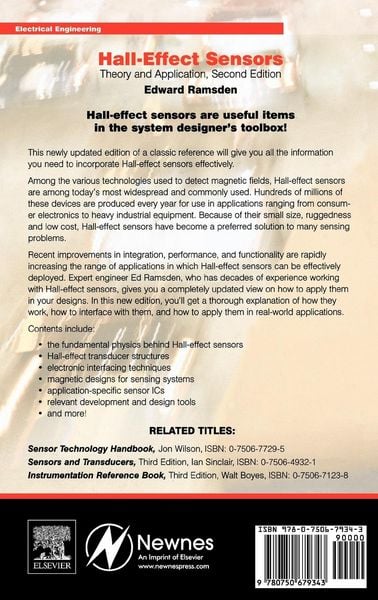
Hall-Effect Sensors Theory and Application

59,99 €

inkl. gesetzl. MwSt., Versandkostenfrei


Beschreibung

Without sensors most electronic applications would not exist-sensors perform a vital function, namely providing an interface to the real world. Hall effect sensors, based on a magnetic phenomena, are one of the most commonly used sensing technologies today. In the 1970s it became possible to build Hall...

Beschreibung

Without sensors most electronic applications would not exist-sensors perform a vital function, namely providing an interface to the real world. Hall effect sensors, based on a magnetic phenomena, are one of the most commonly used sensing technologies today. In the 1970s it became possible to build Hall effect sensors on integrated circuits with onboard signal processing circuitry, vastly reducing the cost and enabling widespread practical use. One of the first major applications was in computer keyboards, replacing mechanical contacts. Hundreds of millions of these devices are now manufactured each year for use in a great variety of applications, including automobiles, computers, industrial control systems, cell phones, and many others. The importance of these sensors, however, contrasts with the limited information available. Many recent advances in miniaturization, smart sensor configurations, and networkable sensor technology have led to design changes and a need for reliable information. Most of the technical information on Hall effect sensors is supplied by sensor manufacturers and is slanted toward a particular product line. System design and control engineers need an independent, readable source of practical design information and technical details that is not product- or manufacturer-specific and that shows how Hall effect sensors work, how to interface to them, and how to apply them in a variety of uses. This book covers:.the physics behind Hall effect sensors.Hall effect transducers.transducer interfacing.integrated Hall effect sensors and how to interface to them.sensing techniques using Hall effect sensors.application-specific sensor ICs.relevant development and design toolsThis second edition is expanded and updated to reflect the latest advances in Hall effect devices and applications! Information about various sensor technologies is scarce, scattered and hard to locate. Most of it is either too theoretical for working engineers, or is manufacturer literature that can't be entirely trusted. Engineers and engineering managers need a comprehensive, up-to-date, and accurate reference to use when scoping out their designs incorporating Hall effect sensors.

Produktdetails

Einband

Gebundene Ausgabe

Erscheinungsdatum

01.02.2006

Verlag Elsevier Science & Technology
Seitenzahl

266

Produktdetails

Einband

Gebundene Ausgabe

Erscheinungsdatum

01.02.2006

Verlag Elsevier Science & Technology
Seitenzahl

266

Maße (L/B/H)

23,4/15,6/2,1 cm

Gewicht

621 g

Auflage

2. Auflage

Sprache

Englisch

ISBN

978-0-7506-7934-3

EU-Ansprechpartner

Elsevier B.V.
Radarweg 29
1043 NX Amsterdam
NL
productsafety@elsevier.com

Herstelleradresse

Elsevier Science & Technology
London Wall 125
EC2Y 5AS London
GB
tradeorders@elsevier.com

Noch keine Bewertungen vorhanden

Verfassen Sie die erste Bewertung zu diesem Artikel

Helfen Sie anderen Kundinnen und Kunden durch Ihre Meinung.

Kundinnen und Kunden meinen

Bewertungen (0)

Die Leseprobe wird geladen.
  • Produktbild: Hall-Effect Sensors
  • Produktbild: Hall-Effect Sensors
  • 1. Hall Effect Physics
    The theory and math behind the Hall effect.
    2. Practical Hall Effect Transducers
    Key characteristics, integrated Hall transducers, transducer geometry, examples.
    3. Transducer Interfacing
    Modeling Hall transducers, biasing, amplifiers, temp. compensation, offset adjustment.
    4. Integrated Sensors, Linear and Digital Devices
    Linear sensors, switches and latches, speed sensors, application-specific devices.
    5. Interfacing to Integrated Hall Sensors
    Interface issues, line driver circuits, the pull-up resistor, interfacing to standard logic devices, discrete logic, driving loads, LED interface, incandescent lamps, relays, solenoids, and inductive loads, wiring reduction schemes, encoding and serialization, digital to analog encoding, voltage regulation and power management.
    6. Proximity Sensing Techniques
    Head-on sensing, slide-by sensing, magnet null-point sensing, float-level sensing, linear position sensing, rotary position sensing, Vane switches,
    7. Current Sensing
    Resistive current sensing, free-space current sensing, toroidal current sensors, digital current sensor, closed-loop current sensors.
    8. Speed and Timing Sensors
    Competitive technologies, magnetic targets, vane switches, geartooth sensing, single-point sensing, differential fixed threshold, differential variable-threshold, speed and direction sensing.
    9. Application-Specific Hall Sensor ICs
    Micro-power switches, two-wire switches, networkable sensors, power devices, smart motor control.
    10. Development Tools for Hall Effect Sensors
    Electronic bench equipment, magnetic instrumentation, mechanical tools, magnetic simulation software.
    Appendix A. Brief Introduction to Magnetics
    Appendix B. Suppliers List
    Glossary
    References and Bibliography
    Index