KI-Beratung Beta

Gutscheinbedingungen

**Gültig bis 30.11.2026 auf Spielzeug, Schreibwaren, Filme, Geschenke & Trends, Musik, tolino eReader & Zubehör, Hörbücher und Hörbuch-Downloads, nicht preisgebundene Bücher und Kalender online auf thalia.at und in der Thalia App. Einzelne Artikel können ausgeschlossen sein. Aufgrund der Buchpreisbindung sind deutschsprachige Bücher und eBooks ausgenommen. Zusätzlich ausgenommen sind Abos & Flatrates, Games, Geschenkkarten/-boxen, Shelfies, Software, Zeitschriften sowie einzelne Artikel von tonies®. Pro Einkauf einmal einlösbar. Nur gültig mit im Onlineshop hinterlegter Bonuscard. Click & Collect nur bei Onlinevorabzahlung möglich. Keine Barauszahlung. Nicht kombinierbar mit anderen Aktionen und Gutscheinen. Gutschein wird auf max. 500€ Bestellwert angerechnet. Nicht gültig für Versandkosten und Services.

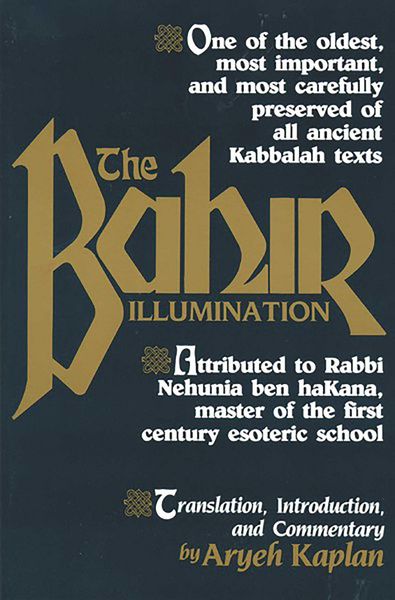
Produktbild: The Bahir

The Bahir

24,99 €

inkl. gesetzl. MwSt., zzgl. Versandkosten


  • Kostenlose Lieferung ab 30 € Einkaufswert
  • Versandkostenfrei für Bonuscard-Kund*innen

Beschreibung

The Bahir is one of the oldest and most influential of all classical Kabbalah texts.  Until the publication of the Zohar, the Bahir was the most widely quoted primary source of Kabbalistic teachings. The Bahir is quoted in every major book on Kabbalah, the earliest being the Raavad's commentary on Sefer...

Beschreibung

The Bahir is one of the oldest and most influential of all classical Kabbalah texts. 
Until the publication of the Zohar, the Bahir was the most widely quoted primary source of Kabbalistic teachings. The Bahir is quoted in every major book on Kabbalah, the earliest being the Raavad's commentary on Sefer Yetzirah, and it is cited numerous times by Rabbi Moshe ben Nachman (Ramban) in his commentary on the Torah. It is also quoted many times in the Zohar. It was first published around 1176 by the Provence school of Kabbalists; the first printed edition appeared in Amsterdam in 1651. The name Bahir is derived from the first verse quoted in the text (Job 37:21), "And now they do not see light, it is brilliant (Bahir) in the skies." It is also called the "Midrash of Rabbi Nehuniah ben HaKana," particularly by the Ramban. The reason might be that Rabbi Nehuniah's name is at the very beginning of the book, but most Kabbalists actually attribute the Bahir to him and his school. Some consider it the oldest kabbalistic text ever written.
Although the Bahir is a fairly small book, some 12,000 words in all, it was very highly esteemed among those who probed its mysteries. Rabbi Judah Chayit, a prominent fifteenth-century Kabbalist, writes, "Make this book a crown for your head." Much of the text is very difficult to understand, and Rabbi Moshe Cordevero (1522-1570), head of the Safed school of Kabbalah, says, "The words of this text are bright (Bahir) and sparkling, but their brilliance can blind the eye." One of the most important concepts revealed in the Bahir is that of the Ten Sefirot, and careful analysis of these discussions yields much of what will be found in later kabbalistic works, as well as their relation to anthropomorphism and the reason for the commandments. Also included is a discussion of reincarnation, or Gilgul, an interpretation of the letters of the Hebrew alphabet, the Thirty-two Paths of Wisdom, and the concept of Tzimtzum. 
 

Produktdetails

Einband

Taschenbuch

Erscheinungsdatum

01.04.1989

Verlag Simon & Schuster Uk
Seitenzahl

296

Produktdetails

Einband

Taschenbuch

Erscheinungsdatum

01.04.1989

Verlag Simon & Schuster Uk
Seitenzahl

296

Maße (L/B/H)

22,7/14,9/2 cm

Gewicht

399 g

Übersetzt von

Aryeh Kaplan

Sprache

Englisch

ISBN

978-0-87728-618-9

Herstelleradresse

Libri GmbH
Europaallee 1
36244 Bad Hersfeld
DE

Email: gpsr@libri.de

Noch keine Bewertungen vorhanden

Verfassen Sie die erste Bewertung zu diesem Artikel

Helfen Sie anderen Kundinnen und Kunden durch Ihre Meinung.

Kundinnen und Kunden meinen

Bewertungen (0)

Die Leseprobe wird geladen.
  • Produktbild: The Bahir